
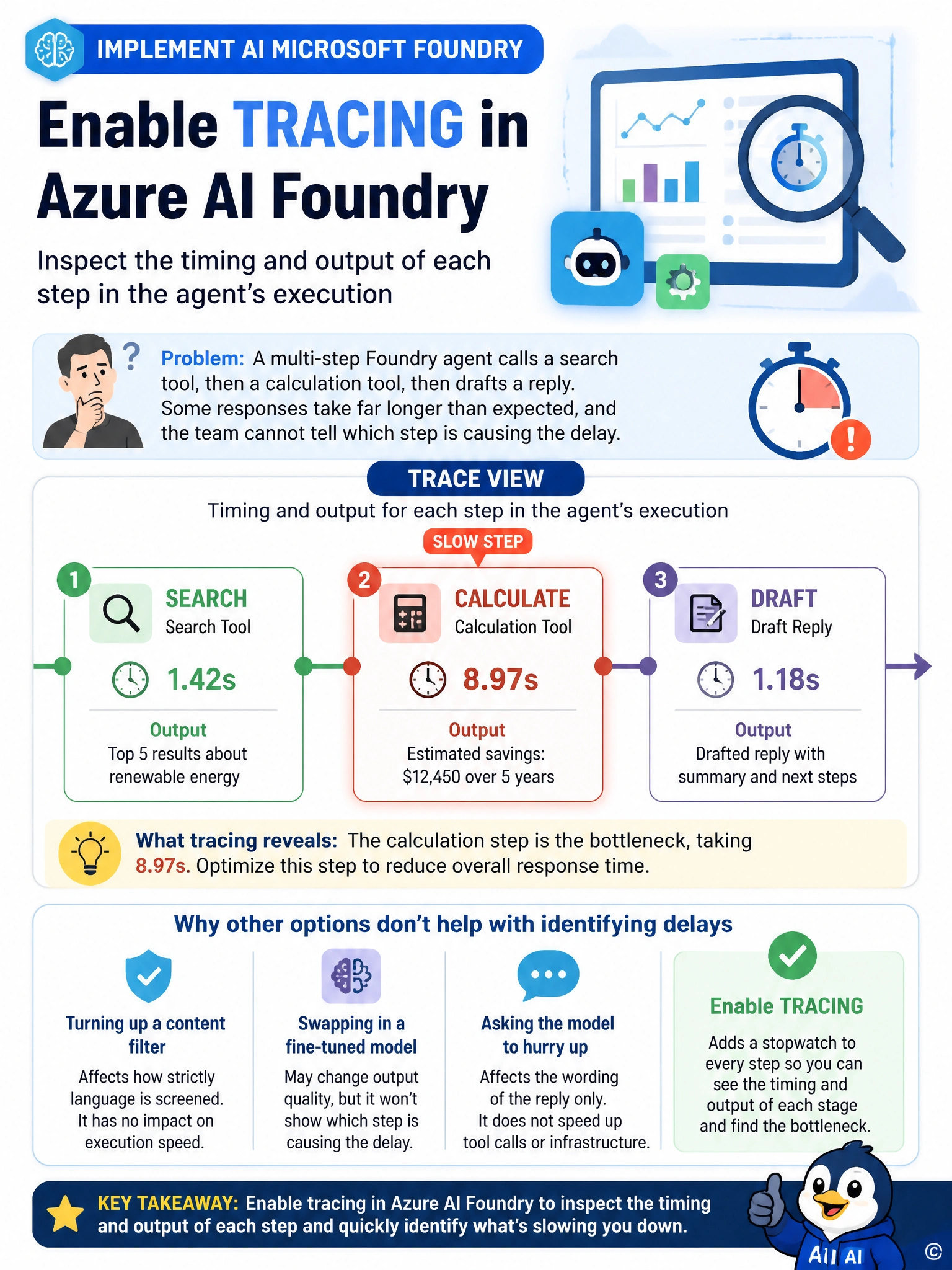
A team built a multi-step Foundry agent that calls a search tool, then a calculation tool, then drafts a reply. In testing, some responses take far longer than expected, and the team cannot tell which step in the chain is responsible for the delay.
Select an answer to reveal the explanation.
Short Explanation
When a reply is slow and the pipeline has three separate stops, a search step, a calculation step, and the drafting step, guessing which one is the bottleneck wastes time that could be spent just looking. Turning on tracing is like putting a stopwatch on every stage of an assembly line, showing exactly which station is holding up the whole line and what it produced along the way. Turning up a content filter has nothing to do with speed, that dial only affects how strictly language gets screened. Swapping in a fine-tuned model might change the quality of the final draft, but it does nothing to expose where the current delay is actually happening. And politely asking the model to hurry up in a system message doesn't change how fast tool calls or infrastructure run, it only changes the wording of what comes back.
Full Explanation
The correct answer is B. Tracing in Azure AI Foundry records the timing, inputs, and outputs of each step in an agent's execution, including individual tool calls, which lets the team see exactly which step in the search-then-calculate-then-draft chain is consuming the extra time. Option A is incorrect because content safety filter severity governs how strictly content is screened for policy violations; it has no effect on tool-call latency and adjusting it would not reveal where time is being lost. Option C is incorrect because fine-tuning changes how a model generates text based on learned examples, but it does not provide visibility into a multi-step agent's execution timeline, and swapping models without diagnosing the bottleneck first risks fixing nothing. Option D is incorrect because asking the model to 'respond more quickly' in a system message has no mechanical effect on execution speed; a system message shapes the content and tone of a reply, not the runtime performance of tool calls or infrastructure.