
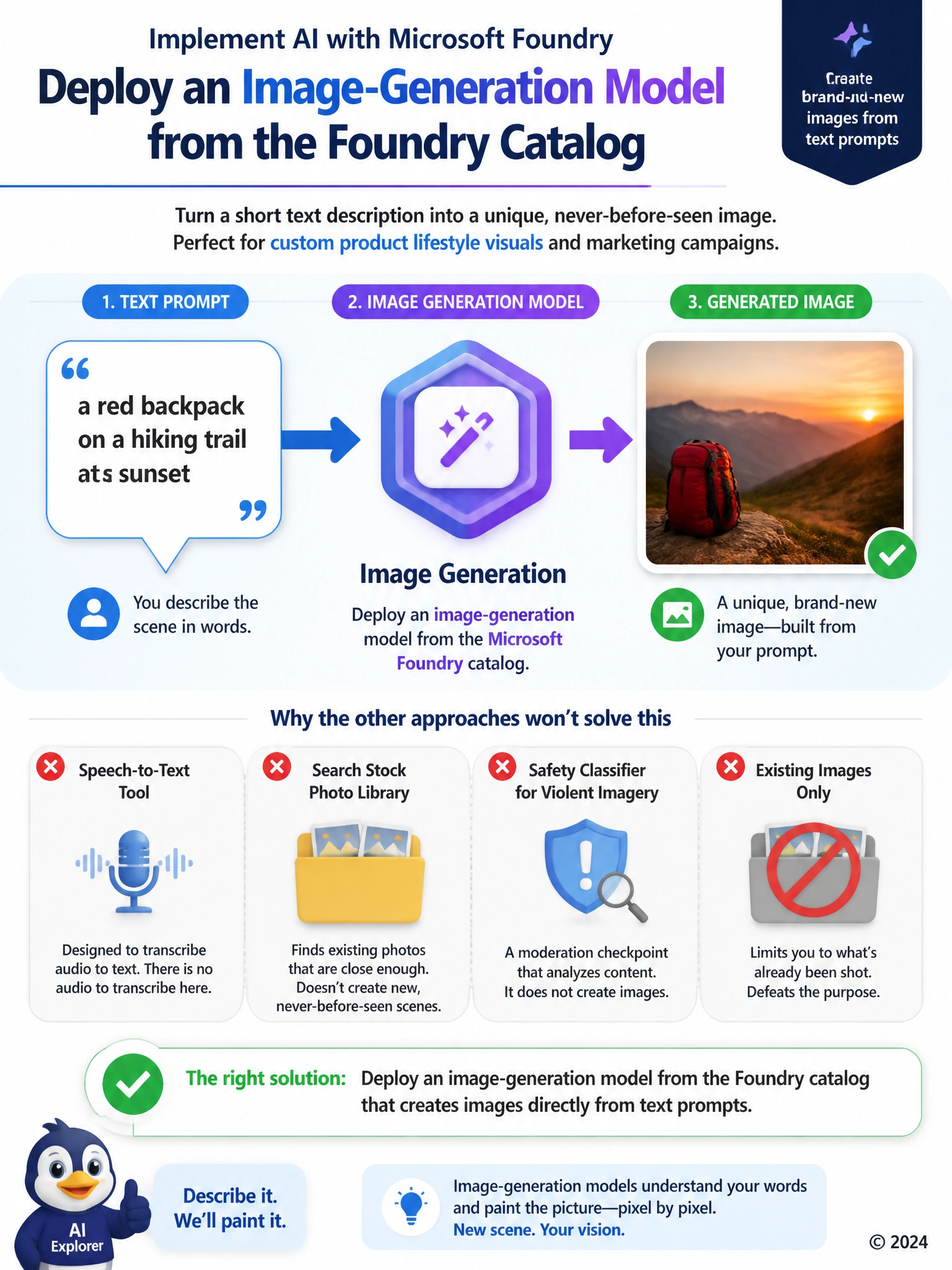
A retail marketing team wants to produce a batch of custom product lifestyle images from short text descriptions, such as 'a red backpack on a hiking trail at sunset', to use in social media ads, without hiring a photographer for each concept.
Select an answer to reveal the explanation.
Short Explanation
This team isn't looking for an existing photo that's close enough, they want a brand-new image built from scratch out of a sentence, which is exactly what an image-generation model is built to do: describe the scene in words, and it paints the picture. A speech-to-text tool would be solving a completely different problem, since there's no audio here to transcribe. Searching a stock photo library with embeddings only surfaces what's already been shot, which defeats the purpose of wanting custom, never-before-seen scenes. And a safety classifier for violent imagery is a moderation checkpoint, not a creation tool, so it wouldn't produce a single image on its own, it would just screen ones that already exist.
Full Explanation
The correct answer is D. An image-generation model available in the Foundry catalog takes a text description as input and produces a new image matching that description, which is exactly the capability this marketing team needs to turn short prompts into custom lifestyle visuals without commissioning original photography. Option A is incorrect because a speech-to-text model converts spoken audio into written text; it has no role here since the team is starting from written descriptions and needs an image as output, not a transcript. Option B is incorrect because an embedding model paired with a search over an existing photo database can only retrieve images that already exist, which does not satisfy the team's need for entirely new, custom scenes built from novel prompts. Option C is incorrect because a content safety classifier screens content for policy violations like violence; it is a moderation tool, not a generation tool, and deploying it alone would produce no images at all.