
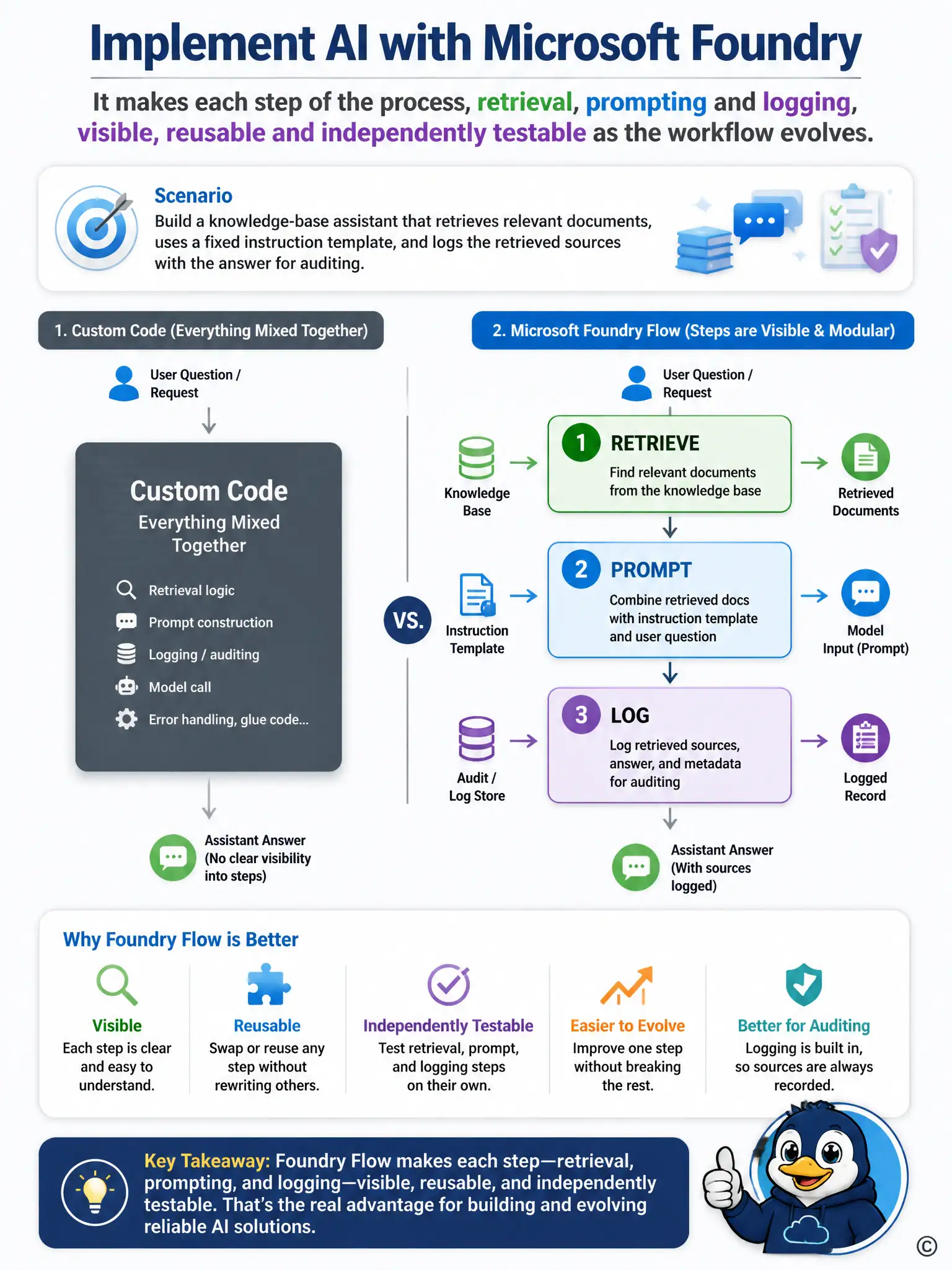
A software company wants an internal knowledge-base assistant that always follows the same sequence: retrieve relevant documents, pass them to the model with a fixed instruction template, then log the retrieved sources alongside the answer for auditing. A developer could write this logic in custom application code that calls the model directly, but the team instead builds it as a flow inside Microsoft Foundry with distinct connected steps for retrieval, prompt construction and logging. What is the main advantage of building this as a Foundry flow rather than a single direct model call from application code?
Select an answer to reveal the explanation.
Short Explanation
You're not buying magic; you're buying clarity. When retrieval, prompt construction and logging are separate, visible steps, you can swap retrieval, tighten the template, or add logging fields without rewriting a tangled block of application code. That's the real payoff.
Full Explanation
The correct answer is the one that makes each step of the process—retrieval, prompting and logging—visible, reusable and independently testable as the workflow evolves. Structuring the work as a flow with separate steps for retrieval, prompt construction and logging makes each part of the process something the team can inspect, modify and test on its own, so if the retrieval step starts returning weak matches, or the logging needs a new field, that piece can be changed without rewriting the whole pipeline. A single direct model call buried in application code would mix all of this logic together, making it harder to reason about or reuse across other tools. The option claiming that flows remove the need to select a specific model deployment is incorrect because flows still require the team to choose and configure a specific model deployment for the prompt step; there is no automatic model selection happening on their behalf. The option claiming that flows guarantee the assistant will never produce an incorrect answer is incorrect because no orchestration structure guarantees correctness; a flow can still produce a wrong answer if the retrieved documents are irrelevant or the model misinterprets them, which is exactly why the team is logging sources for auditing rather than trusting the output blindly. The option claiming that flows eliminate token usage charges for the retrieval and logging steps is incorrect because retrieval and logging steps that call any billed service still incur normal costs, and building steps as a flow does not itself change how usage is metered.