
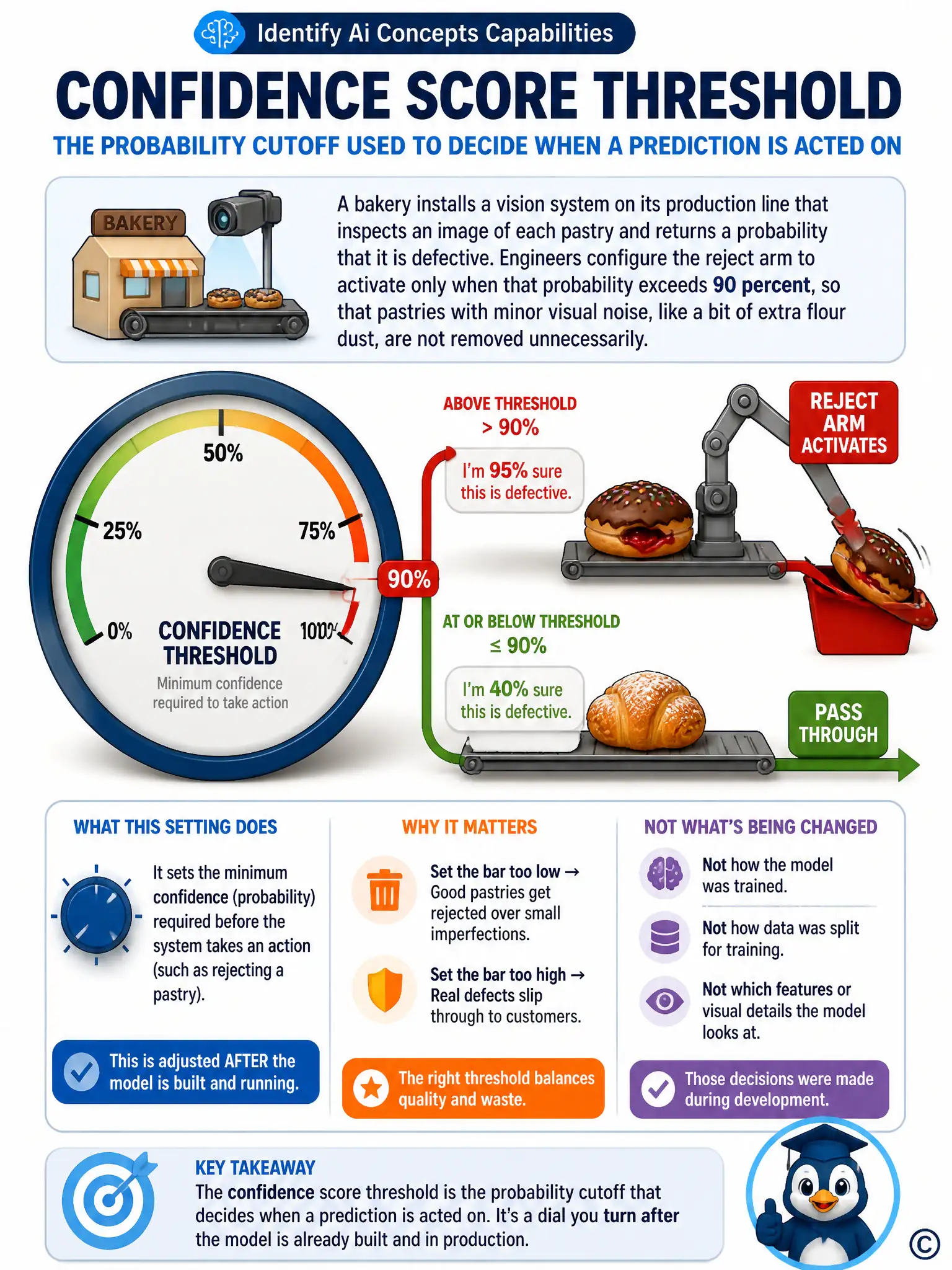
A bakery installs a vision system on its production line that inspects an image of each pastry and returns a probability that it is defective. Engineers configure the reject arm to activate only when that probability exceeds 90 percent, so that pastries with minor visual noise, like a bit of extra flour dust, are not removed unnecessarily. What is being configured here?
Select an answer to reveal the explanation.
Short Explanation
Think of the vision system as giving each pastry a probability. You're not retraining it or changing its inputs; you're setting how sure it must be before the reject arm fires. That minimum probability is a confidence score threshold.
Full Explanation
The correct choice is the confidence score threshold. The vision model outputs a probability, or confidence score, for each pastry, and the engineers are deciding how high that score must be before the system treats the prediction as actionable, in this case rejecting the pastry. That cutoff is the confidence score threshold, and tuning it up or down trades off false rejections against missed defects. The learning rate is incorrect because it controls how much the model's internal weights shift during training, a step that happens before the model is deployed, not a setting applied to its live predictions on the production line. The training and test split ratio is incorrect because it determines how historical data is divided to build and evaluate the model during development; it has no bearing on how an already-trained model's real-time output is acted upon. Feature engineering is incorrect because it concerns choosing and transforming the raw inputs, such as pixel data or color channels, that the model consumes, not the decision rule applied to its output probability. Only the threshold setting matches what the engineers changed.