
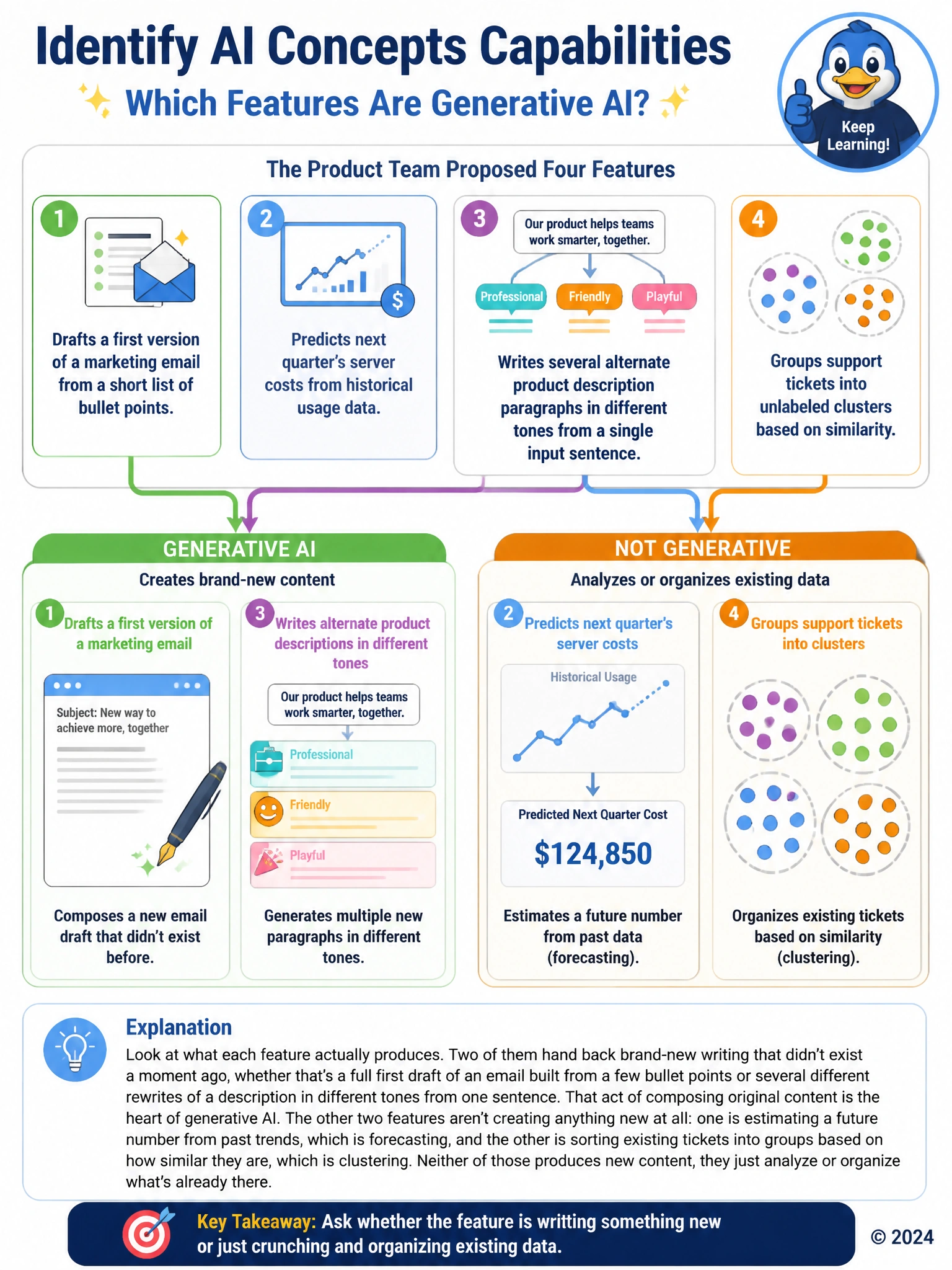
A software company's product team lists four proposed features and must identify which ones are examples of generative AI, since that decision determines which Azure AI Foundry model catalogue the engineering team should draw from. Feature one drafts a first version of a marketing email from a short list of bullet points. Feature two predicts next quarter's server costs from historical usage data. Feature three writes several alternate product description paragraphs in different tones from a single input sentence. Feature four groups support tickets into unlabeled clusters based on similarity. Which two features are examples of generative AI? (Select TWO.)
Select all correct answers, then click Submit.
Short Explanation
Look at what each feature actually produces. Two of them hand back brand-new writing that didn't exist a moment ago, whether that's a full first draft of an email built from a few bullet points or several different rewrites of a description in different tones from one sentence. That act of composing original content is the heart of generative AI. The other two features aren't creating anything new at all: one is estimating a future number from past trends, which is forecasting, and the other is sorting existing tickets into groups based on how similar they are, which is clustering. Neither of those produces new content, they just analyze or organize what's already there. So when you're deciding which catalogue of models a feature belongs in, ask whether it's writing something new or just crunching and organizing existing data.
Full Explanation
The correct answers are B and D. Generative AI produces new, original content, such as text, images, or code, in response to a prompt, and both drafting a marketing email from bullet points and writing several alternate product description paragraphs in different tones from a single sentence involve creating new original text output that did not exist before, which is the defining trait of generative AI. Option C is incorrect because predicting next quarter's server costs from historical usage data is a forecasting task that estimates a future numeric value from past trends, which is a regression problem rather than content generation. Option A is incorrect because grouping support tickets into unlabeled clusters based on similarity is a clustering task, an unsupervised technique for discovering structure in data, which organizes existing tickets into groups rather than generating any new content. Both incorrect options describe the model producing a number or a grouping decision from existing data, not composing new original content, which is the line that separates generative AI from other AI workloads. Because the product team needs to route each feature to the correct Azure AI Foundry model catalogue, correctly distinguishing content-generating features, such as the email draft and the tonal rewrites, from analytical features, such as the cost forecast and the ticket clustering, is exactly the judgment this question tests.