
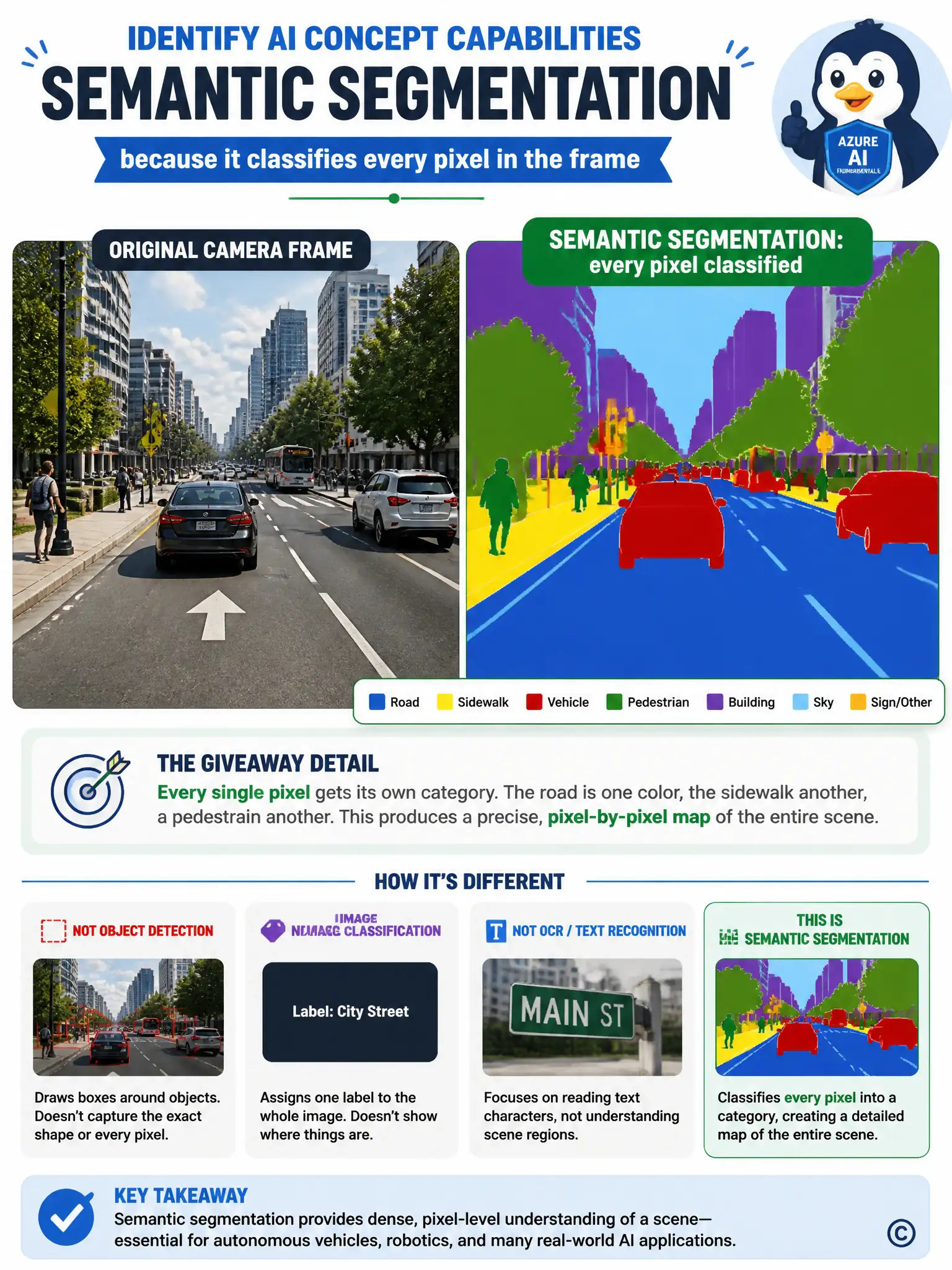
An autonomous vehicle company trains a vision model that assigns every individual pixel in a camera frame to a category such as road, sidewalk, vehicle, or pedestrian, producing a colored map of the entire scene rather than boxes drawn around individual objects. Which computer vision technique is being described?
Select an answer to reveal the explanation.
Short Explanation
You're describing semantic segmentation because it labels every pixel in the frame. That gives you a full colored map of road, sidewalk, vehicle, and pedestrian instead of boxes or one whole-image label.
Full Explanation
Semantic segmentation classifies every individual pixel in an image into a category, producing a dense, per-pixel map of the scene, such as marking which pixels belong to the road, the sidewalk, a vehicle, or a pedestrian, which precisely matches the colored scene map the autonomous vehicle company is generating. The object-detection approach is incorrect because it locates discrete objects and marks each one with a bounding box around its approximate location, producing boxes rather than the pixel-by-pixel category map described in the scenario. The image-classification approach is incorrect because it assigns one overall label to an entire image, such as 'street scene,' and cannot distinguish or label the many different regions within a single frame the way the described model does. The optical-character-recognition approach is incorrect because it extracts and reads printed or handwritten text characters from an image, such as a street sign, which has nothing to do with categorizing every pixel of a scene by object type. Because the scenario explicitly describes pixel-level categorization across the whole frame rather than boxes, a whole-image label, or text extraction, semantic segmentation is the only technique that matches.