
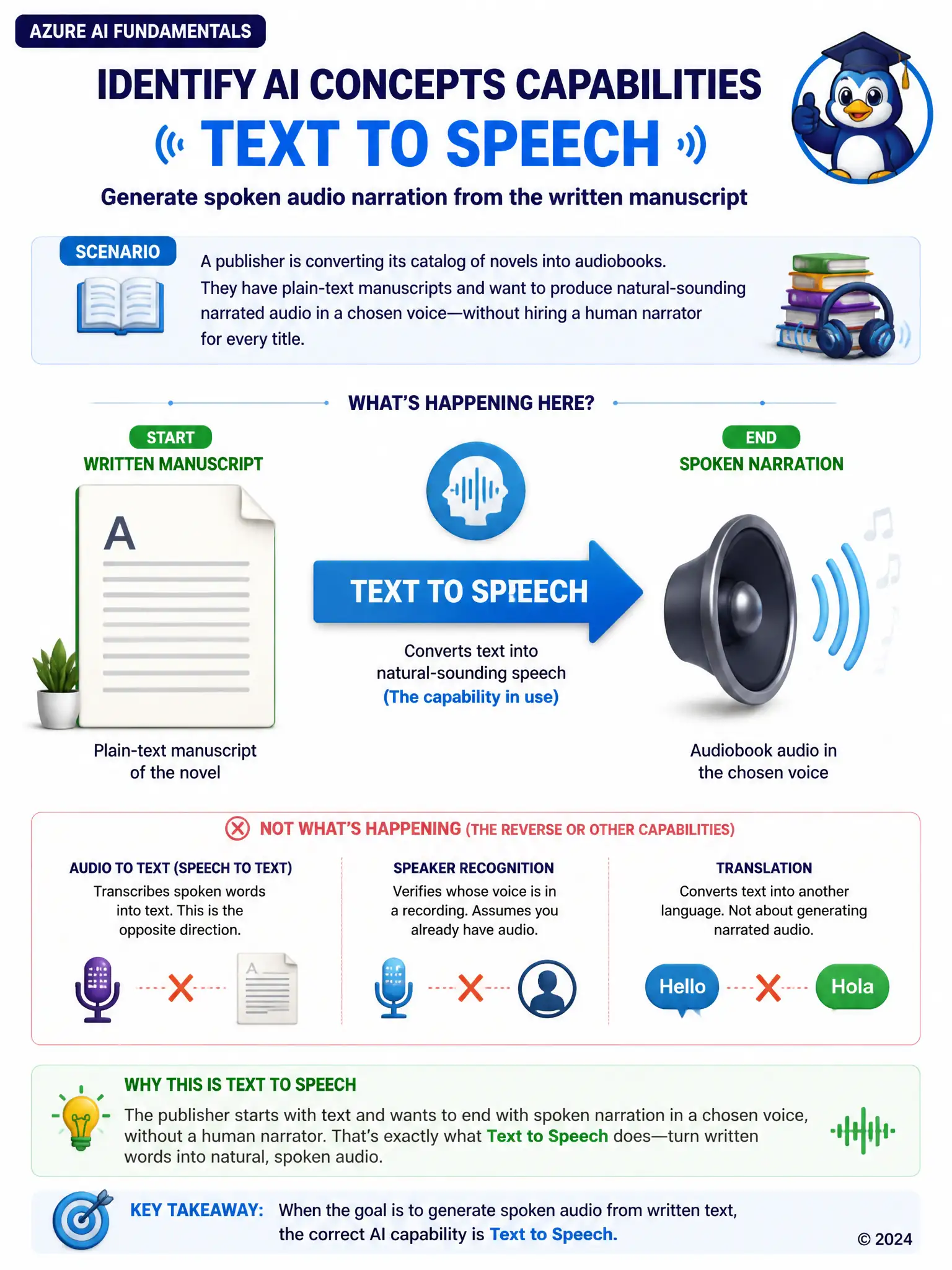
A publisher converting its catalog of novels into audiobooks wants software that takes the plain-text manuscript of a book and produces natural-sounding narrated audio in a chosen voice, without hiring a human narrator for every title. Which AI capability fits this need?
Select an answer to reveal the explanation.
Short Explanation
You need text to speech because you're starting with a written manuscript and ending with natural spoken narration in a chosen voice. It turns text into audio, so you don't have to hire a narrator for every title.
Full Explanation
Text to speech, also called speech synthesis, converts written text into natural-sounding spoken audio in a selected voice, which is precisely what the publisher needs to turn a plain-text manuscript into narrated audio without hiring a human narrator. The speech-to-text option is incorrect because it goes in the opposite direction, converting spoken audio into written text, which would be relevant if the publisher already had a recorded narration and wanted a transcript, not the other way around. The speaker-recognition option is incorrect because it identifies or verifies which specific person is speaking in an audio sample, which has no bearing on generating new narration from text and assumes audio already exists to analyze. The speech-translation option is incorrect because it converts spoken or written content from one language into another, addressing a language barrier rather than the task of producing audio narration from a manuscript that is already in the publisher's target language. Because the manuscript starts as text and the desired output is spoken narration in a chosen voice, text to speech is the only capability that performs that specific conversion.