
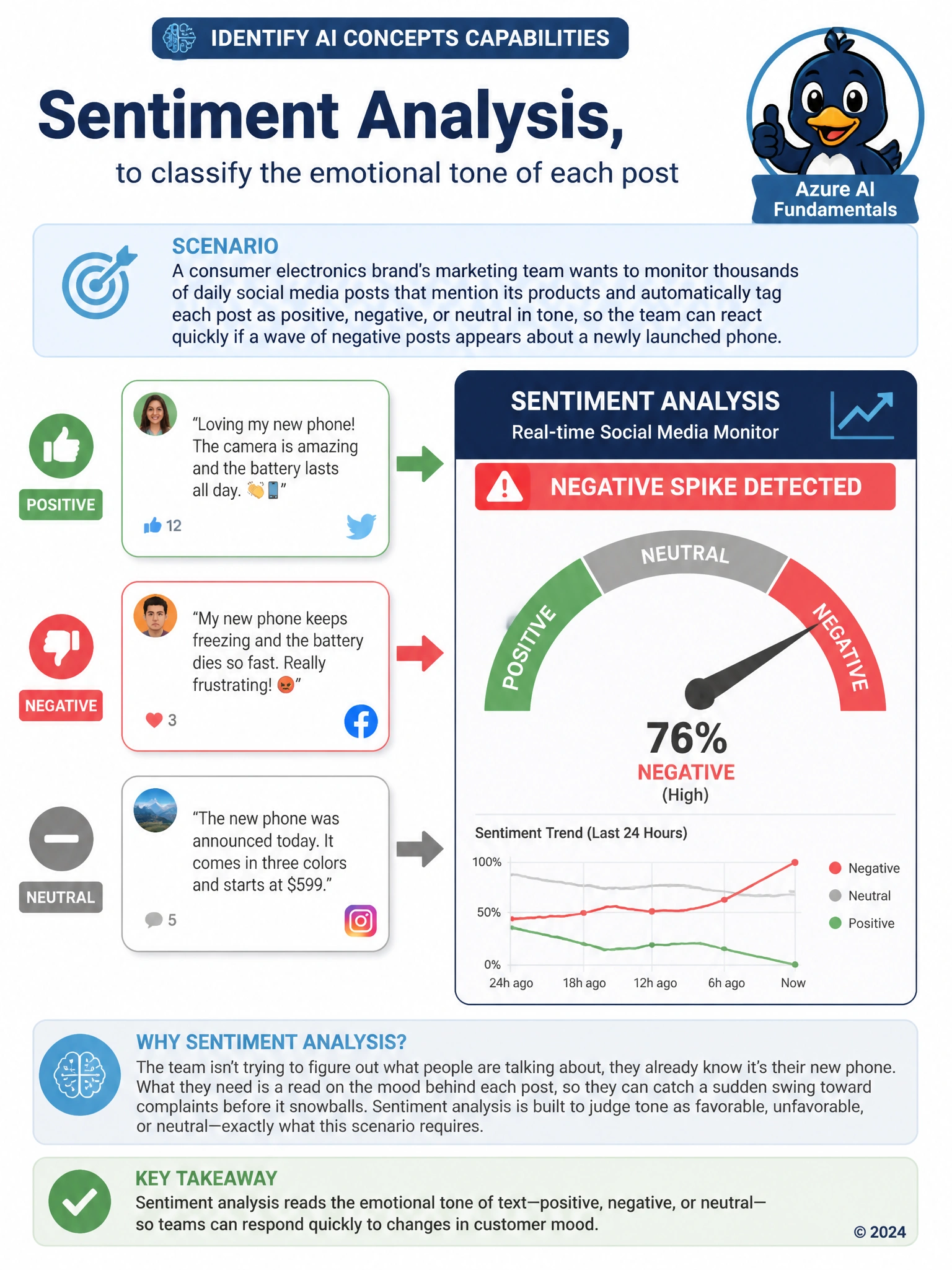
A consumer electronics brand's marketing team wants to monitor thousands of daily social media posts that mention its products and automatically tag each post as positive, negative, or neutral in tone, so the team can react quickly if a wave of negative posts appears about a newly launched phone. Which AI capability should the marketing team use?
Select an answer to reveal the explanation.
Short Explanation
The team isn't trying to figure out what people are talking about, they already know it's their new phone. What they need is a read on the mood behind each post, so they can catch a sudden swing toward complaints before it snowballs. That calls for a tool built specifically to judge tone as favorable, unfavorable, or neutral. Pulling out the main topics of a post tells you the subject, not the feeling behind it. Figuring out what language a post is written in solves a completely different problem, since knowing a post is in Spanish doesn't tell you if the customer is happy. And spotting mentions of product names just confirms the post is relevant, without saying anything about whether that mention is a compliment or a complaint. The tool that actually reads emotional tone is the one that fits here.
Full Explanation
The correct answer is C. Sentiment analysis evaluates text and classifies the emotional tone it expresses, typically as positive, negative, or neutral, which directly matches the marketing team's need to tag thousands of posts by tone so they can spot a spike in negative reaction quickly. Option A is incorrect because key phrase extraction identifies the main topics or subjects discussed in a passage of text, such as 'battery life' or 'camera quality,' but it does not determine whether the sentiment expressed about those topics is favorable or unfavorable. Option B is incorrect because language detection identifies which language a piece of text is written in, which would be useful if posts arrived in multiple languages but does nothing to classify emotional tone once the language is known. Option D is incorrect because named entity recognition locates and categorizes specific entities such as product names, people, or organizations mentioned in text, which could tell the team a post mentions their new phone but not whether the mention is praise or complaint. Only sentiment analysis produces the positive, negative, or neutral tag the team needs to detect a wave of unhappy customers in near real time.