
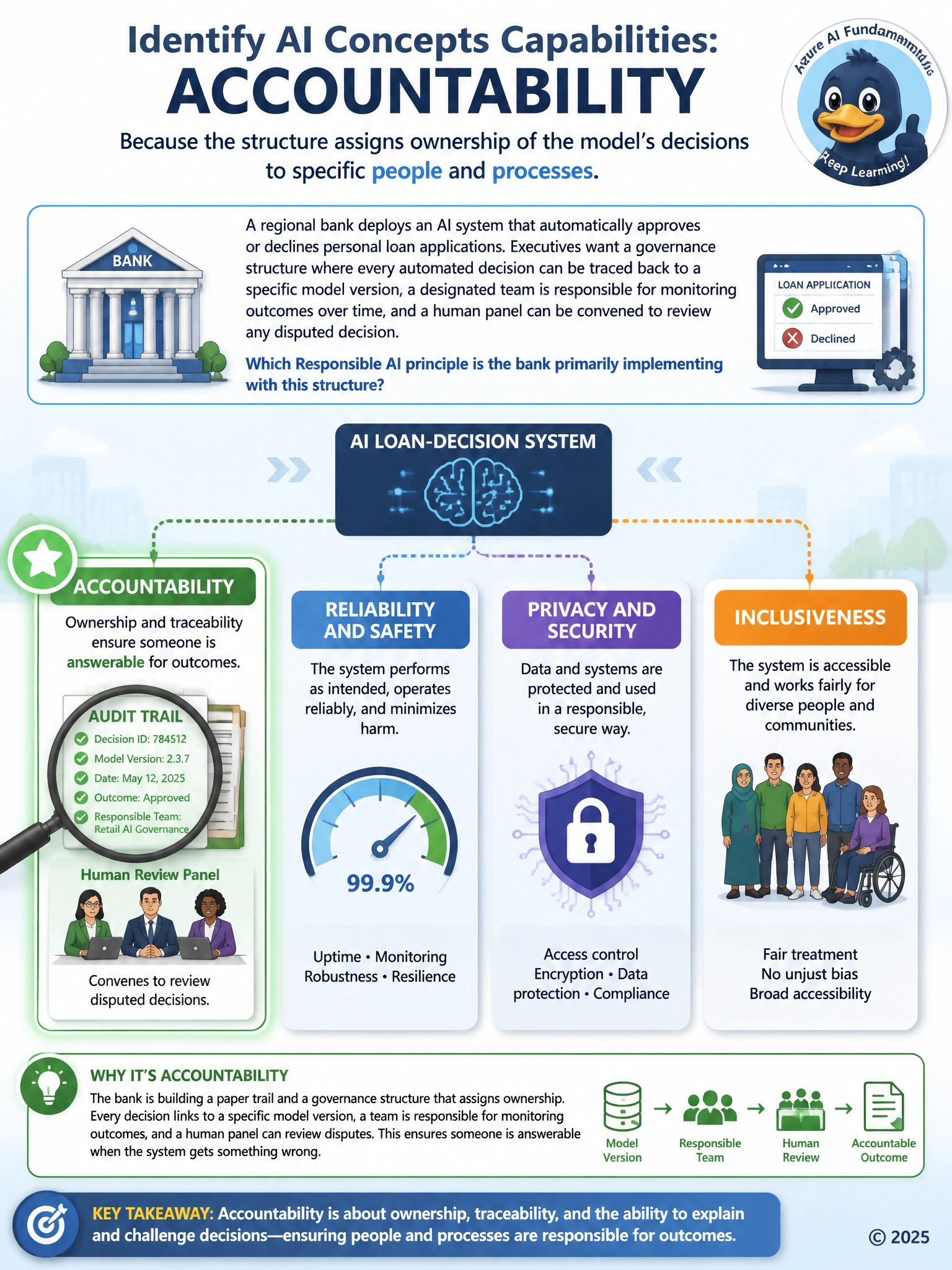
A regional bank deploys an AI system that automatically approves or declines personal loan applications. Executives want a governance structure where every automated decision can be traced back to a specific model version, a designated team is responsible for monitoring outcomes over time, and a human panel can be convened to review any disputed decision. Which Responsible AI principle is the bank primarily implementing with this structure?
Select an answer to reveal the explanation.
Short Explanation
Think about what the bank is actually building here: not a better model, but a paper trail. Every decision points back to a specific version of the system, a team is on the hook for watching how it behaves over time, and there's a human group ready to step in when someone disputes an outcome. That's not about keeping servers running, protecting data, or making sure the system works for every type of applicant equally. It's about making sure someone is answerable when the system gets something wrong. One tempting wrong choice mixes up 'keeping the data safe' with 'keeping the decisions honest' - those are different jobs. Another mixes up 'the system works reliably' with 'someone owns the outcome,' which also misses the point, since a model can run perfectly and still make a decision nobody can explain or challenge. A third confuses fairness of access with governance of outcomes. The scenario is really describing ownership and traceability, which is what accountability means in practice.
Full Explanation
The correct answer is A. The bank's structure ties every automated decision to a traceable model version, assigns a team to monitor outcomes on an ongoing basis, and provides a human panel to review disputed cases. That combination of traceability, ownership, and human oversight is the definition of accountability in Responsible AI: ensuring people, not just algorithms, remain answerable for the system's behavior. Option B is incorrect because reliability and safety concerns whether a model performs consistently and safely under the conditions it was designed for, such as uptime and error handling, not who is answerable for its decisions. Option C is incorrect because privacy and security concerns protecting the applicants' personal and financial data from exposure or misuse, which is a separate concern from decision governance and has not been described in the scenario. Option D is incorrect because inclusiveness concerns designing the system so it works well for people of varying abilities, backgrounds, and demographics, which is about the model's fairness of access and performance across groups, not about establishing traceability and human review of its outputs. Nothing in the scenario describes accessibility, uptime, or data protection measures, so accountability is the only principle that matches the described oversight structure.