
A customer-experience team has 50,000 open-ended survey comments with no predefined category list and wants to discover what topics customers are naturally talking about, grouping similar comments together for review. Which Foundry-based approach fits this task?
Select an answer to reveal the explanation.
Short Explanation
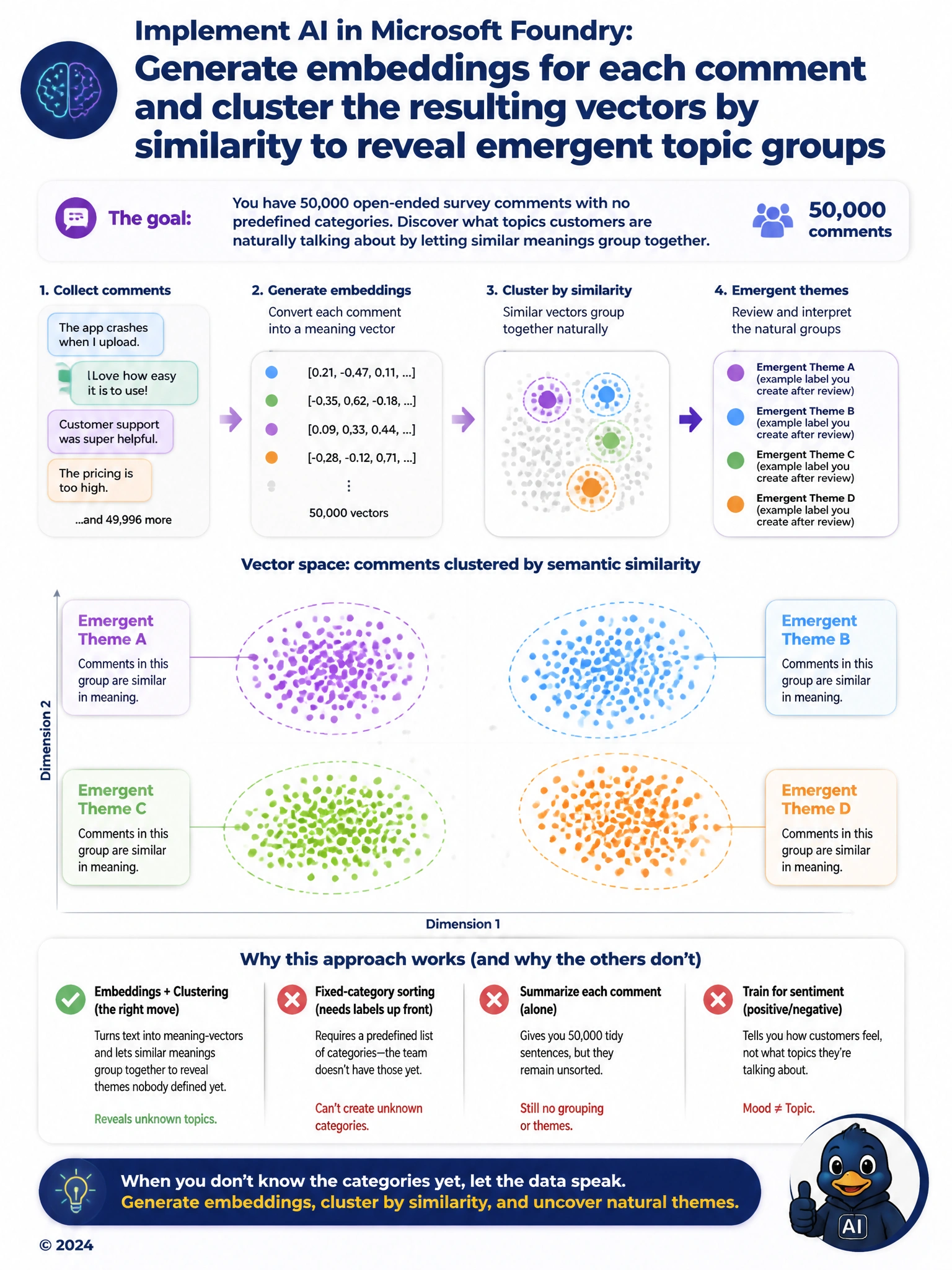
When you don't know yet what the categories should be, you can't ask a model to sort things into a list that doesn't exist. What actually helps is turning each comment into something that captures its meaning, then letting similar meanings drift together into natural clusters, sort of like pouring a box of mixed items onto a table and letting like group with like without anyone labeling the piles first. A fixed-category sorter needs those pile labels handed to it up front, which the team simply doesn't have. Summarizing each comment on its own just gives you 50,000 tidy sentences, still unsorted. And training a model to guess positive or negative tells you mood, not topic. Turning text into meaning-vectors and clustering them is the move that surfaces themes nobody defined yet.
Full Explanation
The correct answer is A. Generating embeddings turns each comment into a vector that captures its meaning, and clustering those vectors by similarity groups comments that discuss related topics together, even though no one told the system in advance what those topics would be. This matches the scenario's core requirement: discovering emergent themes with no predefined category list. Option B is incorrect because classification requires a fixed set of categories decided in advance, but the team explicitly has no such list yet; it fits sorting into known buckets, not discovering unknown ones. Option C is incorrect because summarizing each comment individually produces 50,000 isolated summaries without grouping anything together, leaving the team with the same organizational problem they started with. Option D is incorrect because fine-tuning for sentiment prediction would only classify comments as positive, negative, or neutral, which says nothing about the topics customers are discussing. Embedding-based clustering is the approach purpose-built for surfacing structure in unlabeled text, making it the right fit when the goal is exploration rather than sorting into predetermined boxes.