
A healthcare software vendor is preparing to launch a Foundry-hosted model that will read patient-submitted messages and draft suggested replies for a nurse to review before sending. Which two actions are appropriate responsible-AI mitigations to put in place before launch? (Select TWO.)
Select all correct answers, then click Submit.
Short Explanation
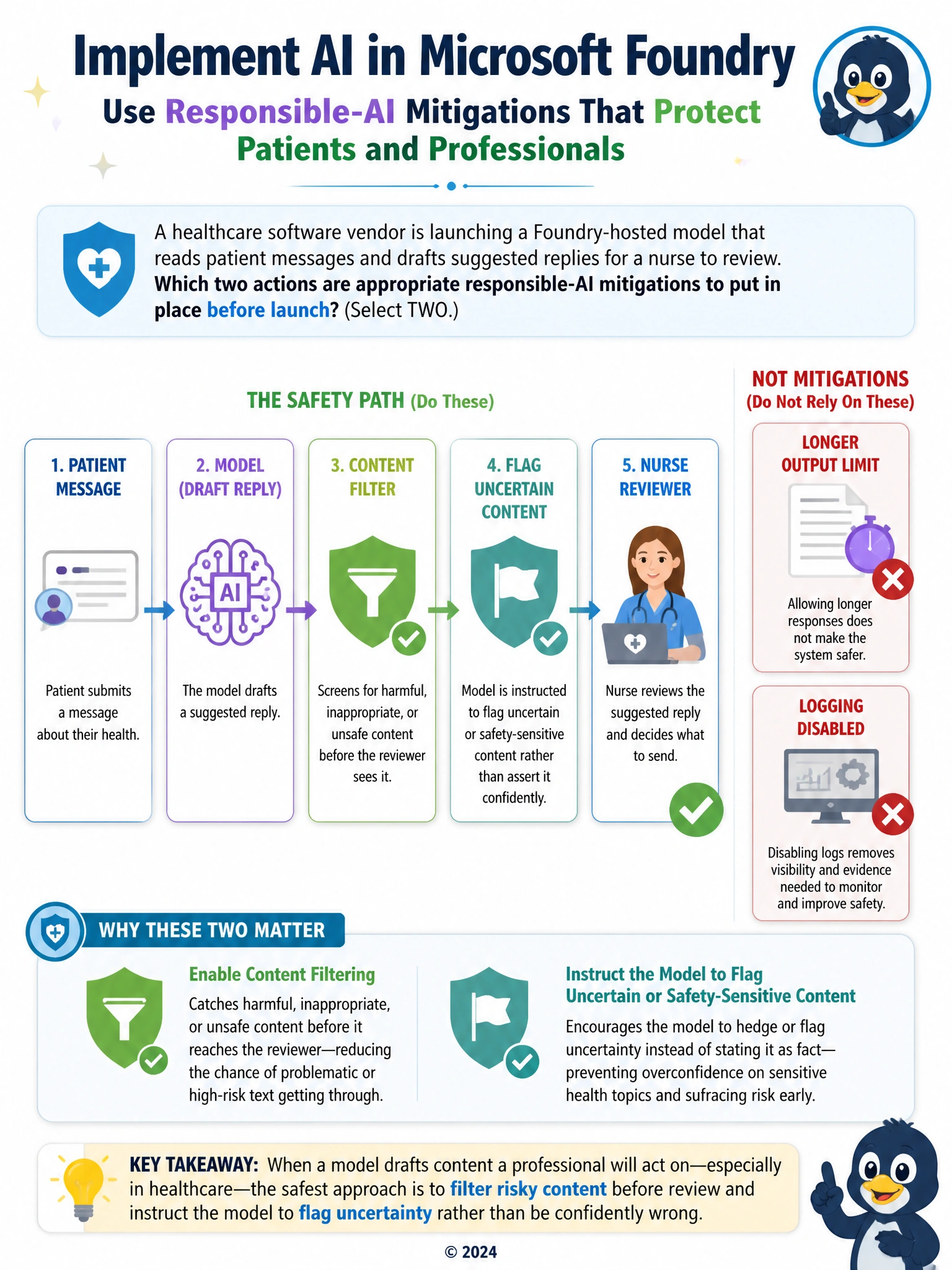
When a model is drafting something a professional will act on, especially in healthcare, the mitigations that matter are the ones that reduce the chance of something harmful or falsely confident slipping through before a human signs off. A screen that catches inappropriate content before a reviewer ever sees it is one clear layer of protection, and nudging the model, through its instructions, to hedge or flag anything uncertain rather than state it as fact is another, since overconfidence on a sensitive topic is exactly the kind of risk you want caught early. Letting the model write longer responses does not make anything safer, it just gives more room for unreviewed content to accumulate. And cutting the logging that records what happened removes the very evidence a team would need afterward to check whether the system behaved appropriately, which is the opposite of a safeguard, it is giving up visibility for a bit of speed.
Full Explanation
The correct answers are B and C. Enabling content filtering reduces the chance that harmful, offensive, or otherwise inappropriate generated text ever reaches the nurse reviewing drafts, and a system message that pushes the model to flag rather than assert uncertain or safety-sensitive content directly reduces the risk of a confidently wrong suggestion slipping past review in a healthcare setting, both of which are genuine responsible-AI mitigations for this scenario. Option D is incorrect because a larger output token limit only changes how much text the model is allowed to generate; it does nothing to reduce risk and, if anything, gives more room for unreviewed detail to appear in a draft. Option A is incorrect because disabling logging removes the audit trail needed to review what the model produced and why, which undermines oversight and accountability rather than supporting it, and any latency saved is not worth losing that traceability in a patient-facing healthcare workflow.