
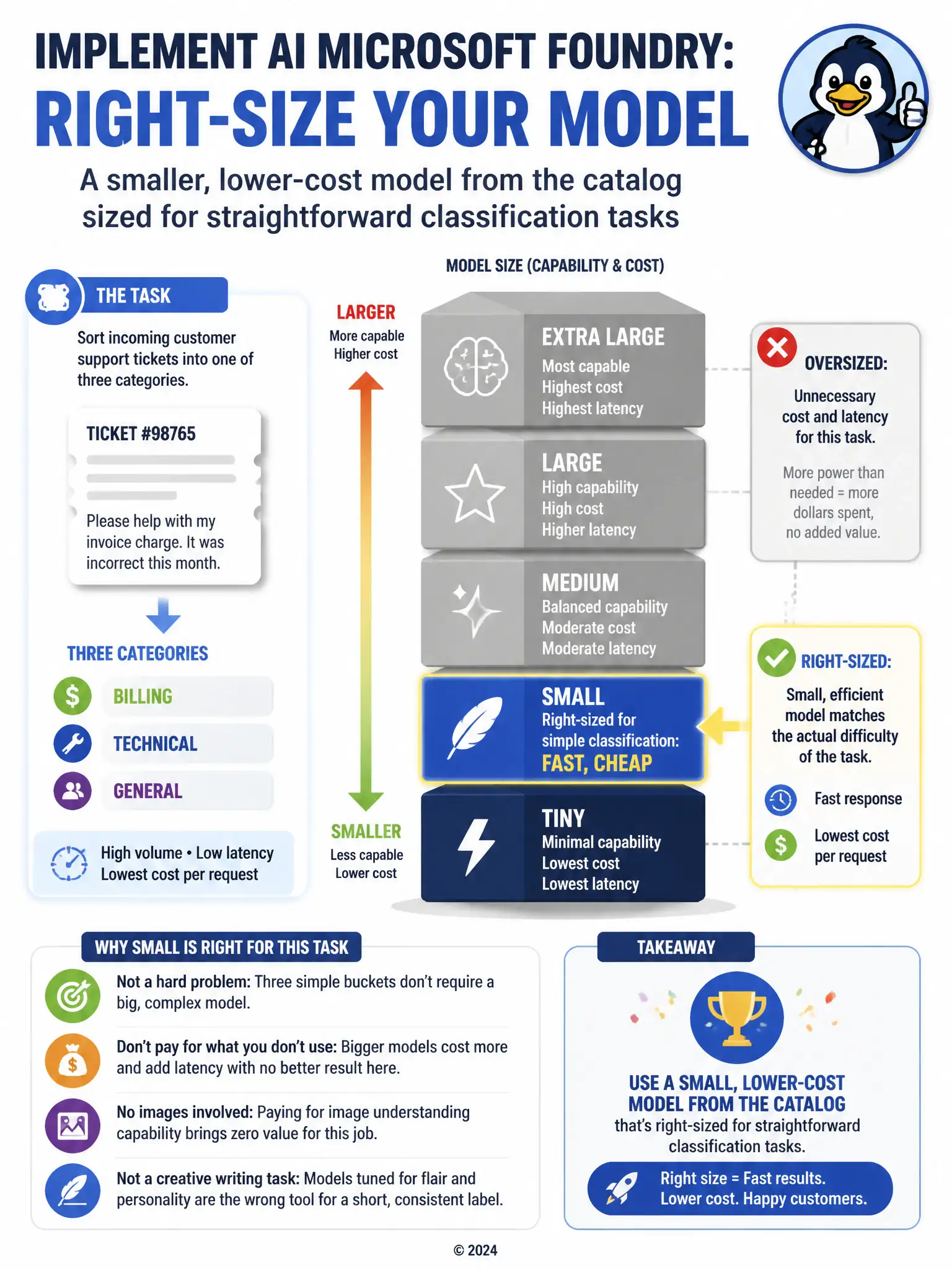
A team needs to sort incoming customer support tickets into one of three categories, billing, technical, or general, at high volume and low latency, with cost per request kept as low as possible. The task involves no images, no long documents, and no multi-step reasoning, just a short label decision per ticket. Which type of model from the Foundry catalog best fits this task?
Select an answer to reveal the explanation.
Short Explanation
Sorting tickets into three buckets isn't hard, so don't make the model do more work than it needs. You want a smaller, lower-cost model sized for straightforward classification to keep latency and cost down. The bigger or fancier models just add expense without helping this simple label decision.
Full Explanation
The correct choice is a smaller, lower-cost model from the catalog sized for straightforward classification tasks. A simple three-way classification task fits a smaller model well, and because the requirement explicitly prioritizes high volume, low latency, and low cost over anything else, matching model size to task complexity is the right tradeoff. The largest flagship reasoning model is incorrect because it is built for complex multi-step tasks; using it here would add unnecessary latency and cost without meaningfully improving accuracy on a task this simple. The multimodal vision-and-text model is incorrect because the scenario states tickets contain no images today, so paying for multimodal capability is a speculative cost for a capability not currently needed; the requirement can be revisited if the input format actually changes. The model fine-tuned specifically for creative writing tone is incorrect because it optimizes for stylistic, expressive output, which is the opposite of what a consistent, terse classification label requires.