
A healthcare provider operating only within the European Union must ensure that inference requests sent to a Foundry-hosted model, along with the patient data in those requests, are processed exclusively within EU-based Azure datacenters to satisfy local regulatory requirements. What should the team configure when creating the model deployment to meet this requirement?
Select an answer to reveal the explanation.
Short Explanation
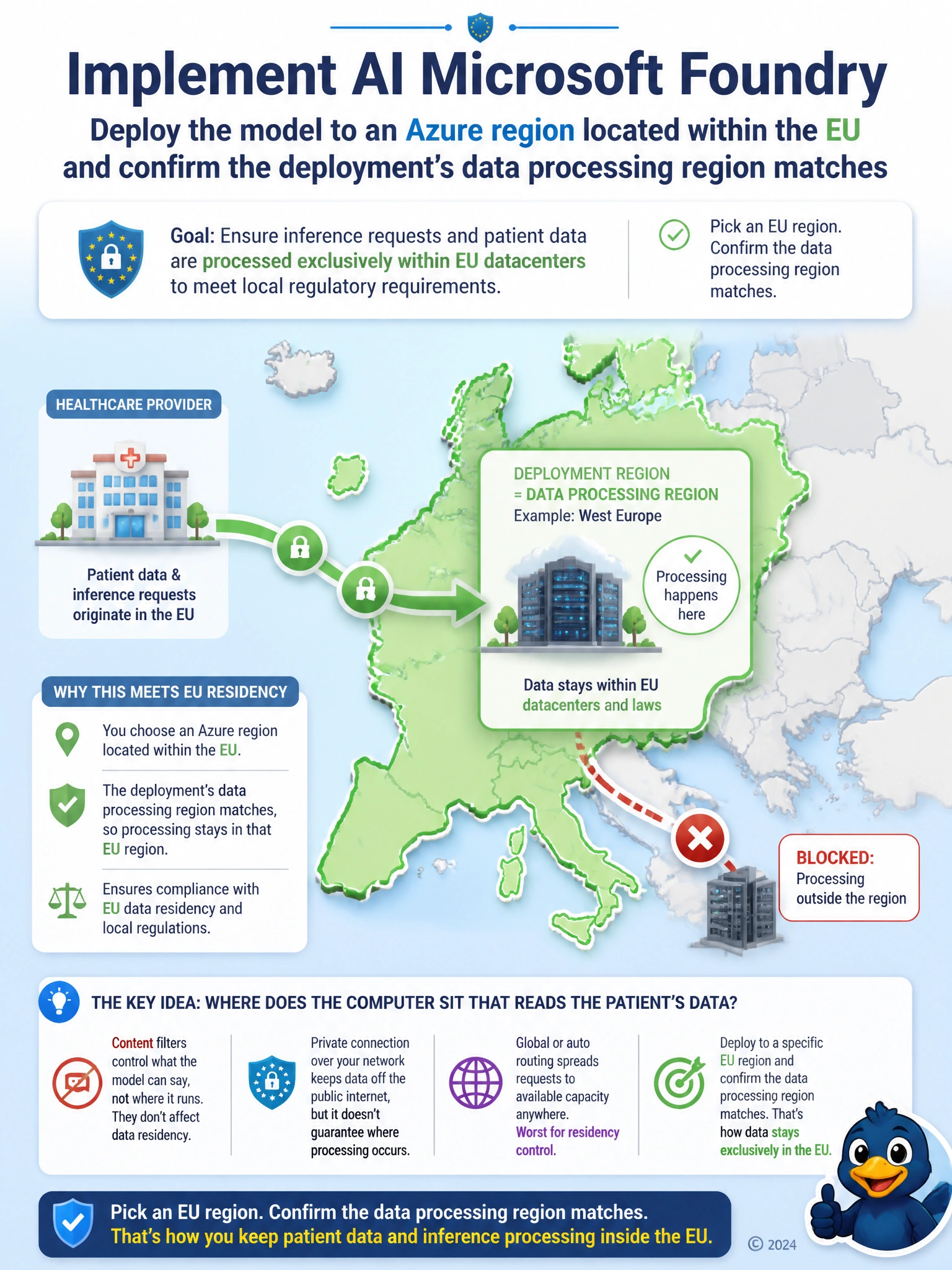
This one comes down to a simple question: where physically does the computer sit that reads the patient's data? Content filters are about what the model is allowed to say, not where it runs, so that doesn't touch the residency problem at all. A private connection over your own network keeps the data from being visible on the open internet as it travels, which is great for security, but it doesn't stop that data from landing on a server outside the EU once it arrives. And the option built for lowest cost by spreading requests across whichever datacenter has room to spare is actually the worst fit here, because it explicitly gives up control over which country the processing happens in. What actually satisfies a strict 'must stay in the EU' rule is picking a specific EU region for the deployment up front and verifying that's really where processing happens, so there's no ambiguity about which country's laws and datacenters are involved.
Full Explanation
The correct answer is C. Selecting an Azure region physically located in the EU and confirming that the deployment's data processing region matches that location is what actually controls where inference requests are processed and where the associated data resides, which is the specific regulatory requirement the provider must satisfy. Option A is incorrect because a content filter category for personal health information governs what the model flags or blocks in its output; it says nothing about which physical datacenter processes the request, so it does not address data residency. Option B is incorrect because a private endpoint secures the network path between the client and the deployment, keeping traffic off the public internet, but it does not by itself pin the deployment to a particular geographic region or guarantee EU-only processing. Option D is incorrect because global standard deployments are explicitly designed to route requests to whichever region has available capacity, which is the opposite of the geographic guarantee this scenario requires; choosing it for cost would directly undermine the residency requirement.