
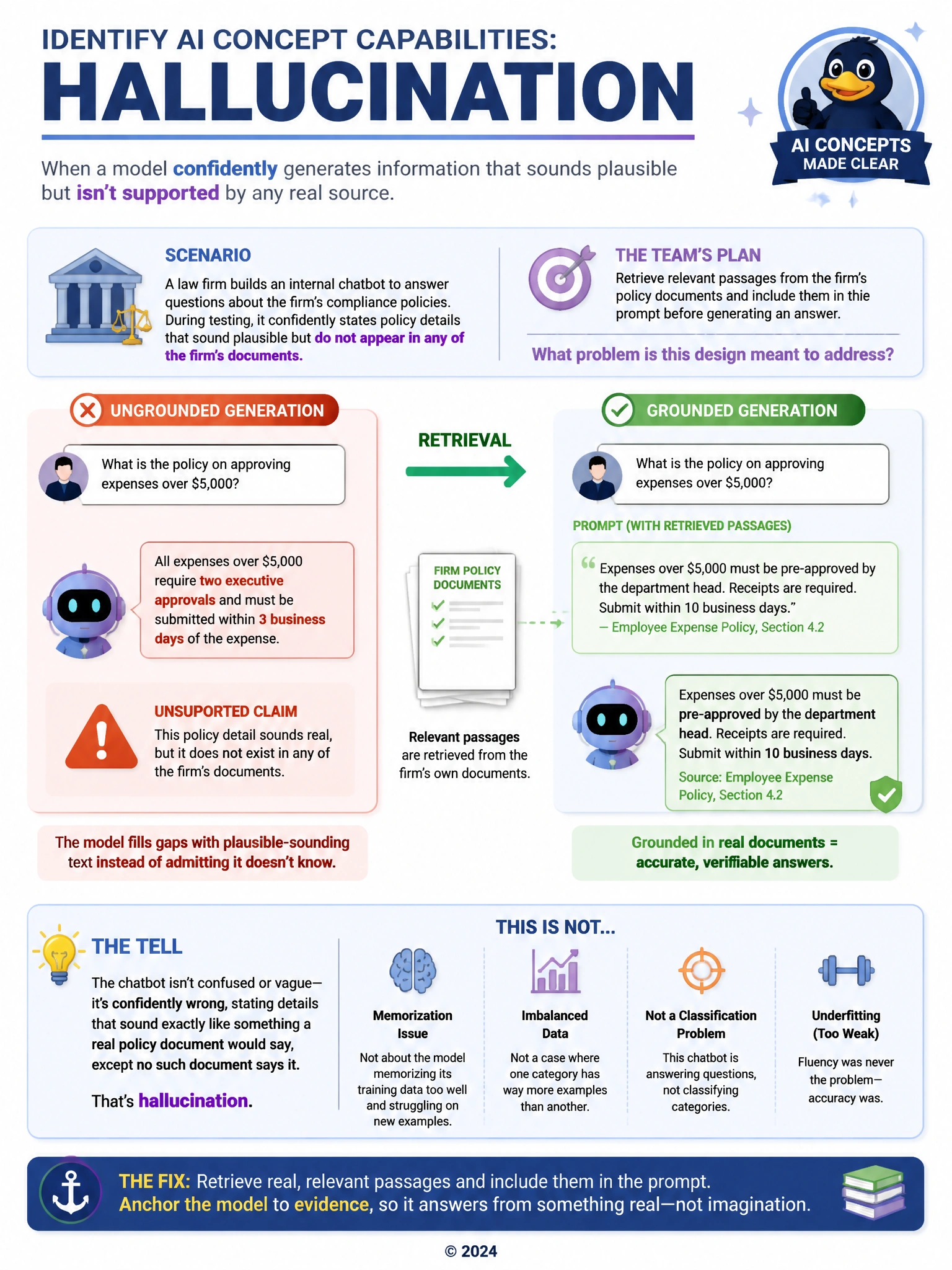
A law firm builds an internal chatbot on a large language model to answer questions about the firm's specific internal compliance policies. During testing, the chatbot confidently states policy details that sound plausible but do not actually appear in any of the firm's documents. To reduce this problem, the team plans to have the chatbot retrieve relevant passages from the firm's own policy documents and include them in the prompt before generating an answer. What problem is this design meant to address?
Select an answer to reveal the explanation.
Short Explanation
Here's the tell: the chatbot isn't confused or vague, it's confidently wrong, stating details that sound exactly like something a real policy document would say, except no such document says it. That's the model filling gaps with plausible-sounding text instead of admitting it doesn't know, and the fix the team is building, pulling real passages from the firm's own documents into the prompt before it answers, is a way of anchoring its response to something real instead of letting it freewheel. That's a different issue from a model that memorized its training data too well and struggles on new examples, and different again from a dataset where one category has way more examples than another, since this chatbot isn't doing classification at all. It's also not a case of a model too weak to learn patterns, since fluency was never the problem, accuracy was.
Full Explanation
The correct answer is A. The chatbot is producing confident, plausible-sounding statements about firm policy that are not actually supported by any real document, which is the defining behavior of hallucination in a large language model; retrieving and inserting real policy passages into the prompt grounds the model's answer in verified source material and reduces this risk. Option B is incorrect because overfitting describes a training-time problem where a model performs well on training data but poorly on new data, which is unrelated to a deployed model inventing unsupported facts at answer time. Option C is incorrect because class imbalance refers to unequal representation of categories in a labeled training dataset used for classification, which has no bearing on a chatbot generating free-form policy statements. Option D is incorrect because underfitting describes a model too simple to capture patterns in its training data, whereas here the model is fluent and confident, just factually ungrounded, which is a different failure mode entirely.