
A manufacturer wants to detect five specific defect types unique to its own product line on an assembly line, using photos its quality team has already labeled. A prebuilt Azure AI Vision image analysis model cannot recognize these defects because they are not part of its general object catalog. What should the team do using Azure AI Foundry's vision capabilities?
Select an answer to reveal the explanation.
Short Explanation
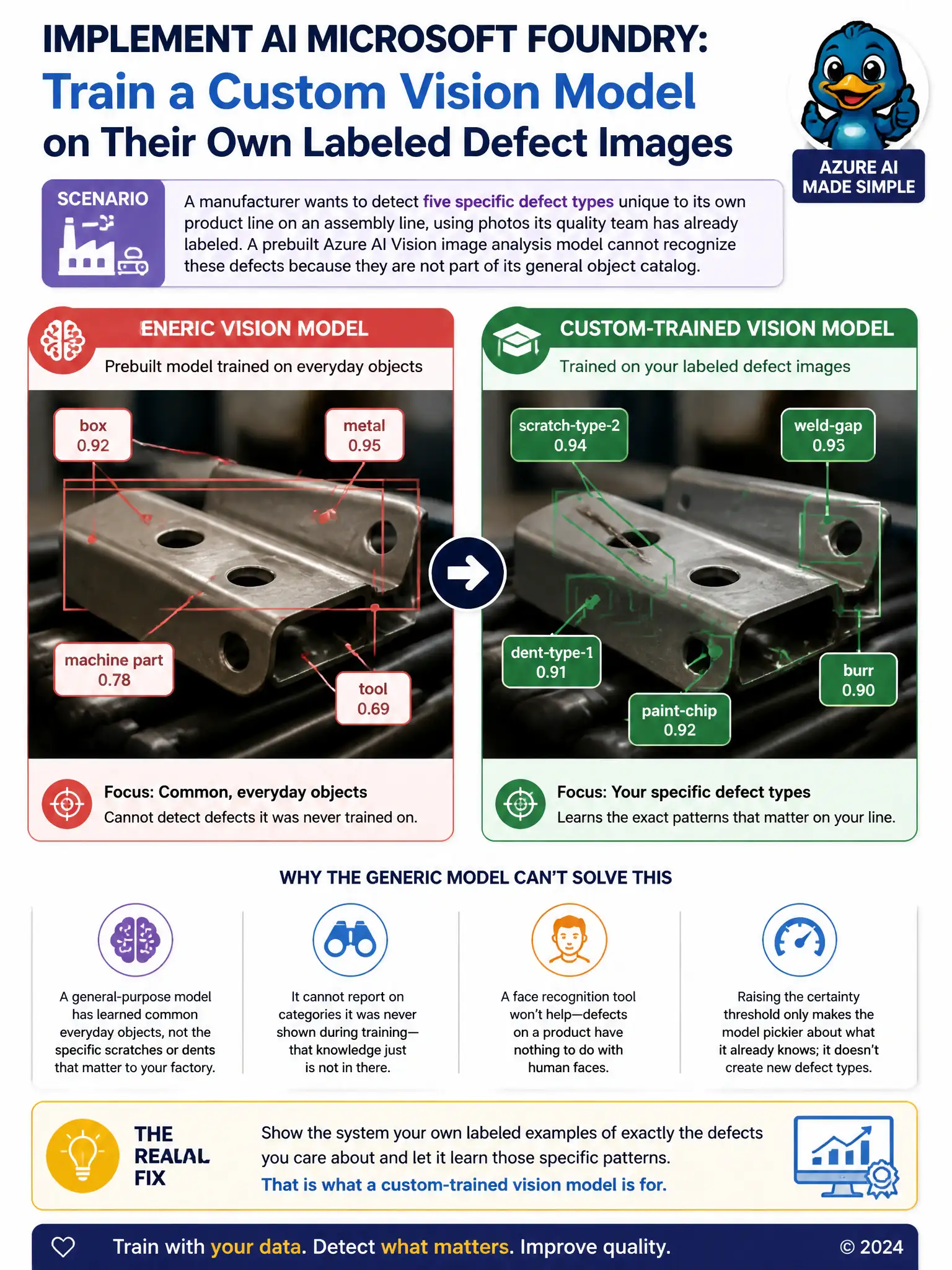
A general-purpose vision model only knows the everyday objects it was trained on, so it can't spot your factory's five defect types no matter how you filter its output. You need to train a custom vision model on your own labeled defect images so it learns those exact patterns.
Full Explanation
Training a custom vision model on the team's own labeled images lets the system learn the specific visual patterns of their five defect types, something no general-purpose prebuilt catalog can offer since it was never trained on those categories. Calling the prebuilt Image Analysis API's generic object detection endpoint and post-processing the generic tags to guess at defects is incorrect because no amount of post-processing can extract defect labels that were never part of the generic model's vocabulary in the first place; the underlying model simply does not know those categories exist. Switching to the prebuilt Face API since it offers more granular detection settings is incorrect because the Face API is built to detect and analyze human faces, which has no relevance to identifying manufacturing defects on a product. Raising the confidence threshold on the prebuilt model's generic tagging output until only defects remain is incorrect because raising a confidence threshold only filters how certain the model is about its existing generic tags; it cannot invent new categories that were never in its training data, no matter how the threshold is tuned. Custom training on labeled, domain-specific images is the only path that produces a model capable of recognizing the manufacturer's particular defects.