
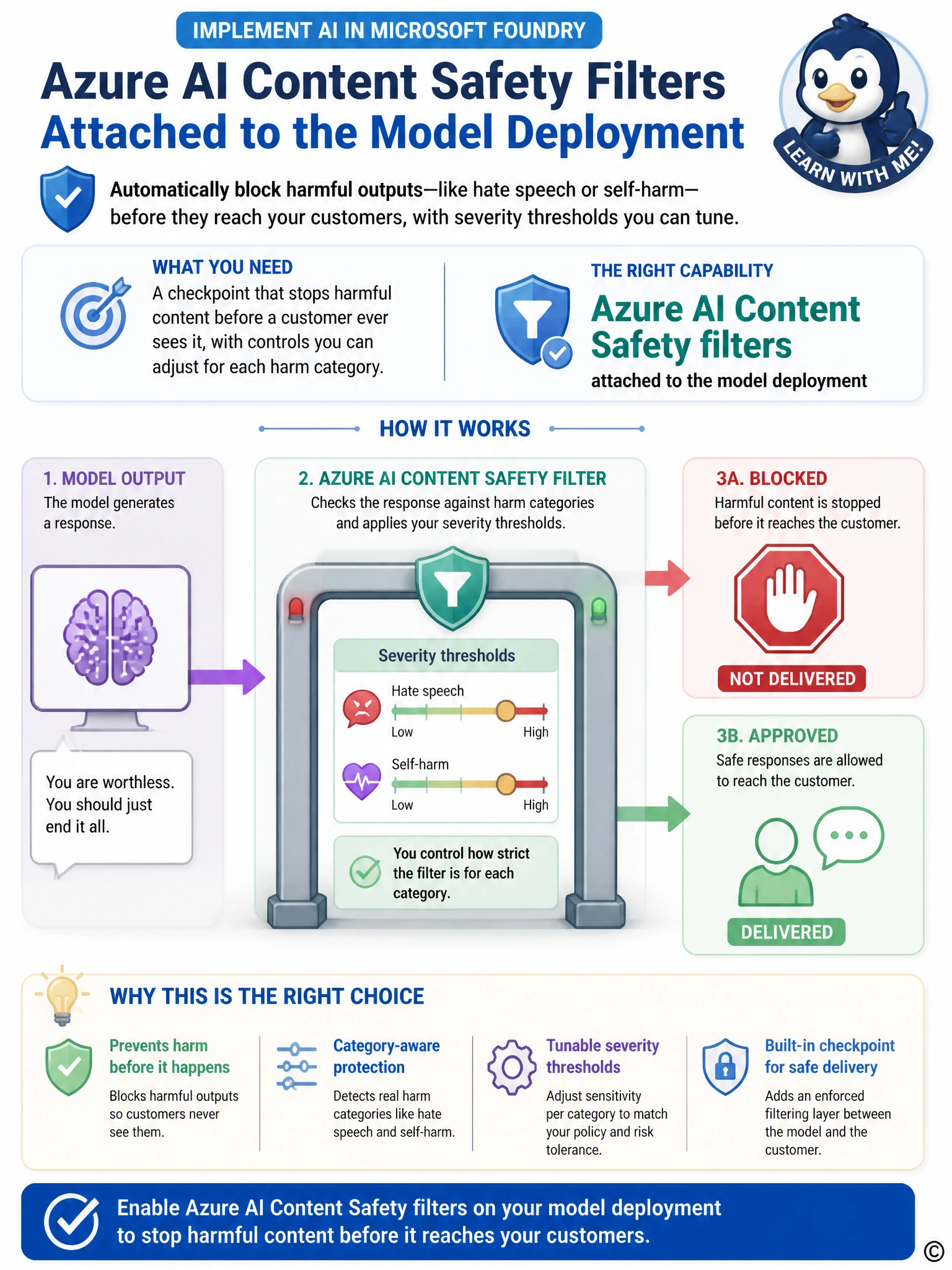
A company deploys a generative AI customer-service model through Azure AI Foundry and needs the system to automatically block outputs containing hate speech or self-harm content before those responses ever reach a customer, with severity thresholds they can tune per category. Which capability should they enable on the deployment?
Select an answer to reveal the explanation.
Short Explanation
What this company needs is a checkpoint that actually stops bad content before a customer ever sees it, not something that just makes bad content less likely or tells someone about it after it already went out. Turning down the model's creativity dial might change its writing style a little, but it is not built to recognize categories like hate speech or self-harm and will not reliably catch them. Asking nicely in the instructions is better than nothing, but a determined or unusual input can still get the model to slip past a plain instruction, since it is a suggestion rather than an enforced rule. And getting notified after something harmful already reached a customer is too late by definition, since the damage from that message is already done. What actually fits is a dedicated content-filtering layer sitting between the model's output and the customer, checking each response against real harm categories with thresholds you can dial up or down, and stopping the bad ones before they go out.
Full Explanation
The correct answer is D. Azure AI Content Safety filters attach directly to the deployment and evaluate generated text against categories like hate speech and self-harm, blocking or flagging content according to configurable severity thresholds before it is returned to the user, which is exactly the enforceable, pre-delivery control the scenario requires. Option A is incorrect because temperature adjusts the randomness and creativity of the model's word choices; it does not classify content into harm categories or block anything, so lowering it offers no reliable safety guarantee. Option B is incorrect because a system prompt is a soft instruction the model may still fail to follow under adversarial or unusual inputs; it is not an enforced technical safeguard with adjustable severity thresholds. Option C is incorrect because alerting admins after the fact means the harmful content has already reached the customer, which fails the requirement to block it before delivery. Only the dedicated content-filtering service provides the enforced, tunable, pre-response gating the company needs.