
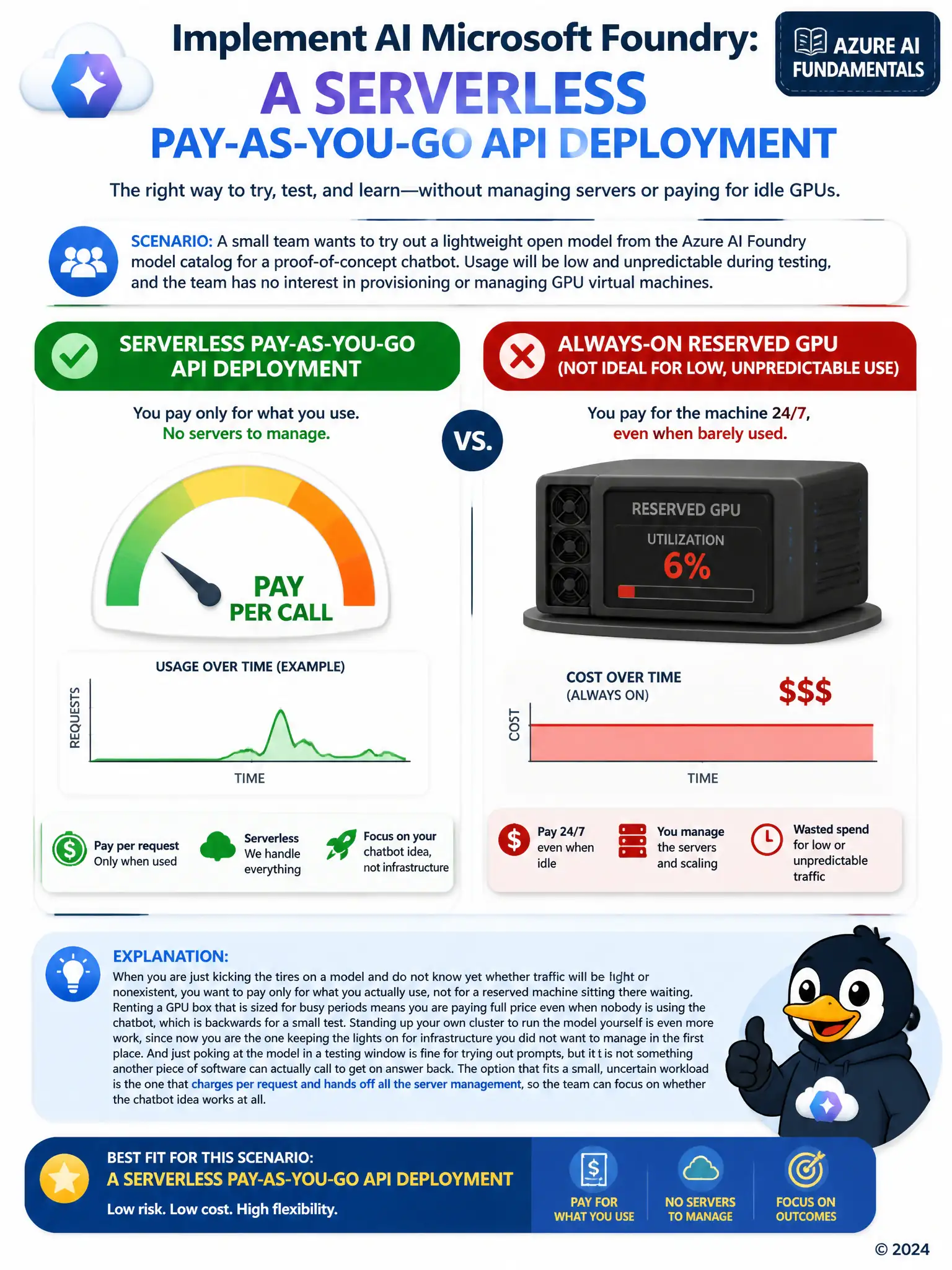
A small team wants to try out a lightweight open model from the Azure AI Foundry model catalog for a proof-of-concept chatbot. Usage will be low and unpredictable during testing, and the team has no interest in provisioning or managing GPU virtual machines. Which deployment approach best fits their situation?
Select an answer to reveal the explanation.
Short Explanation
When you're just kicking the tires on a model and don't know whether traffic will be light or nonexistent, you want to pay only for what you actually use, not for a reserved machine sitting there waiting. Renting a GPU box sized for busy periods means you're paying full price even when nobody's using the chatbot, which is backwards for a small test. Standing up your own cluster is even more work, and poking at the model in a testing window isn't something another piece of software can call for an answer; the serverless pay-as-you-go API deployment charges per request and hands off server management.
Full Explanation
The correct answer is a serverless pay-as-you-go API deployment because it bills per call rather than for reserved infrastructure, which fits a proof of concept with light, unpredictable traffic, and it requires no GPU virtual machine provisioning or maintenance from the team. A dedicated managed online endpoint with reserved GPU compute sized for peak load is incorrect because reserving GPU compute sized for peak load means paying for idle capacity most of the time, which is wasteful for a low-traffic proof of concept and also reintroduces the VM management the team wants to avoid. An AKS cluster with the model container image deployed and scaled manually is incorrect because standing up and manually scaling an AKS cluster requires exactly the kind of infrastructure operations the team explicitly wants to skip, and it adds substantial setup time for a quick test. The Foundry playground UI used directly as the chatbot's production backend is incorrect because the playground is an interactive testing surface for experimenting with prompts and settings, not a callable API endpoint that an application can integrate with in production; a real chatbot needs an actual deployed endpoint to send requests to. For a lightweight, low-commitment test, the serverless option minimizes both cost and operational burden while still providing a real callable endpoint.