
A financial services company has an assistant that already answers customer questions reasonably well through prompt engineering, but compliance reviewers keep flagging that responses inconsistently use the company's exact required disclosure wording across thousands of daily conversations. Adjusting the prompt has not fixed the inconsistency. Which next step in Microsoft Foundry is most appropriate?
Select an answer to reveal the explanation.
Short Explanation
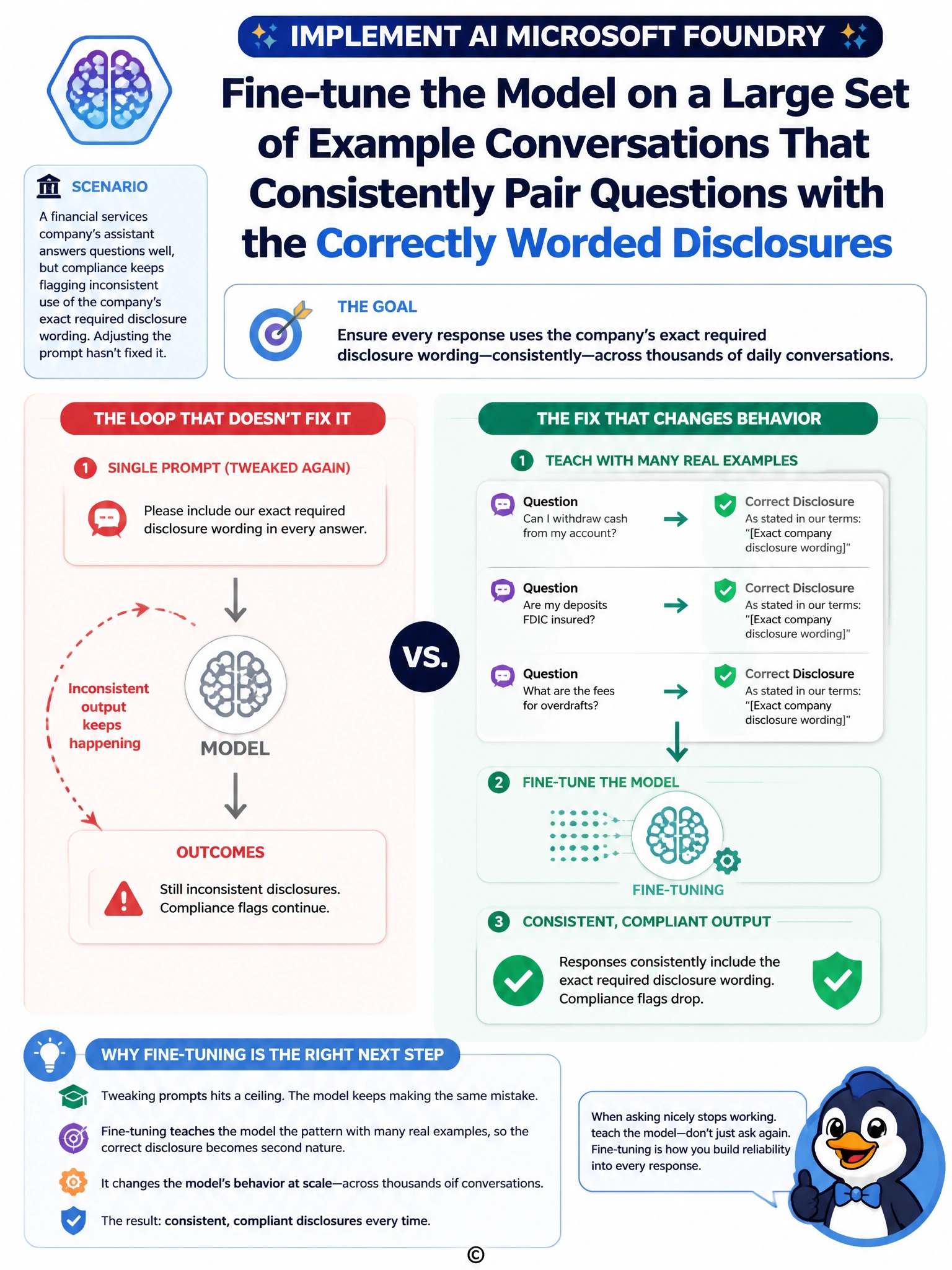
When tweaking the instructions you give a model stops fixing a recurring mistake, that is usually a sign you need to teach the model the pattern directly rather than keep asking nicely, and that is exactly what fine-tuning is for: showing it many real examples of questions paired with the exact disclosure wording until that pairing becomes second nature. Turning randomness down to zero just makes the model repeat itself more consistently, including repeating the wrong wording consistently, so it does not solve a missing-content problem. Swapping in a smaller, cheaper model trades away capability to save money; it does not make required wording more likely to appear correctly. And making instruction text visually bigger in a prompt does nothing at all, since a language model reads plain text and has no concept of font size or emphasis. Training on real labeled examples is the fix that actually changes the model's behavior at scale.
Full Explanation
The correct answer is B. Fine-tuning trains the model's weights on many labeled examples that consistently pair customer questions with the exact required disclosure wording, which addresses a pattern the team needs enforced across thousands of interactions in a way that prompt adjustments alone have failed to achieve. Option A is incorrect because lowering temperature reduces randomness in phrasing but does not teach the model the specific disclosure language it is missing; a deterministic model can still be deterministically wrong. Option C is incorrect because switching to a smaller model addresses cost, not consistency, and a smaller model is not inherently more likely to include specific required wording; it may in fact perform worse without additional training. Option D is incorrect because font size is a formatting concept with no effect on a language model, which does not perceive visual emphasis in a system prompt; the underlying instruction is processed as plain text regardless of styling. Since the problem is a recurring pattern that prompt engineering has not resolved, fine-tuning on representative examples is the tool built to bake that pattern into the model's behavior.