
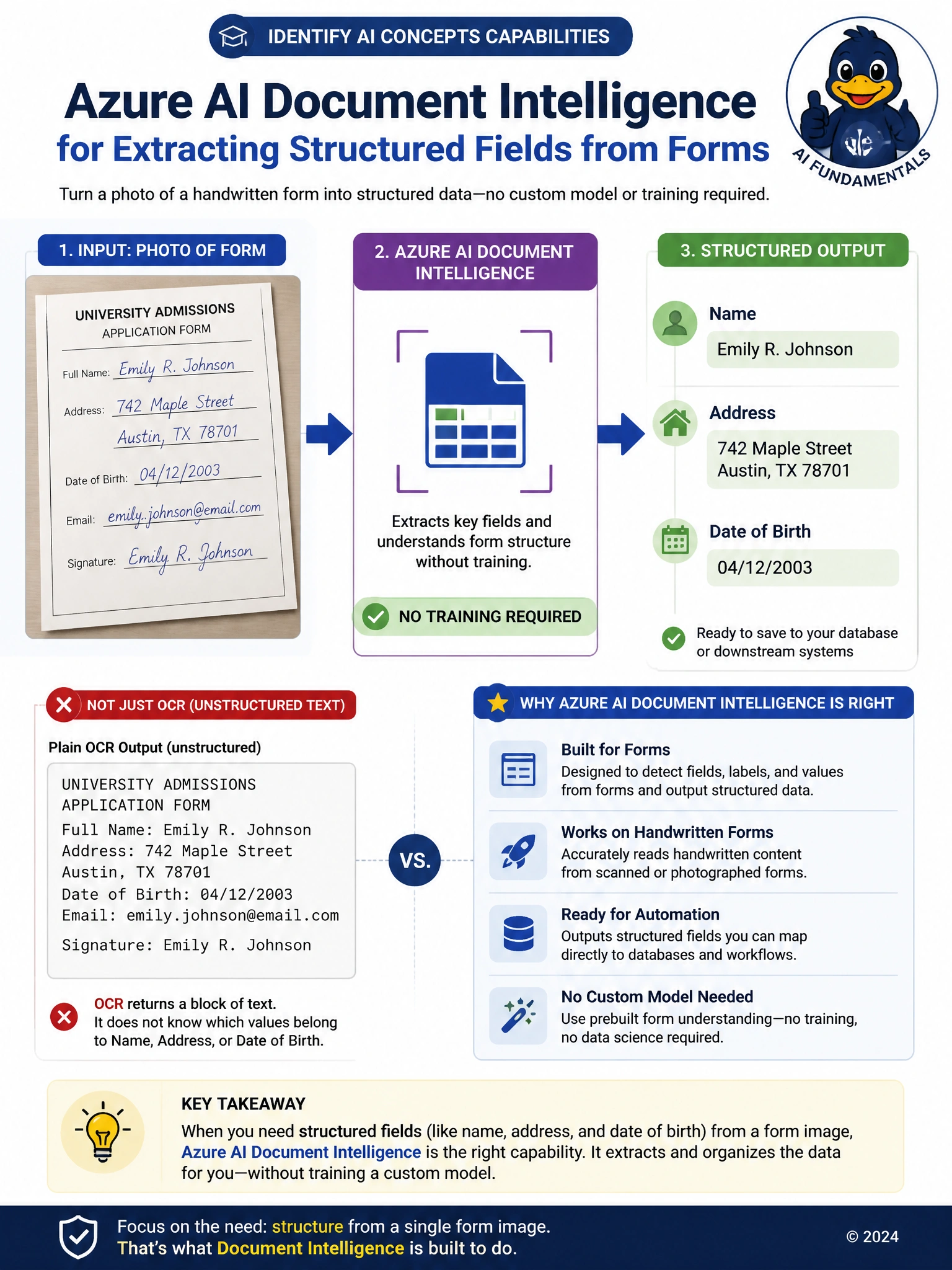
A university admissions office wants to use a service that can accept a photo of a handwritten application form and output the applicant's name, address, and date of birth as structured text fields, without training a custom model. Which Azure AI capability should the office use?
Select an answer to reveal the explanation.
Short Explanation
Think about what the admissions office actually needs: not just text pulled off a page, but that text organized into labeled boxes like name and date of birth. That is a forms-extraction job, and Azure has a service built specifically to look at a scanned or photographed form and hand back structured fields ready to drop into a database. Plain text-reading services would just give you a blob of words with no idea which ones are the address versus the name. A document-search tool is a trap here too, since it is meant for finding things across a pile of files you already have digitized, not pulling fields off a brand-new incoming form. And anything built for understanding spoken requests is solving a completely different problem, since there is no speech involved at all. The office wants structure out of a single image, and that points squarely at the form-processing capability.
Full Explanation
The correct answer is A. Azure AI Document Intelligence is purpose-built to take images or scans of forms, including handwritten ones, and return structured key-value fields such as name, address, and date of birth, which is exactly what the admissions office needs without building or training a custom model from scratch. Option B is incorrect because basic OCR only returns raw extracted text without organizing it into named fields, so the office would still have to parse the output manually. Option C is incorrect because knowledge mining is designed to index and make searchable a large existing collection of documents, not to extract structured data from a single incoming form. Option D is incorrect because conversational language understanding processes spoken or typed natural language utterances to determine intent, which has no relevance to reading handwriting from an image.