
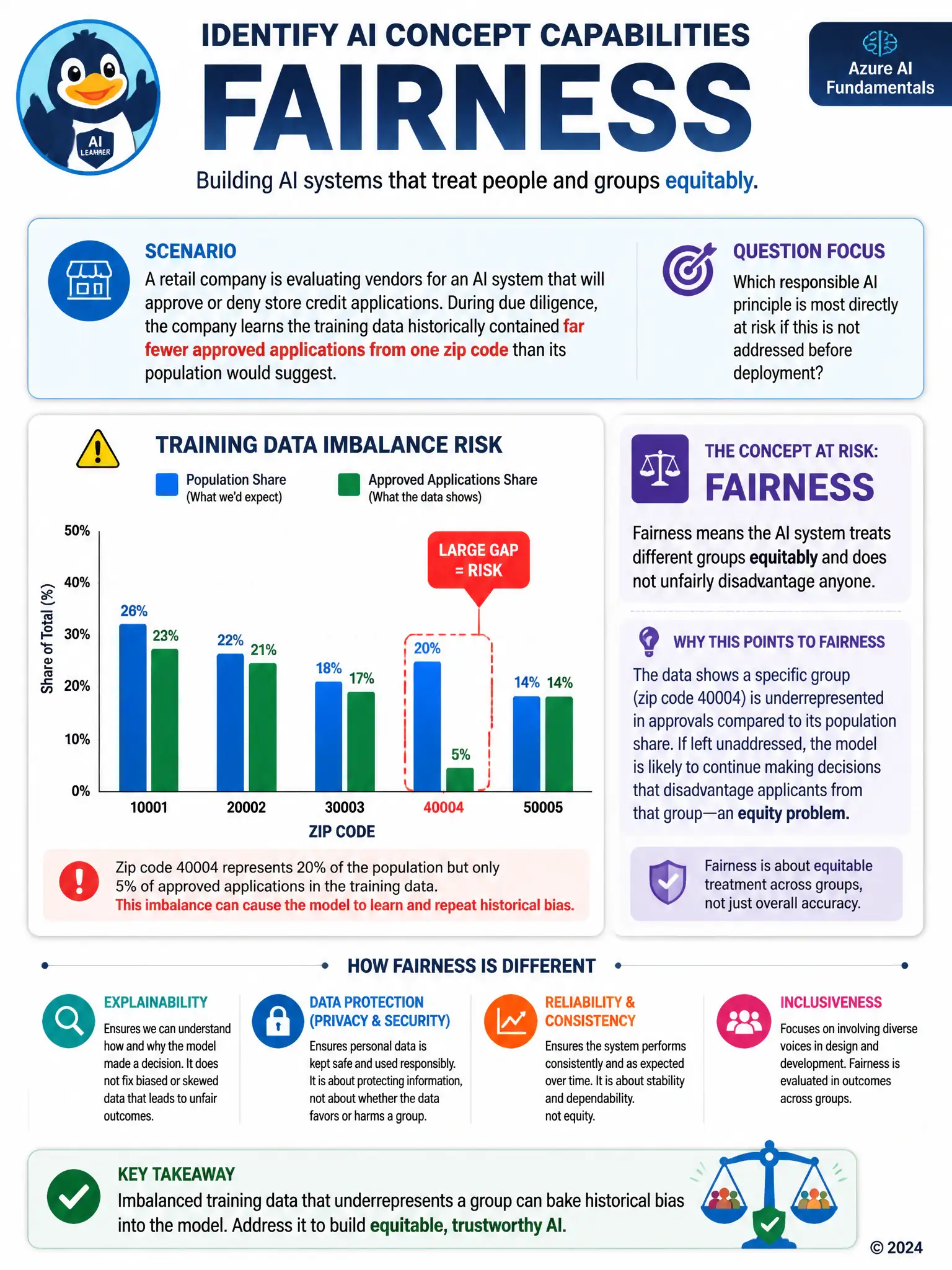
A retail company is evaluating vendors for an AI system that will approve or deny store credit applications. During due diligence, the company learns the training data historically contained far fewer approved applications from one zip code than its population would suggest. Which responsible AI principle is most directly at risk if this is not addressed before deployment?
Select an answer to reveal the explanation.
Short Explanation
If your training data shows far fewer approvals from one zip code than its population suggests, you're looking at a fairness problem. That imbalance can teach the model to treat applicants from that area unfairly. Explainability, data protection, and steady performance don't fix biased historical data.
Full Explanation
Fairness is the principle most directly at risk because it concerns whether an AI system treats different groups of people equitably. Training a credit-approval model on data that under-represents approvals from a particular zip code risks the model learning and perpetuating that historical imbalance, producing biased outcomes for applicants from that area. The transparency principle is not the best fit because it is about whether the system's decisions and workings can be explained and understood by users and stakeholders, which is a separate concern from whether the underlying data itself is skewed. The privacy and security principle is not the best fit because it concerns protecting personal data from misuse or unauthorized access, not the statistical composition of a training dataset. The reliability and safety principle is not the best fit because it concerns whether a system performs consistently and predictably under expected conditions, which is a different issue from whether it produces systematically unequal outcomes across demographic groups.