
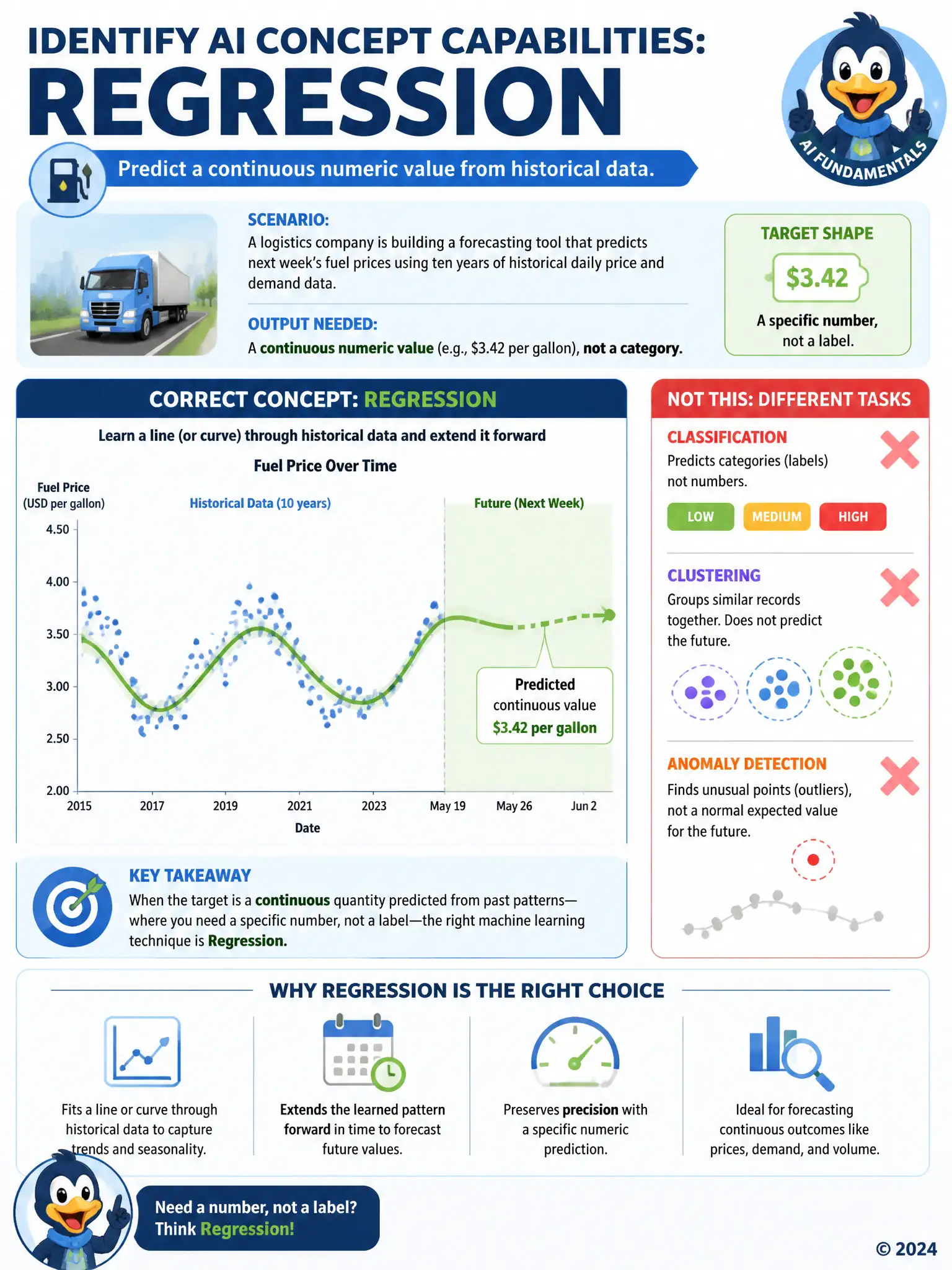
A logistics company is building a forecasting tool that predicts next week's fuel prices using ten years of historical daily price and demand data. The output needed is a continuous numeric value, not a category. Which type of machine learning task should the data science team frame this as?
Select an answer to reveal the explanation.
Short Explanation
You need a continuous number, like $3.42 per gallon, not a label. Regression is built to learn from historical patterns and forecast that numeric value. Classification would bucket the answer and lose the precision you need.
Full Explanation
Regression is the machine learning task used when the model must predict a continuous numeric value from historical data, and predicting a future fuel price, which can take on any decimal value within a range, fits that definition exactly. It learns from past patterns to draw a line, or a curve, through historical data and extend it forward. Classification is incorrect because it assigns inputs to discrete categories, such as 'price will rise' or 'price will fall', which discards the precise numeric value the company actually needs. Clustering is incorrect because it is an unsupervised technique that groups similar data points together without producing a predicted future value at all, so it cannot forecast a specific price. Anomaly detection is incorrect because it is designed to flag unusual or outlier data points, such as a sudden price spike, rather than to forecast an expected future value under normal conditions.