
A card-payment processor wants to flag transactions that deviate sharply from a customer's normal spending pattern, but the company has almost no historical examples labeled as confirmed fraud. Which AI approach is most appropriate for this situation?
Select an answer to reveal the explanation.
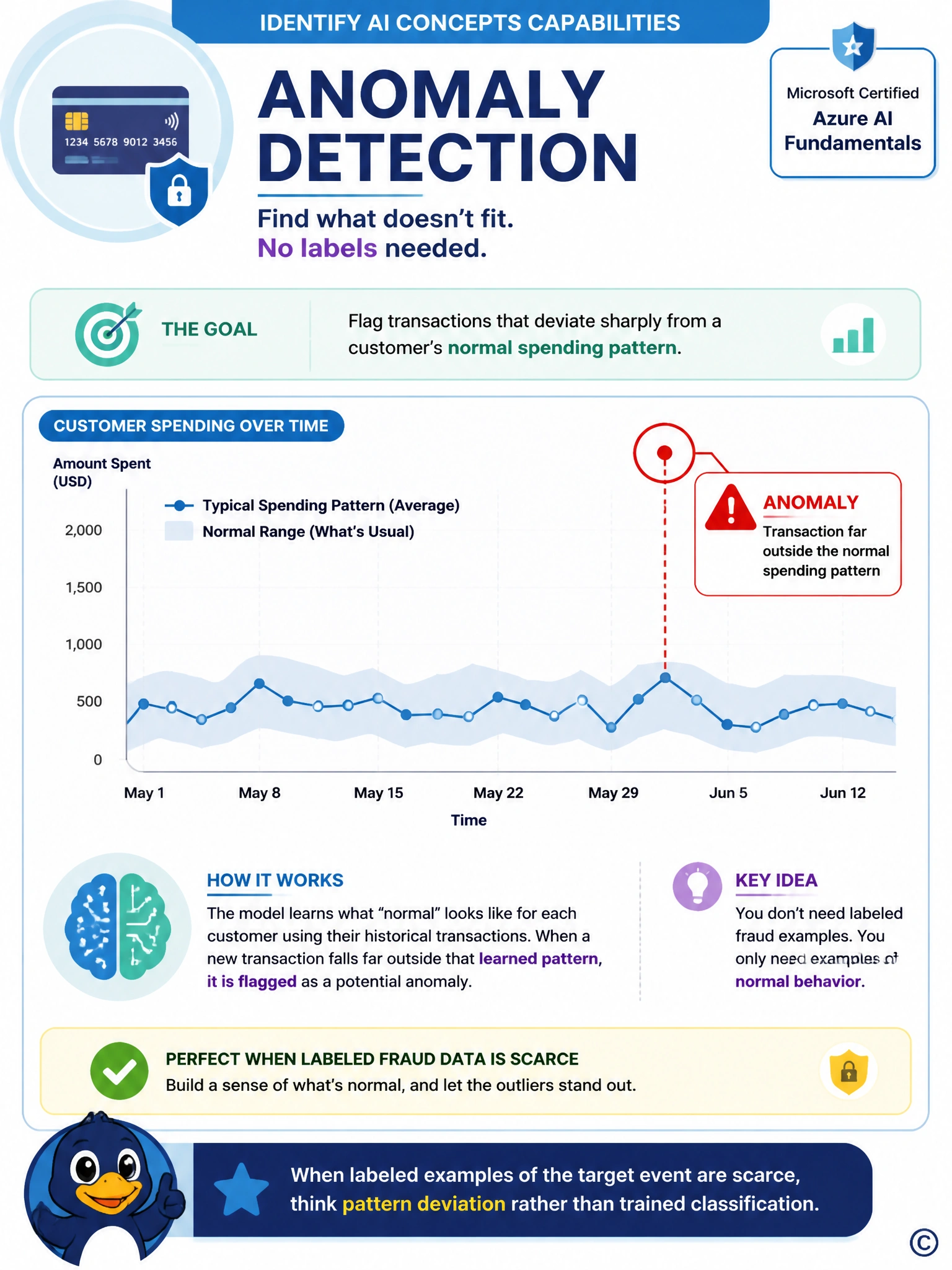
Short Explanation
The giveaway here is that the company barely has any confirmed examples of the exact thing it is trying to catch, so any approach that depends on learning from lots of correctly labeled past cases is going to struggle. Instead, the smarter move is to build a sense of what normal spending looks like for each customer and flag whatever strays far from that baseline, which does not require a stack of labeled fraud examples to get started. One of the other choices needs exactly that kind of labeled history to work well, learning a clean boundary between fraud and non-fraud from many tagged examples, and the scenario tells you that data barely exists. Another option is about chatting with users through text or voice, which has nothing to do with scanning transaction patterns. The last one is about organizing and searching a big pile of documents, which is unrelated to comparing a purchase against someone's typical habits. When labeled examples of the target event are scarce but you still need to catch outliers, think pattern deviation rather than trained classification.
Full Explanation
The correct answer is D. Anomaly detection is built to identify data points that deviate significantly from an established normal pattern without requiring large sets of labeled examples of the rare event, which fits the processor's situation of wanting to flag unusual transactions while lacking confirmed fraud labels to train against. Option A is incorrect because supervised classification requires a substantial set of correctly labeled historical examples, in this case confirmed fraud cases, to learn the boundary between fraudulent and legitimate transactions, and the scenario explicitly states that such labeled examples are almost nonexistent, making this approach impractical here. Option B is incorrect because conversational AI is about carrying on dialogue with users through chat or voice, and has no role in analyzing transaction patterns for irregularities. Option C is incorrect because knowledge mining extracts and indexes information from collections of documents or content, which does not address the task of statistically comparing a transaction against a customer's typical spending behavior. The scarcity of labeled fraud data combined with the goal of catching deviations from a normal baseline is the specific pairing that points to anomaly detection rather than a labeled, supervised approach.