
A hospital deploys an AI system that recommends a likely diagnosis to physicians based on patient scans and lab results. The compliance team requires that physicians can see which factors drove each recommendation, and also requires that the patient scan data used by the system is protected from unauthorized access. Which two Microsoft responsible AI principles are being addressed by these two requirements? (Select TWO.)
Select all correct answers, then click Submit.
Short Explanation
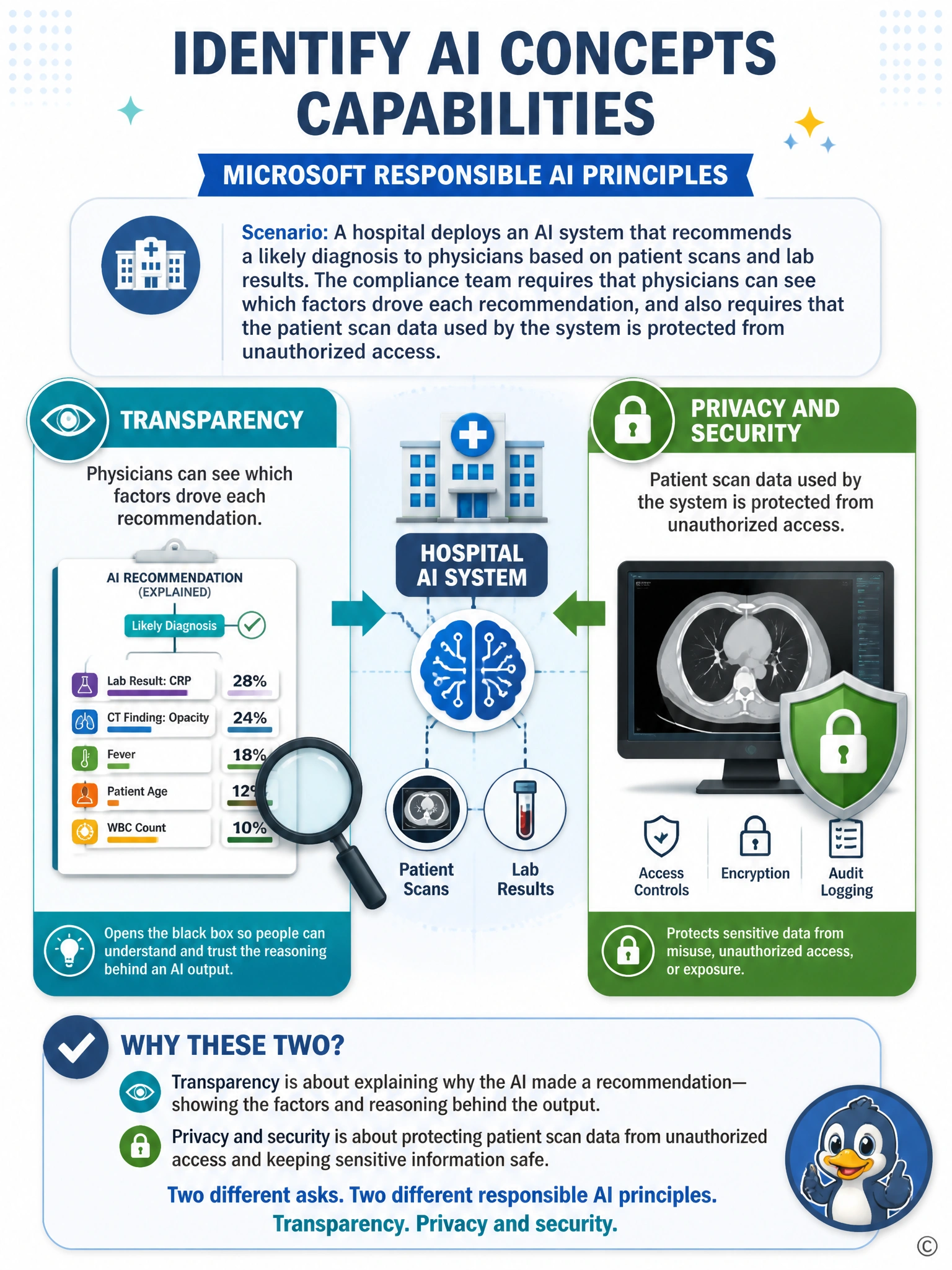
There are really two separate asks buried in this scenario, and each one maps to a different idea. Wanting physicians to see why the system landed on a particular recommendation is about opening up the black box so people can understand and trust the reasoning behind an output. Wanting patient scan data locked down from anyone who should not see it is a completely different concern, about keeping sensitive information safe from misuse or exposure. Together those are the two principles being tested, and they do not overlap with the other choices offered. One of those other choices is about making sure a system works well for people of different abilities and backgrounds during design, which is not mentioned anywhere in this hospital scenario. The other is about the system holding up reliably and safely under normal and unusual conditions, which would apply if the concern were about the system crashing or misdiagnosing under stress, not about explaining outputs or guarding data. Separate the explain-why requirement from the protect-the-data requirement and you land on the right pair.
Full Explanation
The correct answers are A and D. The requirement that physicians can see which factors drove each recommendation is about making the system's decision-making understandable to the people relying on it, which is the transparency principle, since it calls for openness about how and why an AI system reaches its outputs. The requirement that patient scan data is protected from unauthorized access is about safeguarding sensitive information, which is the privacy and security principle, since it addresses protecting data and system integrity from misuse or breach. Option B is incorrect because inclusiveness concerns designing and building systems that engage people of varying abilities and backgrounds, which is not what either requirement in the scenario describes. Option C is incorrect because reliability and safety concerns whether the system performs consistently and correctly under expected and unusual conditions, such as handling edge cases without failure, and neither requirement here is about the system's operational robustness; one is about explaining outputs and the other is about protecting data access. Matching each compliance requirement to its underlying goal, explainability to transparency and data protection to privacy and security, is what separates the two correct principles from the two distractors that describe unrelated concerns.