
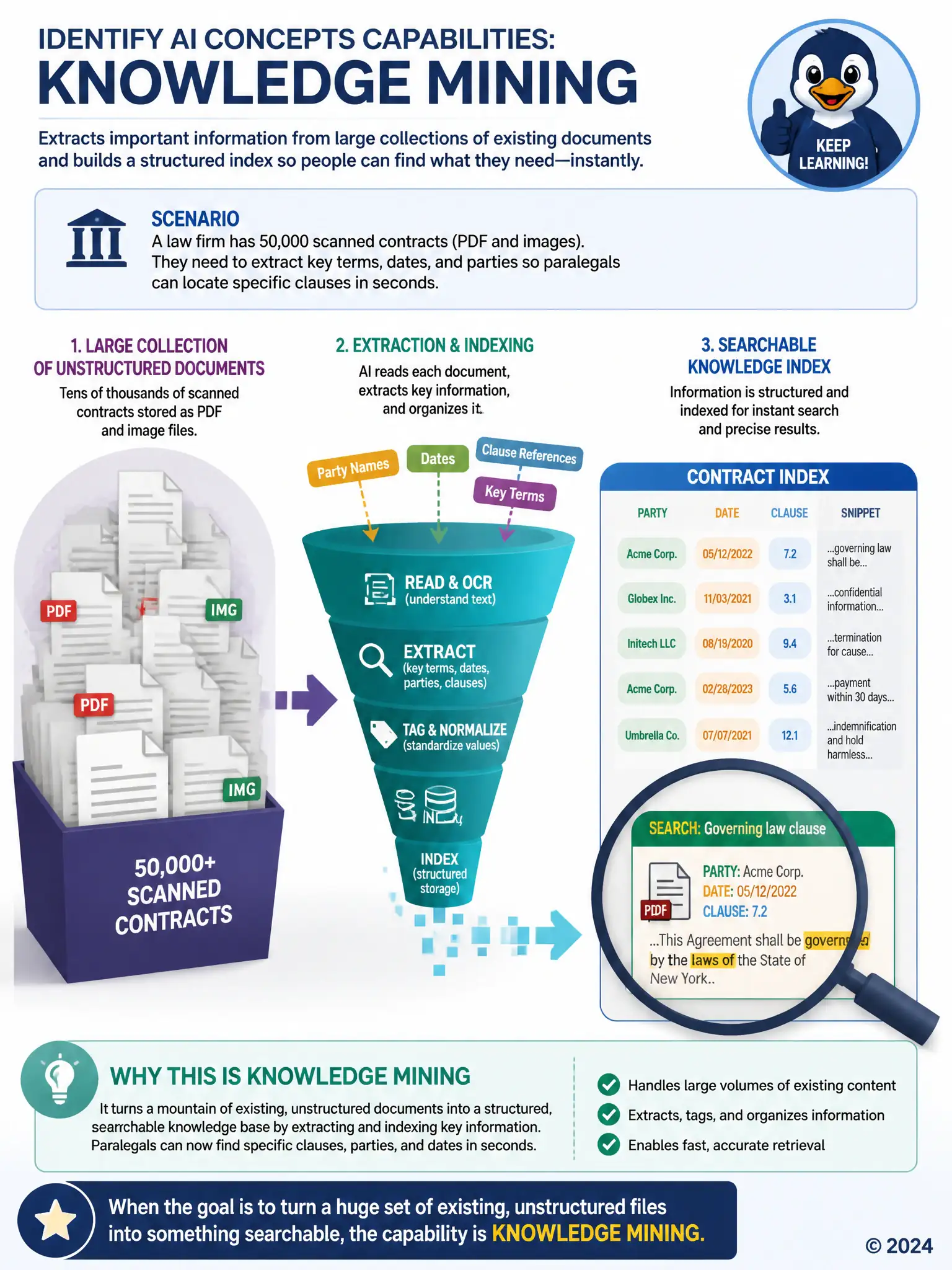
A law firm has 50,000 scanned contracts stored as PDF and image files and wants to build a searchable index that extracts key terms, dates, and parties from each document so paralegals can locate specific clauses in seconds. Which AI capability addresses this need?
Select an answer to reveal the explanation.
Short Explanation
You need knowledge mining because it pulls names, dates, and key terms out of 50,000 scanned contracts and indexes them for fast search. Generative AI creates new content, conversational AI chats, and regression predicts numbers, so none of them solve the extraction-and-indexing job.
Full Explanation
Knowledge mining is the capability designed to pull structured, searchable information such as names, dates, and key terms out of large volumes of unstructured or semi-structured content, including scanned PDFs and images, and organize it into an index that people can query quickly, which is exactly what the firm needs to help paralegals find clauses across 50,000 contracts. The generative AI option is incorrect because generative AI focuses on producing new content, such as drafting text or summaries, rather than extracting and indexing existing information from a large document repository for search purposes. The conversational AI option is incorrect because conversational AI is about carrying on a dialogue with a user through chat or voice, and while a search interface could later be layered with a chat experience, the core task described here, extracting and indexing terms across a document set, is knowledge mining rather than conversation. The regression option is incorrect because regression is a machine learning technique for predicting a continuous numeric value, such as a price or a quantity, and has nothing to do with extracting terms from scanned documents. The combination of a large unstructured document collection and the goal of fast, structured search is the clearest indicator that this scenario calls for knowledge mining.