
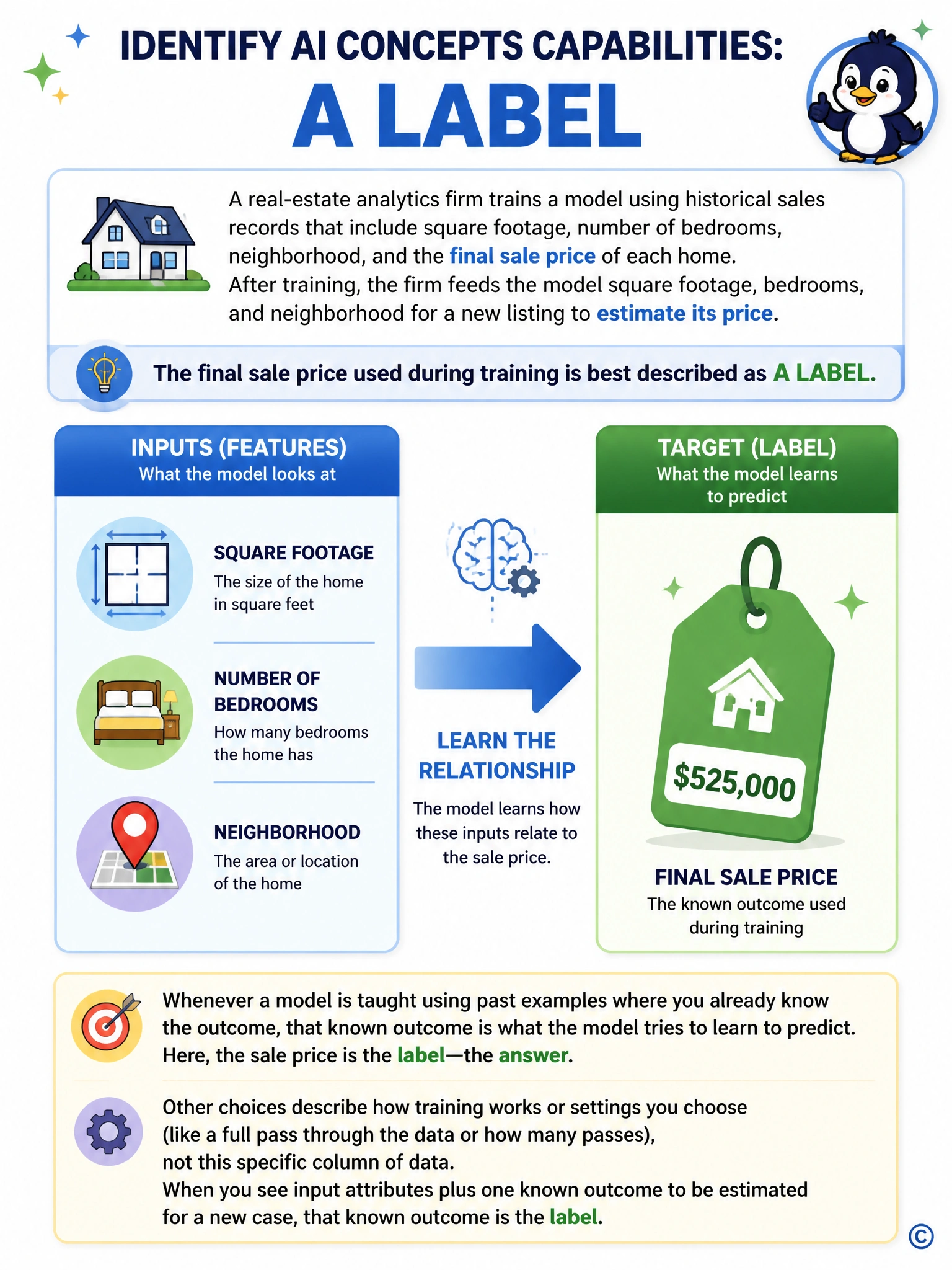
A real-estate analytics firm trains a model using historical sales records that include square footage, number of bedrooms, neighborhood, and the final sale price of each home. After training, the firm feeds the model square footage, bedrooms, and neighborhood for a new listing to estimate its price. In this setup, the final sale price used during training is best described as which of the following?
Select an answer to reveal the explanation.
Short Explanation
Whenever a model is being taught using past examples where you already know the outcome, that known outcome is what the model is trying to learn to predict, and here that is the sale price. Everything else about the house, its size, bedroom count, and neighborhood, is what the model looks at to make its guess, not what it is guessing. Two of the other choices are really about how training works mechanically rather than about this specific column of data. One refers to a full lap through the training data during the learning process, which is a training-loop concept, not a description of the price column. Another refers to a setting the person building the model dials in ahead of time, like how many passes to run, which again is unrelated to a value pulled from historical records. So when you see a scenario listing input attributes plus one known outcome that the model is later asked to estimate for a new case, the known outcome is the piece being learned, and that is the role the sale price plays here.
Full Explanation
The correct answer is D. The sale price is the value the model is being trained to predict, and in supervised machine learning the known outcome attached to each historical example is called the label; the model learns the relationship between the other attributes and this label so it can predict it for new, unseen listings. Option A is incorrect because square footage, bedrooms, and neighborhood are the inputs used to make the prediction, which are the features, while sale price plays the opposite role as the target being predicted rather than an input describing the property. Option B is incorrect because an epoch refers to one complete pass of the training algorithm through the entire training dataset during the learning process, a concept about training iterations, not about what a specific data column represents. Option C is incorrect because a hyperparameter is a setting configured before training begins, such as how many training passes to run or how quickly the model adjusts, and it is chosen by the person building the model rather than being a value drawn from the historical sales records themselves. Recognizing that the model is being taught to output sale price from the other attributes is what identifies sale price as the label in this supervised learning task.