
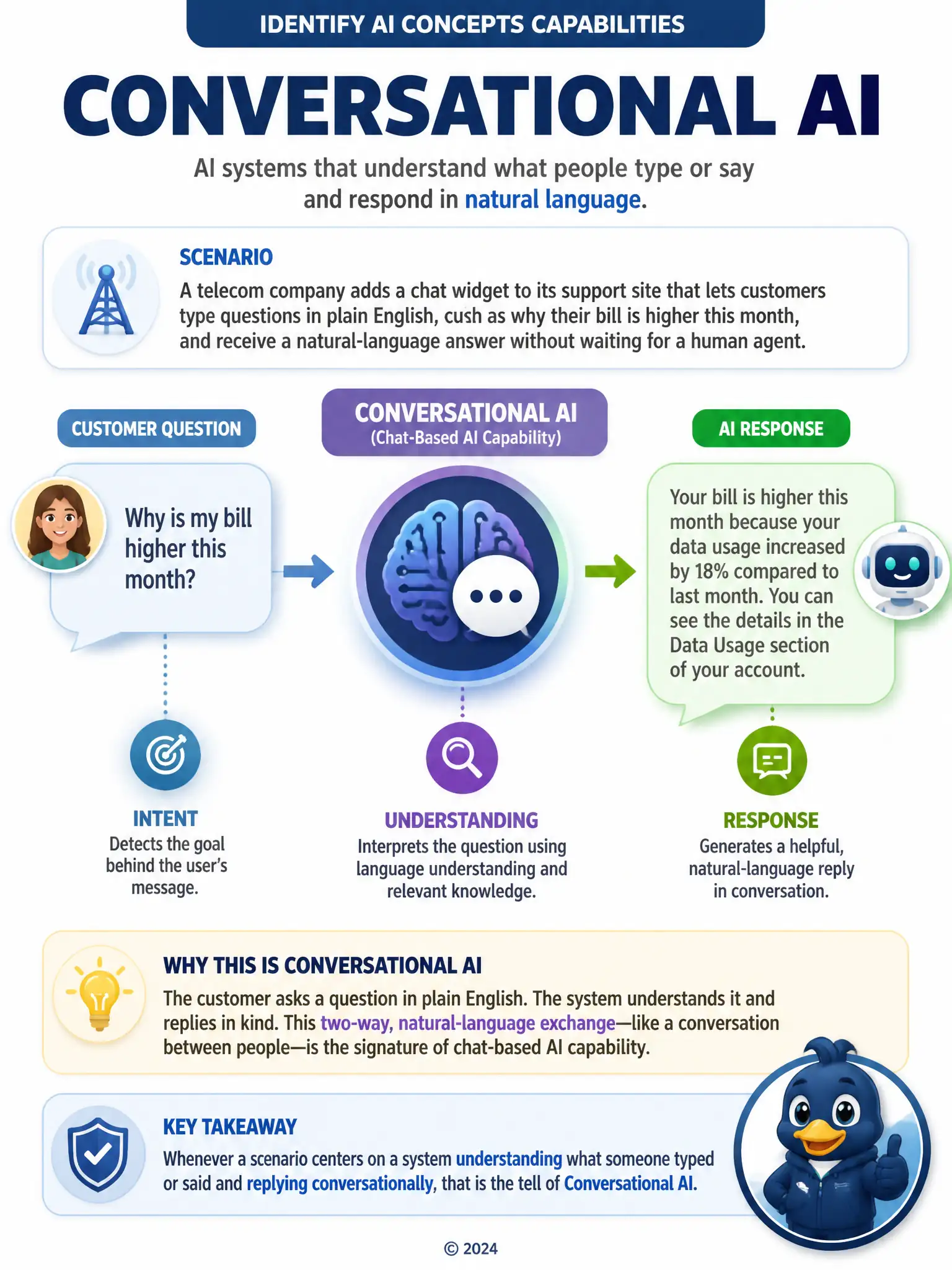
A telecom company adds a chat widget to its support site that lets customers type questions in plain English, such as why their bill is higher this month, and receive a natural-language answer without waiting for a human agent. Which AI capability is this chat widget primarily demonstrating?
Select an answer to reveal the explanation.
Short Explanation
You're looking at a system that takes a plain-English question and replies in natural language, so it's holding up its end of a conversation. That live, two-way chat exchange is conversational AI. The other capabilities don't involve talking with a customer.
Full Explanation
The correct capability is conversational AI. The widget accepts free-form written questions and responds in natural language, carrying on an interactive exchange with the customer, which is the defining trait of conversational AI, a capability built to understand user intent and generate humanlike dialogue in real time. Computer vision is incorrect because it processes images or video, and no visual input is involved in a customer typing a question into a text box. Knowledge mining is incorrect because it extracts and indexes information from large sets of existing documents or records so it can be searched, which is a different task from generating a live conversational response to a specific customer's question. Anomaly detection is incorrect because it identifies unusual patterns in data, such as a spike in network errors, and has nothing to do with answering a customer's billing question through dialogue. The key signal in the stem is the back-and-forth exchange in natural language between the customer and the system, which is precisely what conversational AI is designed to handle, distinguishing it from workloads that process images, search document repositories, or watch for unusual data patterns.