
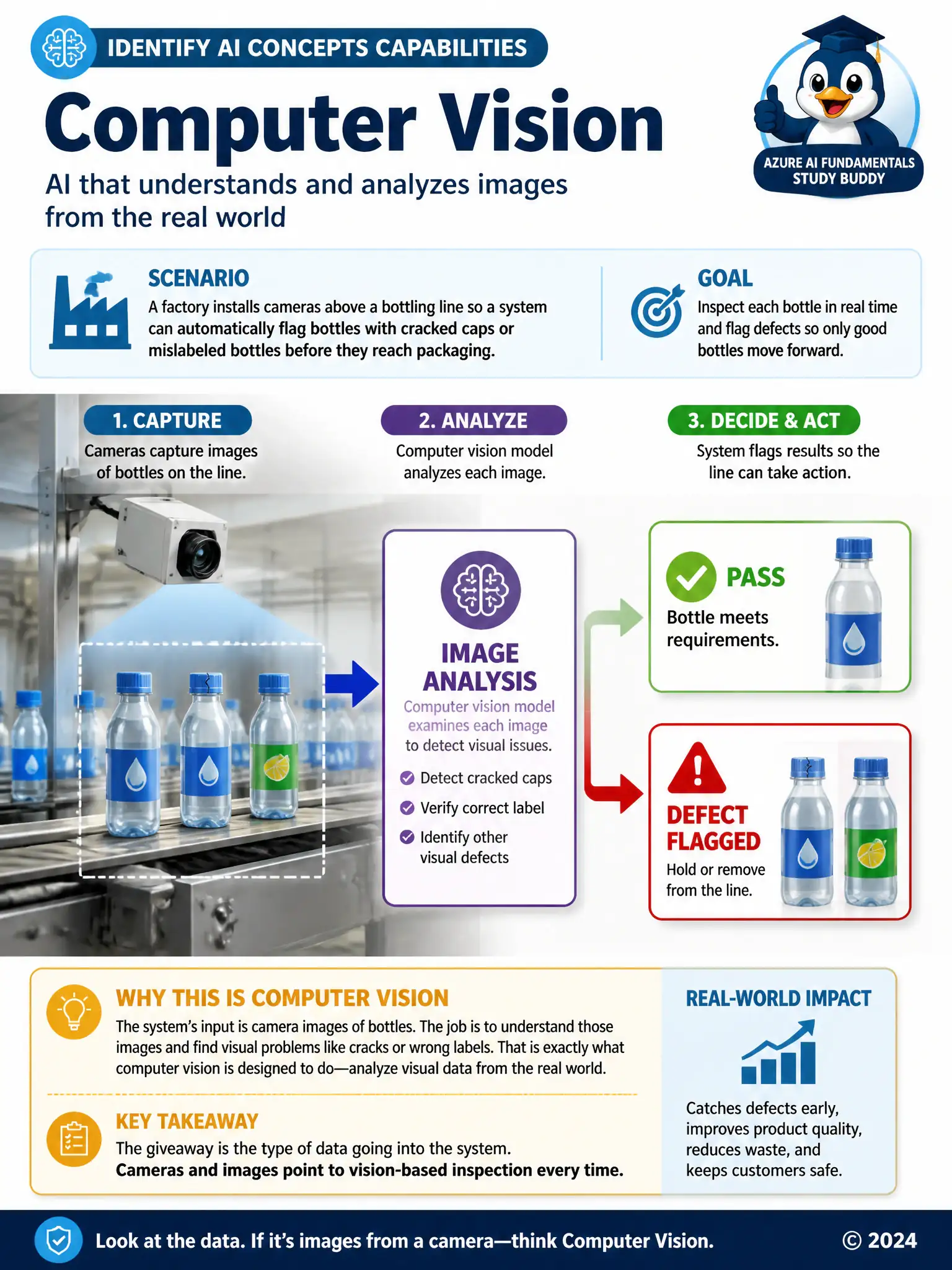
A factory installs cameras above a bottling line so a system can automatically flag bottles with cracked caps or mislabeled bottles before they reach packaging. Which AI workload category best fits this system?
Select an answer to reveal the explanation.
Short Explanation
Think about what the system sees: camera pictures of bottles. If the job is spotting cracked caps or label flaws from images, that's computer vision. The other workloads don't match because they handle language, documents, or chat—not live visual inspection.
Full Explanation
The correct answer is Computer vision. The system analyzes images captured by cameras to detect physical defects like cracked caps and label errors, which is the core task of computer vision, specifically object detection and image classification applied to a production line. The natural language processing option is incorrect because natural language processing works with text or speech, and nothing in this scenario involves reading or generating language. The knowledge mining option is incorrect because knowledge mining extracts structured information from large collections of documents or content repositories, not from a live video feed of physical objects. The conversational AI option is incorrect because conversational AI powers chatbots and voice assistants that carry on a dialogue with a person, and this system never interacts with a human through conversation; it inspects bottles and raises an alert. The distinguishing detail in the stem is that the input is visual, images from cameras, and the task is identifying visible physical flaws, which maps directly to computer vision's ability to locate and classify objects or defects within an image. Recognizing that keyword pairing, visual input plus defect or object identification, is the fastest way to sort this workload correctly on the exam.