
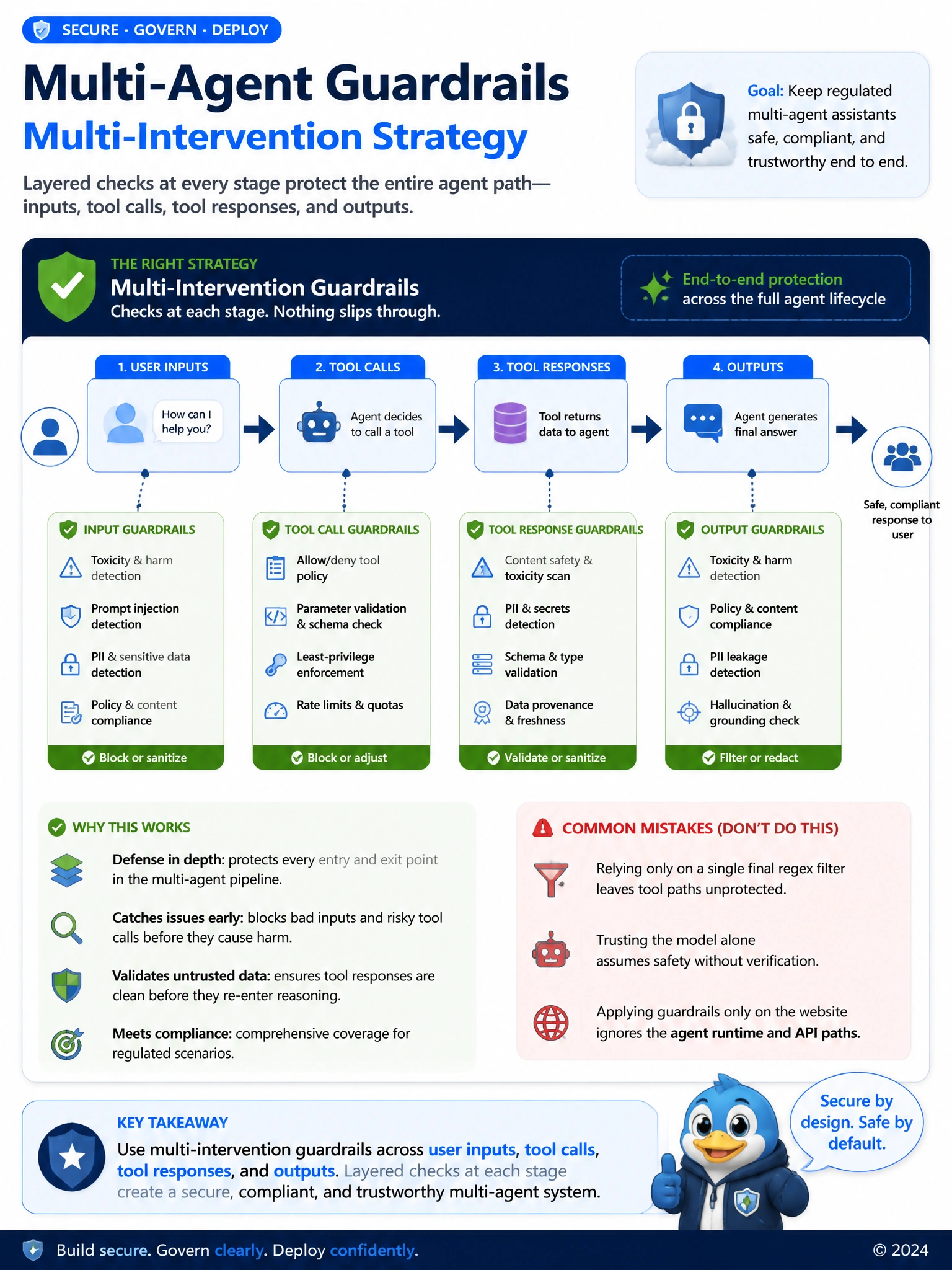
A regulated multi-agent assistant must block toxic user inputs, prevent disallowed tool calls, validate tool responses before they re-enter reasoning, and filter final answers for policy violations. What guardrail strategy matches this requirement?
Select an answer to reveal the explanation.
Short Explanation
Answer D. Guardrail design for multi-agent solutions is multi-intervention: inputs, tool calls, tool responses, and outputs. Single final-regex filters and model-trust-only approaches leave tool paths unprotected. Website-only guardrails ignore the agent runtime.
Full Explanation
Correct answer: D. Design multi-intervention guardrails so unsafe content cannot enter, unsafe tools cannot run, poisoned tool results cannot steer the agent, and unsafe answers cannot leave. Each stage may use different detectors (content safety, allowlisted tools, schema validation, output filters).
A is incomplete: final-only filtering misses malicious tool invocation and bad tool payloads.
B is incorrect: base models are not sufficient policy engines for regulated multi-agent systems.
C is incorrect: product marketing pages are outside the agent execution path that needs control.
Test guardrails with synthetic adversarial data and measure false positive/negative rates.