
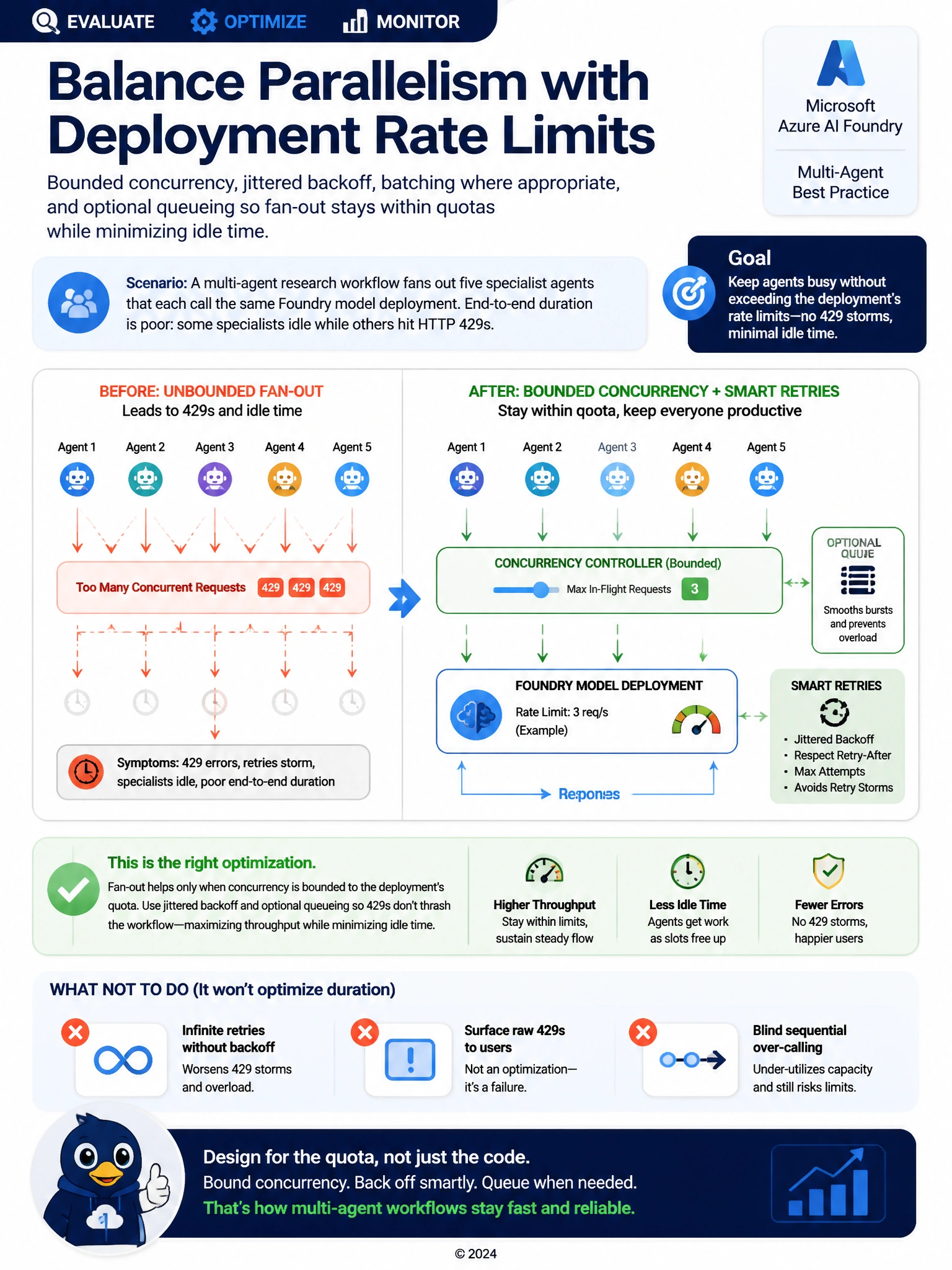
A multi-agent research workflow fans out five specialist agents that each call the same Foundry model deployment. End-to-end duration is poor: some specialists idle while others hit HTTP 429s. What optimization strategy should you apply first?
Select an answer to reveal the explanation.
Short Explanation
Answer C. Optimizing task duration includes parallelism and rate limits. Fan-out helps only when concurrency is bounded to the deployment’s quota, with backoff/queueing so 429s do not thrash the workflow. Infinite retries without backoff worsen storms. Surfacing raw 429s to users is not optimization. Blind sequential over-calling without control also fails duration goals.
Full Explanation
Correct answer: C. Multi-agent duration optimization must jointly consider parallel specialist work and platform rate limits. Use a concurrency governor aligned to tokens-per-minute and requests-per-minute, exponential backoff with jitter, and work queues. Batch similar sub-tasks when the API allows.
A is wrong: excessive sequential calling increases latency and still may hit limits; it also discards beneficial parallelism.
B is wrong: infinite zero-backoff retries amplify load and prolong outages.
D is wrong: rate-limit faults should trigger control-plane handling and user-safe fallbacks, not become the business answer.
Monitor queue depth, 429 rates, and p95 workflow duration together.