
An internal knowledge multi-agent system answers similar HR policy questions thousands of times per day. Token spend is high even though many user phrasings map to the same grounded answer. You need lower latency and cost without serving stale policy after documents change. Which caching strategy is most appropriate?
Select an answer to reveal the explanation.
Short Explanation
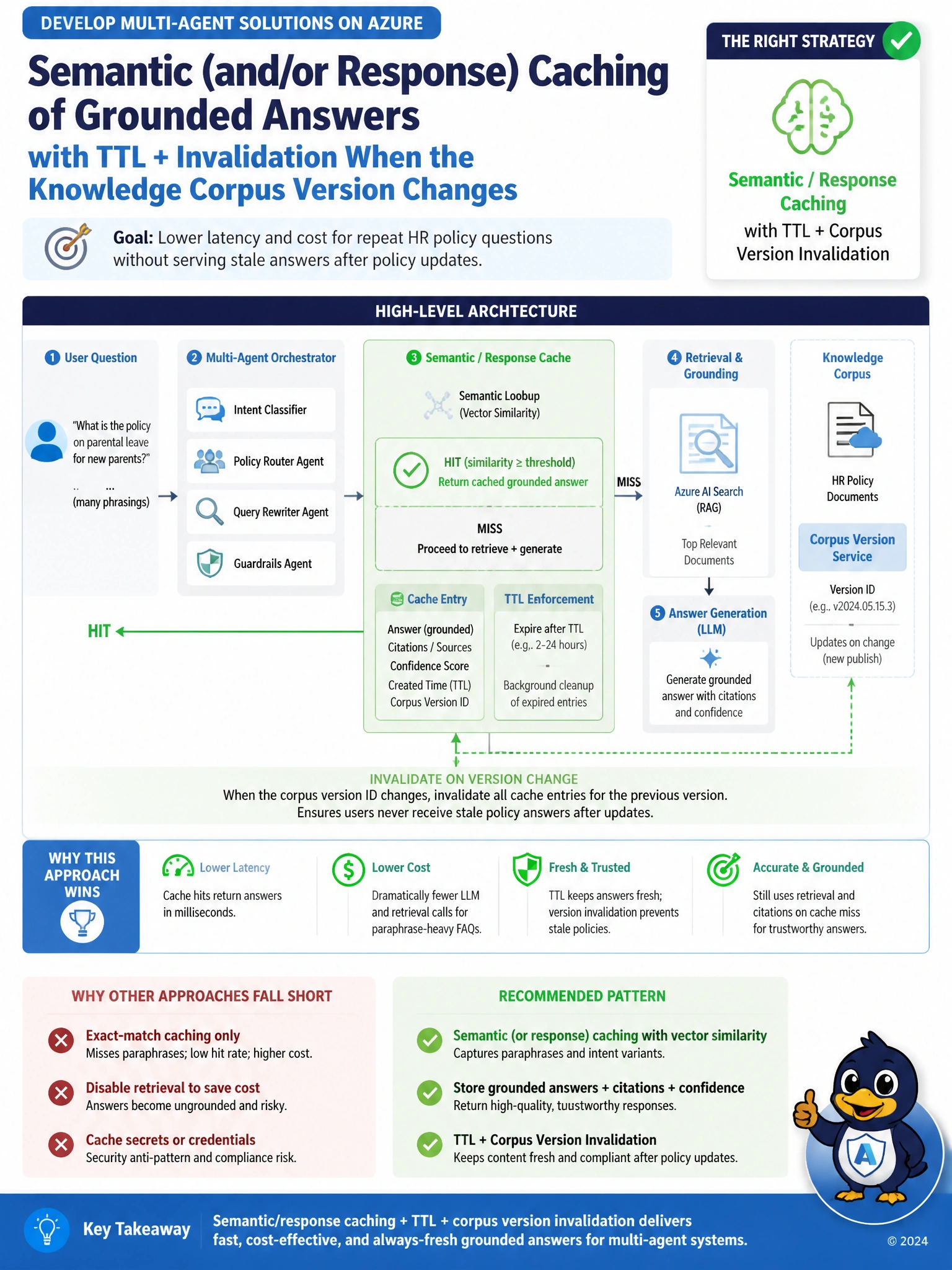
Answer B. Multi-agent solutions should design caching strategies that include prompt caching, semantic caching, and response caching. Semantic/response caches cut cost on paraphrase-heavy FAQs while TTL and corpus-version invalidation prevent stale HR policy. Exact-only caches miss paraphrases. Turning off retrieval hurts grounding. Caching credentials is a security anti-pattern.
Full Explanation
Correct answer: B. The develop domain calls out caching strategy: prompt caching, semantic caching, and response caching. For repetitive HR Q&A, embed the question (or normalized intent), look up a prior grounded answer, and return it when similarity exceeds a threshold—subject to TTL and knowledge-version keys so updates invalidate cache entries.
A is weaker: exact string matching fails on paraphrases that dominate real traffic and “never invalidate” guarantees stale policy.
C is wrong because pure parametric answers drop RAG grounding required for policy accuracy.
D is wrong and unsafe: secrets must never live in answer caches; use proper identity systems.
Also consider per-tenant cache keys to preserve isolation in multi-tenant Foundry deployments.