
Before promoting a multi-agent Foundry solution from test to production, the security team wants automated adversarial probing of prompts, tool misuse, and jailbreaks as part of CI—not only annual pen tests. Which approach best applies shift-left security for this solution?
Select an answer to reveal the explanation.
Short Explanation
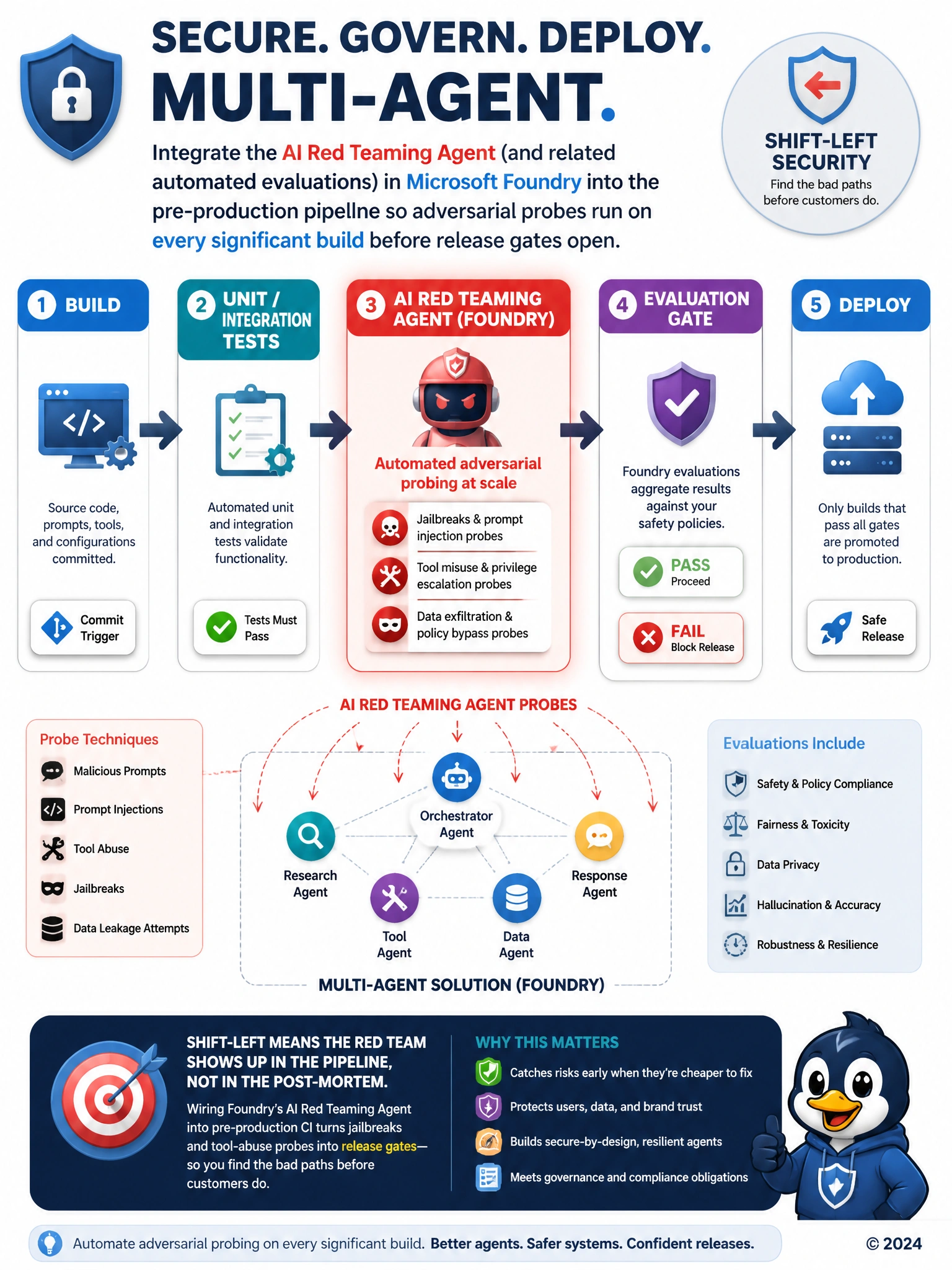
Correct answer: A. Shift-left means the red team shows up in the pipeline, not in the post-mortem. Wiring Foundry’s AI Red Teaming Agent into pre-production CI turns jailbreaks and tool-abuse probes into release gates—so you find the bad paths before customers do.
Full Explanation
Shift-left security for multi-agent solutions includes automated adversarial testing early in the SDLC. Microsoft Foundry provides an AI Red Teaming Agent (and evaluation capabilities) intended to probe agentic systems for jailbreaks, prompt injection, and unsafe tool use. Option A is correct because it integrates those probes into pre-production CI with release gating.
Option B is incorrect: provider-level content filters are necessary but insufficient for multi-agent tool chains, custom prompts, and domain policies.
Option C is incorrect because post-go-live manual workshops without blocking gates fail shift-left and leave production exposed until remediation eventually lands.
Option D is incorrect and dangerous: unauthenticated public staging invites real attackers and data exposure without structured findings or consent frameworks.
Exam tip: Associate “shift-left” + Foundry multi-agent security with AI Red Teaming Agent / automated evaluations in CI, not only annual pen tests.