
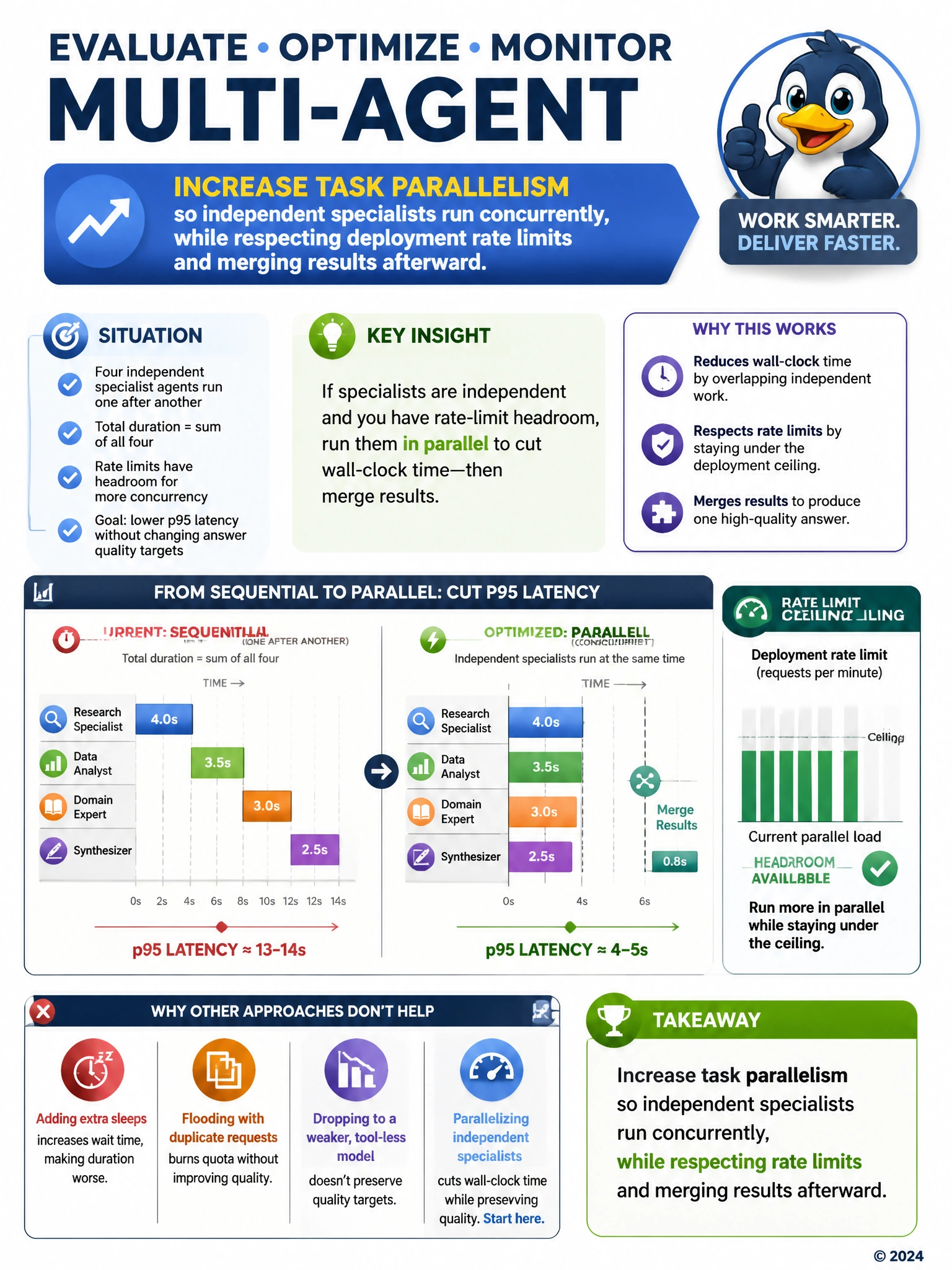
A multi-agent research workflow currently runs four independent specialist agents one after another; total duration is the sum of all four. Model deployment rate limits still have headroom for higher concurrency. Product requires lower p95 latency without changing answer quality targets. What optimization should the team apply first?
Select an answer to reveal the explanation.
Short Explanation
If specialists are independent and you still have rate-limit headroom, parallelize to cut wall-clock time—then merge. Extra sleeps make duration worse. Flooding duplicates burns quota without quality gain. Dropping to a weaker tool-less model is not a latency optimization that preserves quality. A is the task-duration optimization.
Full Explanation
Correct answer: A. Optimizing task duration for multi-agent solutions includes parallelism and rate-limit awareness. Independent specialists should run concurrently when dependencies allow, constrained by deployment quotas, with aggregation of outputs.
B is incorrect because artificial serialization increases latency.
C is incorrect because duplicate flooding wastes tokens and risks throttling without improving useful work.
D is incorrect because shrinking capability may harm quality and does not specifically exploit available parallelism.
Exam focus: duration optimization = parallelize independent work under rate limits.