
A customer-service multi-agent system can draft refund decisions, but company policy requires that any refund over $500 must be approved by a human supervisor before the refund tool executes. Agents may still gather facts and draft the recommendation autonomously below that threshold. Which implementation best meets the requirement?
Select an answer to reveal the explanation.
Short Explanation
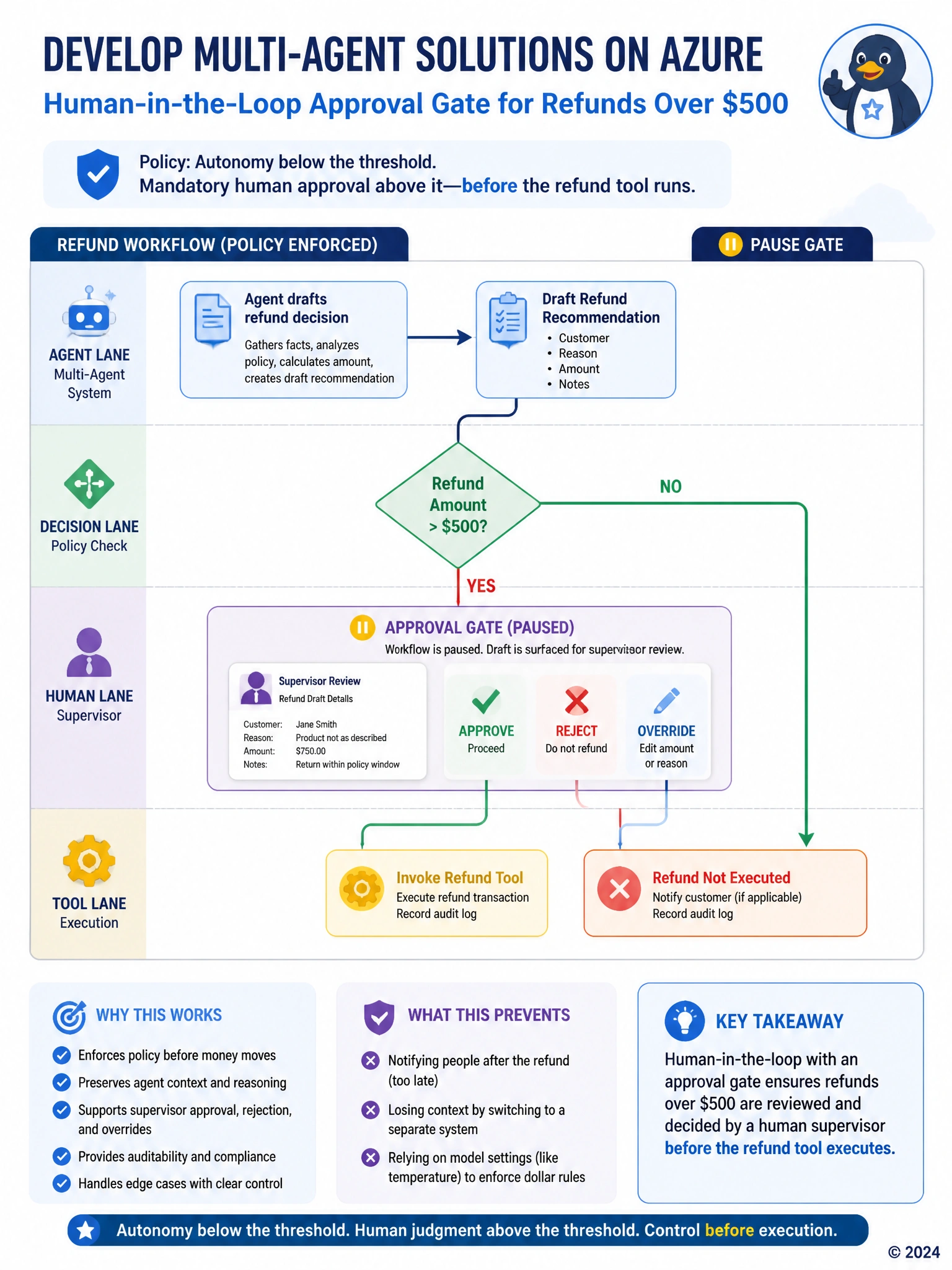
Policy is clear: autonomy below the threshold, mandatory human approval above it—before the tool runs. That is human-in-the-loop with an approval workflow, overrides, and edge-case handling. Notifying people after money leaves is audit theater, not control. Kicking every refund into a disconnected legacy app loses agent context and over-constrains small refunds. Temperature does not enforce dollar thresholds. B is the pattern that actually gates execution.
Full Explanation
Correct answer: B. Implementing multi-agent orchestration includes human-in-the-loop processes such as approval workflows, overrides, and edge-case handling. Conditional gates based on business thresholds (here, refund amount > $500) pause autonomous execution until a human decision is recorded, then proceed or cancel the tool call.
A is incorrect because post-facto notification does not prevent unauthorized high-value refunds.
C is incorrect because fully removing the tool and context from agents fails the dual requirement of autonomous handling below the threshold and assisted handling above it.
D is incorrect because temperature controls sampling randomness, not policy enforcement of monetary limits.
Exam focus: HITL approval is a control before side-effecting tools, conditioned on business rules.