
A global retailer needs multi-agent compute that scales for Black Friday traffic spikes, isolates noisy neighbor batches, meets reliability targets, and controls cost during quiet hours. Which compute specification direction best balances these concerns?
Select an answer to reveal the explanation.
Short Explanation
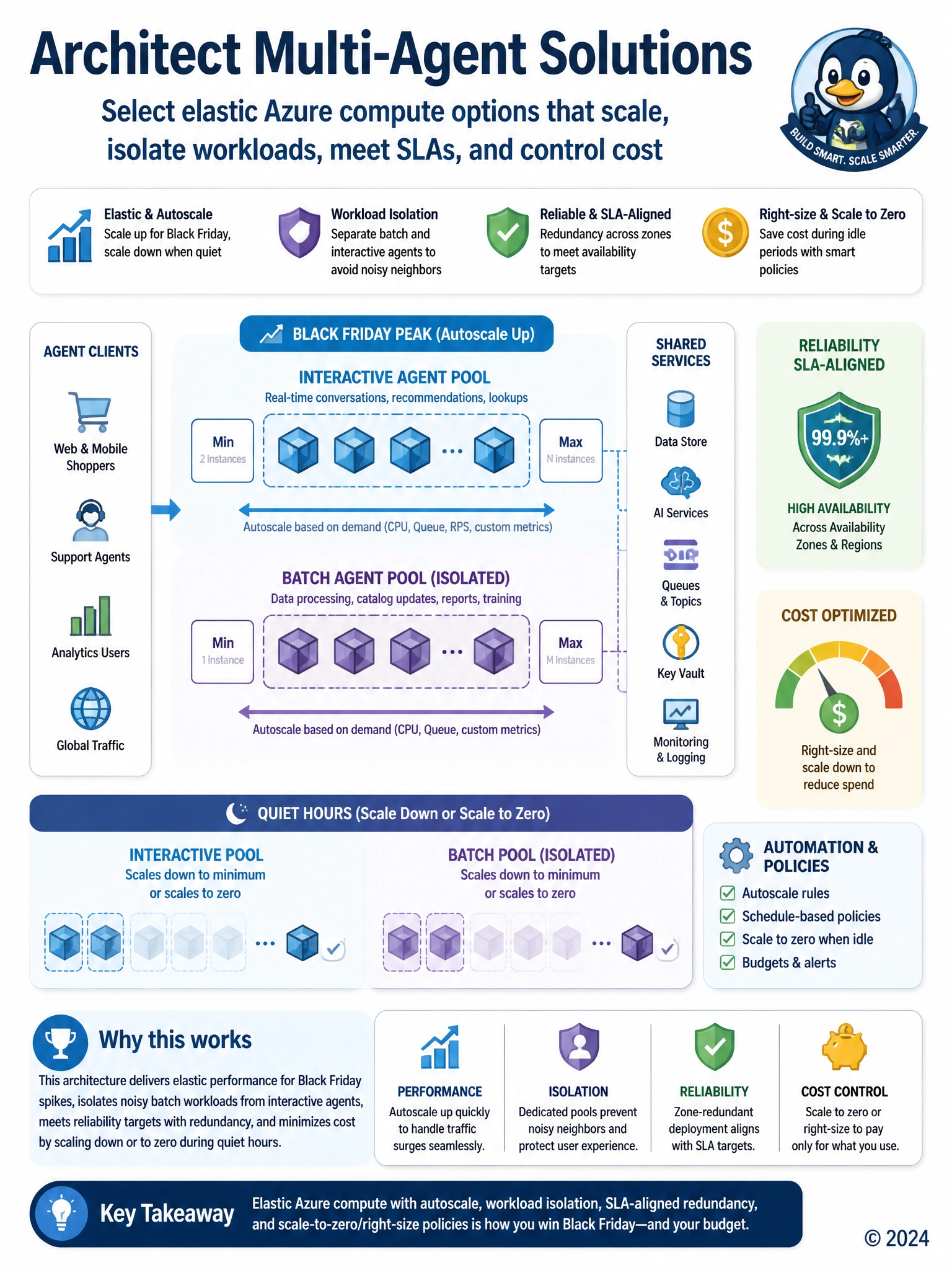
The correct answer is C. Elastic Azure compute with autoscale, isolation between batch and interactive agents, redundancy for SLAs, and right-size/scale-down when quiet is how you hit Black Friday and cost goals together. One fat VM neither isolates nor scales efficiently. Laptop and free-tier prod are not enterprise answers.
Full Explanation
Option C is correct. Technology component selection for multi-agent solutions includes compute that meets scalability, reliability, operational efficiency, security, and cost requirements—typically elastic platform services with isolation and idle cost controls.
Option A is incorrect because a single static oversized VM wastes cost at idle, risks single-host failure, and offers poor noisy-neighbor isolation.
Option B is incorrect because developer laptops cannot meet global retail reliability, security, or capacity needs.
Option D is incorrect because unsupported free tiers lack enterprise SLA, security, and capacity guarantees.