
Six weeks after launch, a multi-agent HR policy assistant still passes its original pre-release evaluation suite, but employees report that answers have become more verbose, less actionable, and occasionally cite retired policy versions after knowledge-base updates. Which monitoring strategy best closes this gap?
Select an answer to reveal the explanation.
Short Explanation
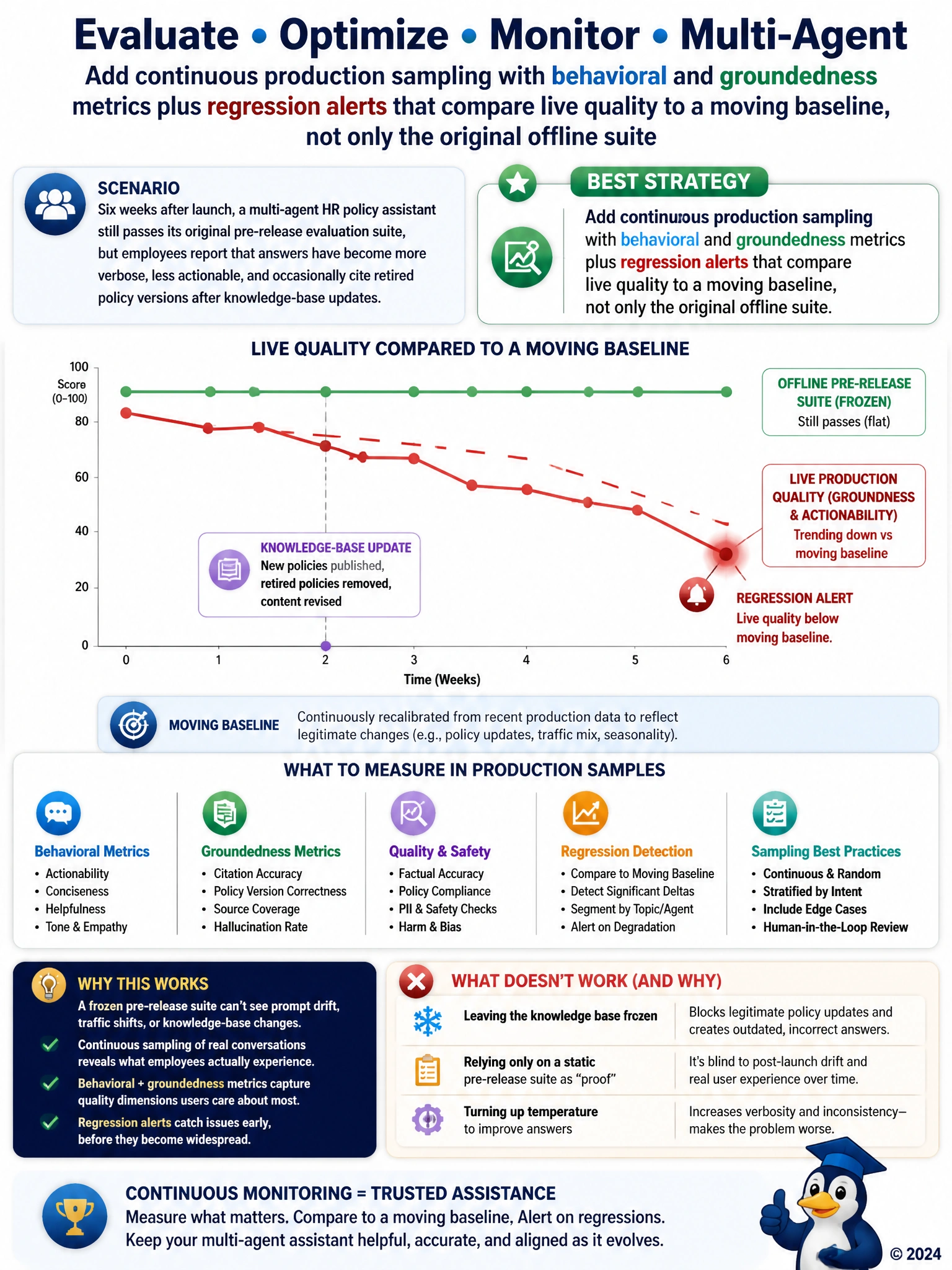
The correct answer is C. A frozen pre-release suite cannot see what happens after knowledge-base edits and six weeks of prompt and traffic drift. You need continuous sampling of live conversations, metrics for behavior and groundedness, and alerts when live quality moves off a baseline. Leaving the KB frozen forever blocks legitimate policy updates. Treating a static suite as proof ignores employee reality. Raising temperature makes verbosity and inconsistency worse, not better.
Full Explanation
Option C is correct. Evaluate/monitor guidance for multi-agent systems includes behavioral drift and quality regression detection against production traffic. Offline suites are necessary but insufficient when indexes, policies, and usage patterns change after launch. Continuous sampling with groundedness and behavioral metrics plus regression alerts detects silent degradation while the original suite still passes.
Option A is incorrect because freezing knowledge indefinitely prevents required policy updates and is not a monitoring strategy.
Option B is incorrect because a static suite that does not reflect new documents or live distributions can remain green while user-visible quality declines.
Option D is incorrect because higher temperature increases randomness and often worsens verbosity and inconsistency; it does not monitor or correct grounding to current policies.