
You are implementing multi-agent RAG for a legal discovery suite. A Searcher agent retrieves passages; an Analyst agent reasons over them. Early tests show poor retrieval precision and lost clause boundaries. Which RAG design change best addresses embedding quality and retrieval precision?
Select an answer to reveal the explanation.
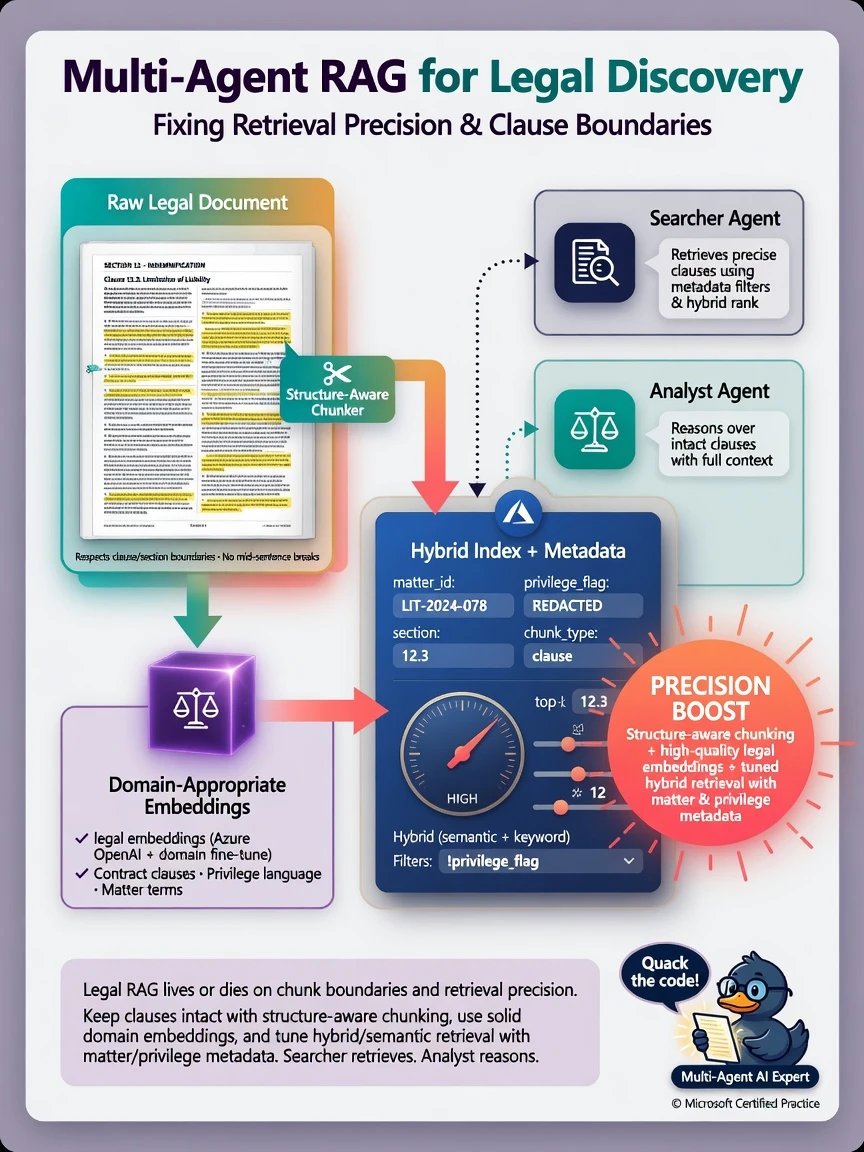
Short Explanation
Legal RAG lives or dies on chunk boundaries and retrieval precision. Keep clauses intact with structure-aware chunking, use solid embeddings, and tune hybrid/semantic retrieval with matter/privilege metadata. Searcher retrieves; Analyst reasons. Option A. Tiny 20-token shards (B) shred meaning. Titles-only (C) under-retrieves. Stuffing whole folders (D) is not multi-agent RAG and will not scale.
Full Explanation
Multi-agent RAG architecture skills include chunking, embedding quality, and retrieval precision. Option A improves each dimension and preserves privileged-matter controls via metadata filters.
Option B destroys semantic units critical in legal text.
Option C yields high precision only on titles while missing operative clause content.
Option D abandons retrieval architecture, blows context limits, and increases cost/latency.
Exam tip: Specialist retrieval agents still need a high-quality index design underneath the orchestration.