
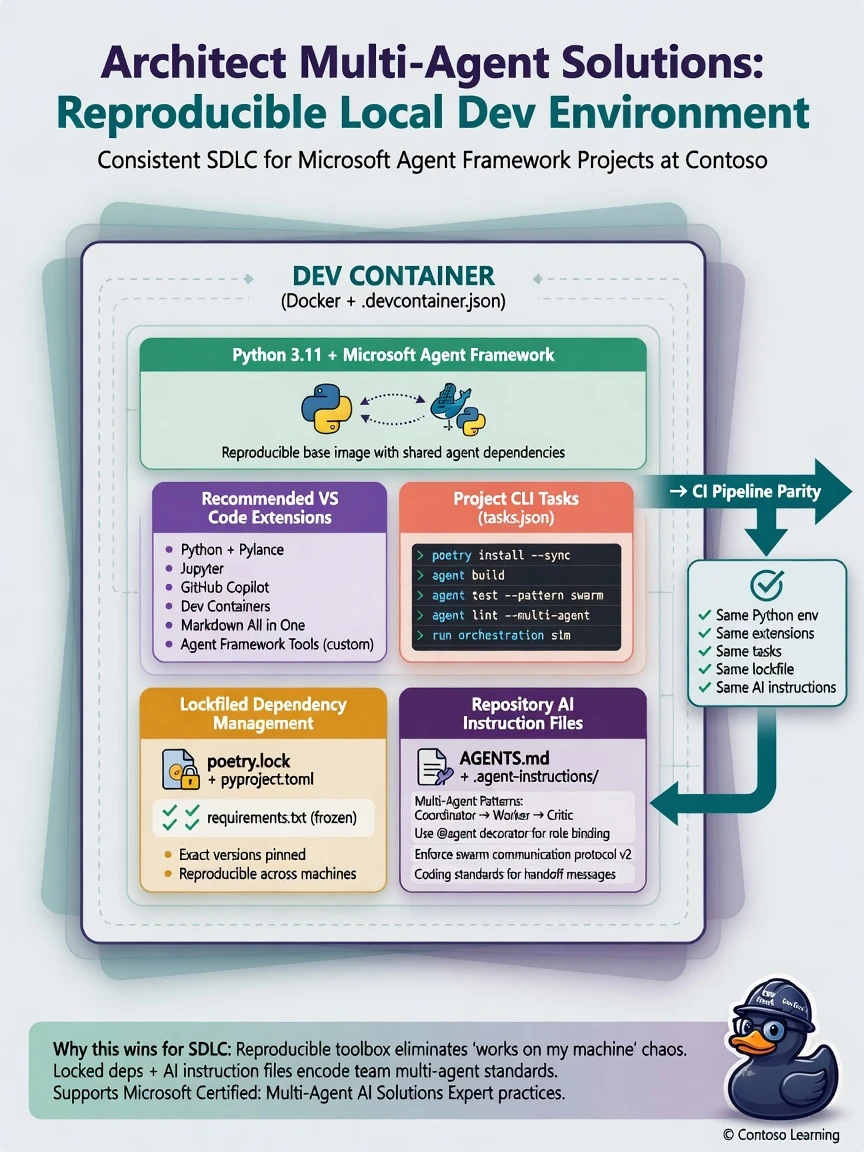
A multi-agent engineering team at Contoso wants consistent local development for Microsoft Agent Framework projects, including shared Python dependencies, VS Code extensions, CLI tooling, and checked-in AI coding instructions for agent patterns. Which technology-component specification best supports the SDLC?
Select an answer to reveal the explanation.
Short Explanation
SDLC for agent systems needs a reproducible toolbox. Option B is the package: dev containers, VS Code extensions, CLI workflows, locked dependencies, and AI instruction files that teach the team’s multi-agent patterns. Chaos installs (A) create “works on my machine.” Production-only portal editing (C) kills proper engineering. Putting secrets in AI instructions (D) is a security anti-pattern.
Full Explanation
AI-500 includes specifying developer tools and environments for the SDLC: dev containers, VS Code extensions, CLI, dependency management, and AI instructions. Option B covers those elements as a coherent engineering baseline.
Option A undermines reproducibility and CI parity.
Option C rejects modern software practice and prevents automated testing and code review.
Option D mixes guidance with secrets and risks credential leakage into prompts, logs, and repositories.
Exam tip: AI instructions belong in-repo for patterns and policies — never for secrets.