
Adventure Works is designing memory for a multi-agent project planning suite: a Planner agent, a Risk agent, and a Scheduler agent collaborate on long-running programs spanning weeks. Users expect same-session continuity, shared team decisions during a sprint, and recall of prior project outcomes months later with strict tenant isolation. Which multi-tier state design should the architect specify?
Select an answer to reveal the explanation.
Short Explanation
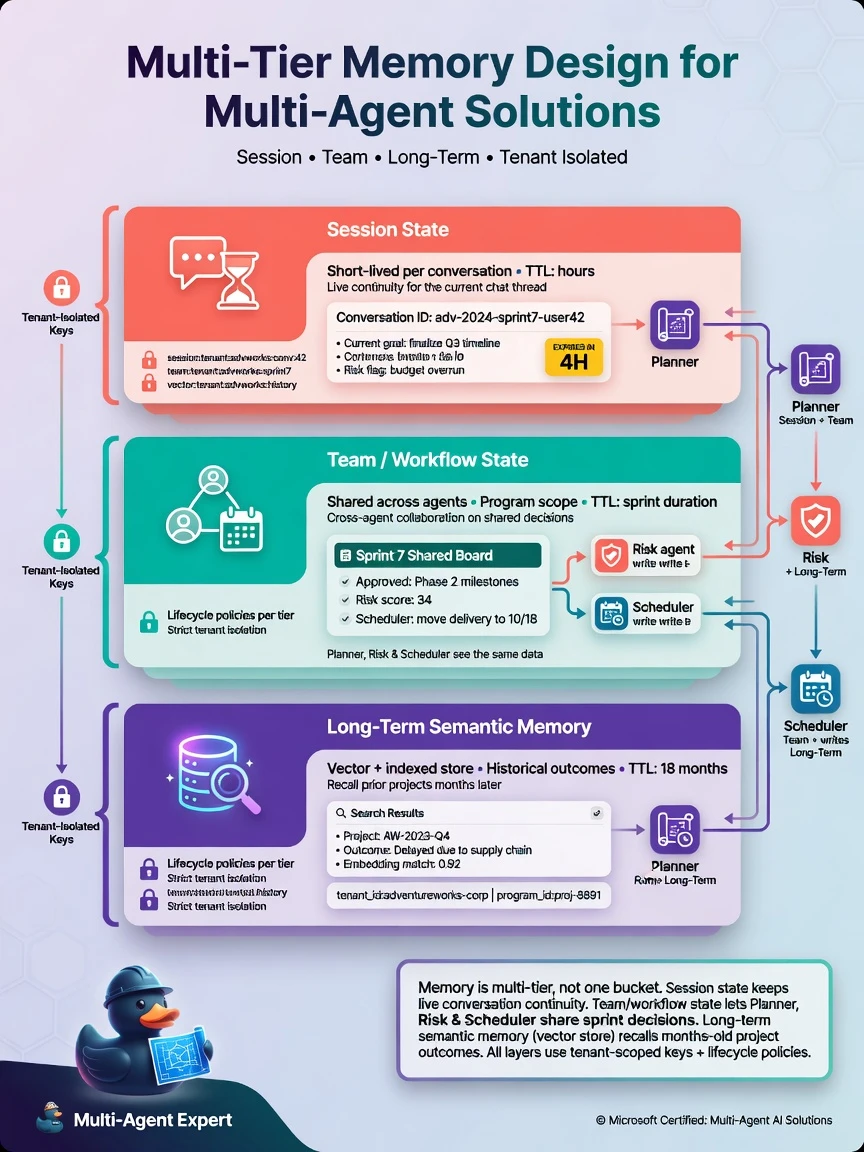
Memory is multi-tier, not one bucket. You need session state for the live conversation, shared team/workflow state so Planner/Risk/Scheduler see the same sprint decisions, and long-term semantic memory for months-old outcomes — all tenant-scoped with lifecycle rules. That is option D. One global Redis key (A) smashes isolation. Context-window-only (B) forgets across sessions and agents. Cookies plus email (C) is not an enterprise multi-agent state architecture.
Full Explanation
AI-500 requires multi-tier state persistence: session state, shared team state, and long-term semantic memory with lifecycle and tenant isolation. Option D maps directly to those tiers and policies.
Option A fails tenant isolation and mixes transient chat with durable enterprise knowledge in one unbounded store.
Option B ignores production requirements for long-running programs; context windows cannot hold weeks of multi-agent collaboration reliably.
Option C is operationally fragile, non-queryable at scale, and unsuitable for controlled semantic recall or compliance lifecycle.
Design notes: session state may live in conversation stores with short TTL; team state may be workflow/program-scoped documents; long-term memory typically uses embeddings plus metadata filters (tenant, project, ACL). Clear write rules prevent agents from polluting shared memory with unverified drafts.
Exam tip: If the stem mentions session + team collaboration + months-later recall, pick the three-tier memory answer.