
Fabrikam Finance is designing three agents for invoice processing: IntakeAgent (parse invoices), MatchingAgent (3-way match PO/receipt/invoice), and PaymentAgent (initiate payment). Compliance requires that no agent may release payments above $25,000 without a finance manager approval. How should the architect specify autonomy levels and behavioral guidelines?
Select an answer to reveal the explanation.
Short Explanation
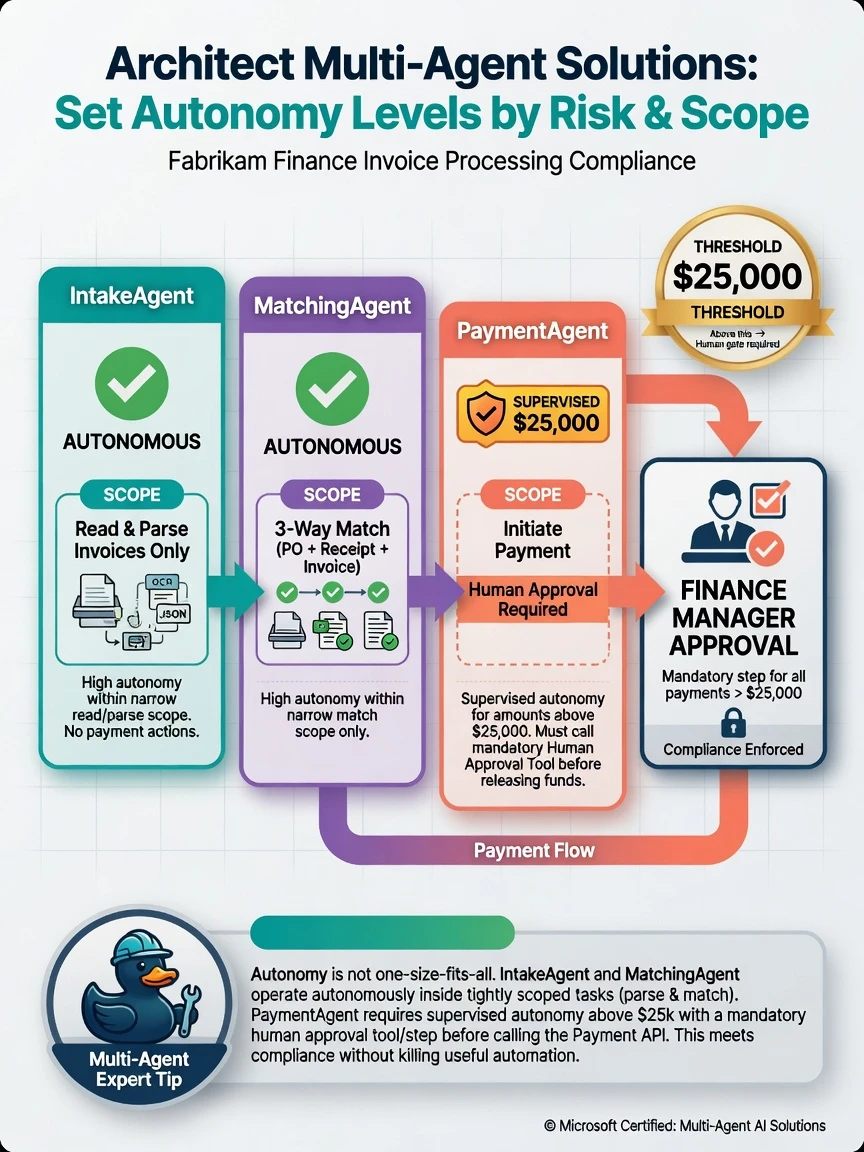
Autonomy is not one-size-fits-all. Intake and matching can run with high autonomy inside narrow scopes; payment is different. Option B is right: PaymentAgent is supervised above $25k and must call a human approval step before any release, while the other agents stay autonomous only for parse and match. Full autonomous payment for everyone (A) fails compliance. Killing automation entirely (C) ignores the low-risk path. Letting MatchingAgent pay (D) confuses decision quality with authorization — matching is not payment authority.
Full Explanation
AI-500 expects architects to specify agent personas, scopes, boundaries, and autonomy levels explicitly. Option B correctly differentiates autonomy by risk: parse and match can be highly autonomous within read/compute scopes, while payment initiation above a monetary threshold requires supervised autonomy and a human-in-the-loop approval control.
Option A is wrong because post-payment audits do not prevent unauthorized high-value releases; they only detect issues after money moves.
Option C is wrong because removing PaymentAgent discards valid automation for low-value invoices that can safely auto-process under policy.
Option D is wrong because tool and authority scopes must be least-privilege. Matching accuracy does not confer payment rights; conflating analysis agents with action agents creates dangerous privilege concentration.
Exam tip: Autonomy levels should track blast radius — high financial impact actions default to supervised or constrained autonomy.