
Your DTAP pipeline promotes multi-agent configs (prompts, tool allowlists, model deployment references) as versioned artifacts. A production canary shows elevated tool-failure rates after promotion. What rollback design should already be in place?
Select an answer to reveal the explanation.
Short Explanation
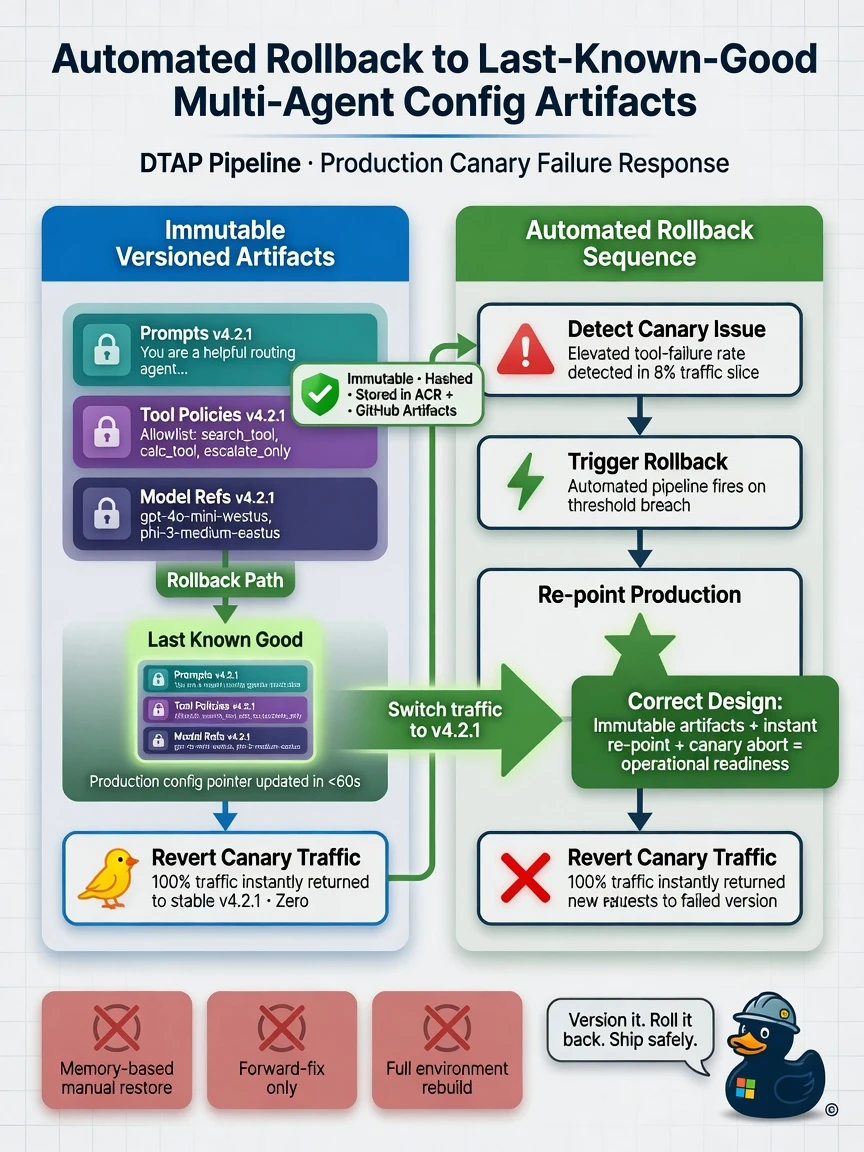
D is operational readiness. Multi-environment release strategies need rollback: immutable versions of prompts, tool policies, and model references, plus automated re-point to last known good and instant canary abort. Memory-based manual restore is unreliable. Forward-fix-only is ideology, not incident response. Rebuilding the whole environment is slow and unnecessary when configs are versioned. Design rollback before you need it.
Full Explanation
Correct Answer — D
Multi-environment strategies include rollback, release management, and rollout control. Versioned immutable artifacts for prompts, tool allowlists, and model references enable automated re-point to last known good and immediate canary reversion when tool failures spike.
Why A is wrong: Memory-based restore is error-prone and slow under incident pressure.
Why B is wrong: Refusing rollback increases customer impact when canaries fail.
Why C is wrong: Full environment rebuild is excessive when config re-point suffices.
Exam tip: Immutable agent config artifacts + automated last-known-good rollback.