
A healthcare multi-agent system must never recommend changing prescribed medications and must refuse diagnosis claims. Built-in generic safety filters help but do not encode this clinical policy. What should you add?
Select an answer to reveal the explanation.
Short Explanation
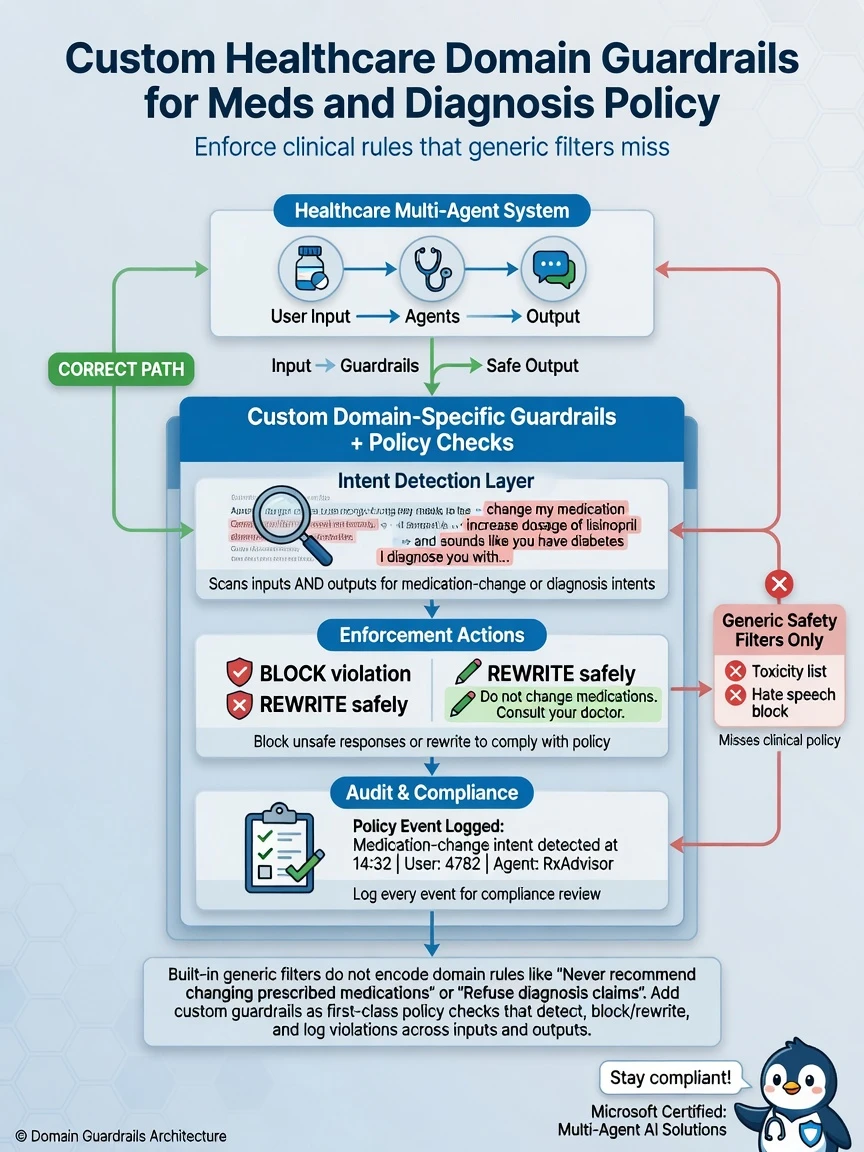
A is required. Custom guardrails capture domain-specific constraints beyond generic safety—here, no med changes, no diagnosis claims. Enforce on inputs and outputs, block/rewrite, and audit. Generic toxicity lists miss clinical policy. Fax retyping is not an automated guardrail architecture. Maximizing helpfulness against clinical policy is unsafe. Encode domain rules as first-class guardrails and tests.
Full Explanation
Correct Answer — A
You must design custom guardrails for domain-specific constraints. Healthcare medication and diagnosis policies need dedicated detection and enforcement on inputs/outputs with compliance logging—not only generic toxicity filters.
Why B is wrong: Generic lists do not encode clinical non-diagnosis / non-prescribing rules.
Why C is wrong: Manual fax retyping is not a scalable technical guardrail strategy.
Why D is wrong: Unrestricted advice violates clinical policy and responsible AI constraints.
Exam tip: Domain policy → custom guardrails + audit, not only stock filters.