
Operations reports that a multi-agent workflow’s quality slowly worsened over two weeks without a code deploy. Tool schemas are unchanged. You need a monitoring strategy that catches this class of failure and supports response. What should you design?
Select an answer to reveal the explanation.
Short Explanation
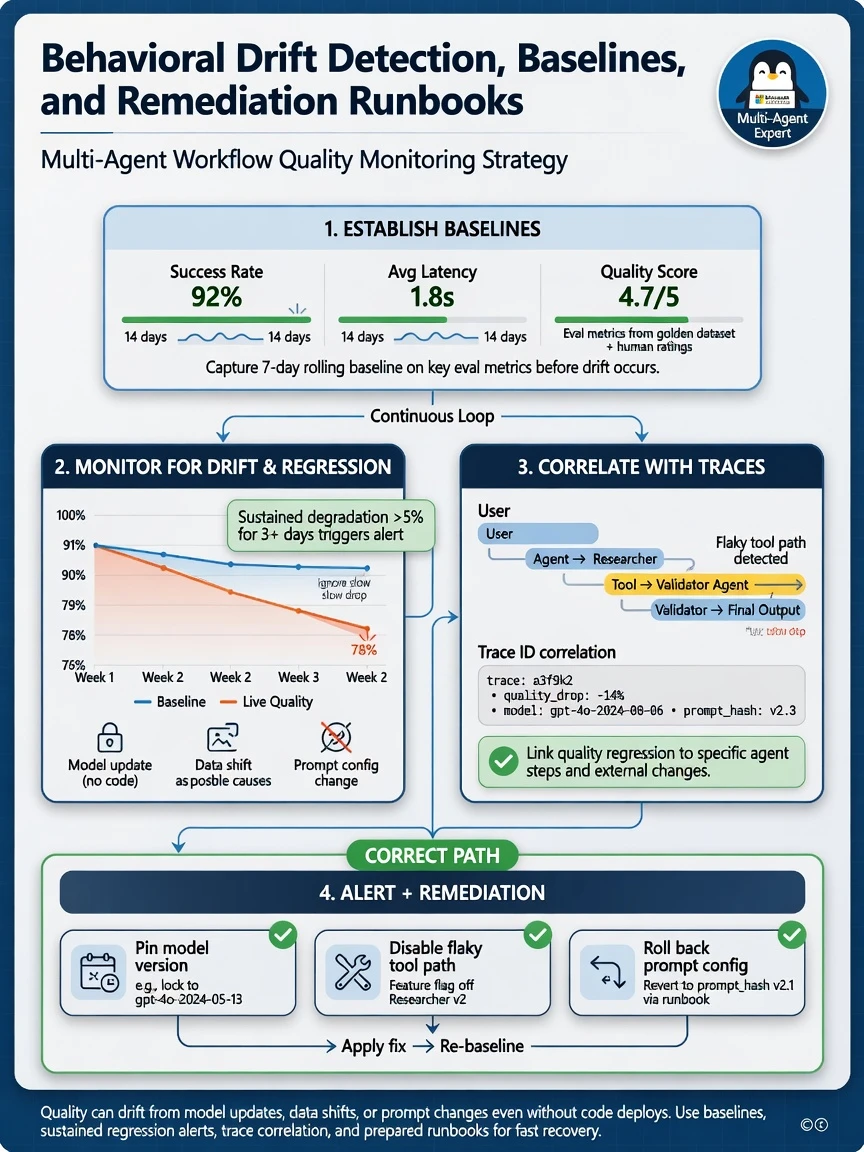
A is correct. Multi-agent reliability monitoring includes agent health, workflow failures, trace correlation, drift detection, quality regression, and remediation. Quality can drift from model updates, data shift, or prompt-config changes even without app code deploys. Baseline metrics, alert on sustained regression, use traces to diagnose, and have remediation ready—pin versions, feature-flag tools, roll back prompts. Region-down-only alerts miss silent quality death. Alerting on every success is noise. Design for drift as a first-class operational hazard.
Full Explanation
Correct Answer — A
Monitoring reliability for multi-agent solutions covers health, failures, trace correlation, drift detection, quality regression, and remediation. Slow quality loss without code deploys is classic behavioral drift; baselines, alerts, correlated traces, and predefined remediation actions are the appropriate strategy.
Why B is wrong: Platform outage alerts do not detect gradual quality regression.
Why C is wrong: Model, data, and config changes can shift behavior without application code commits.
Why D is wrong: Alerting on successes creates noise and hides real incidents.
Exam tip: Drift detection + baselines + remediation runbooks, not only infra uptime.