
An orchestrator agent hands work to three specialist agents over a long-running case. Each specialist appends full intermediate reasoning and raw tool dumps into a shared conversation buffer. After several hops, agents begin dropping earlier constraints and contradicting prior decisions. Which approach best implements context management between agents?
Select an answer to reveal the explanation.
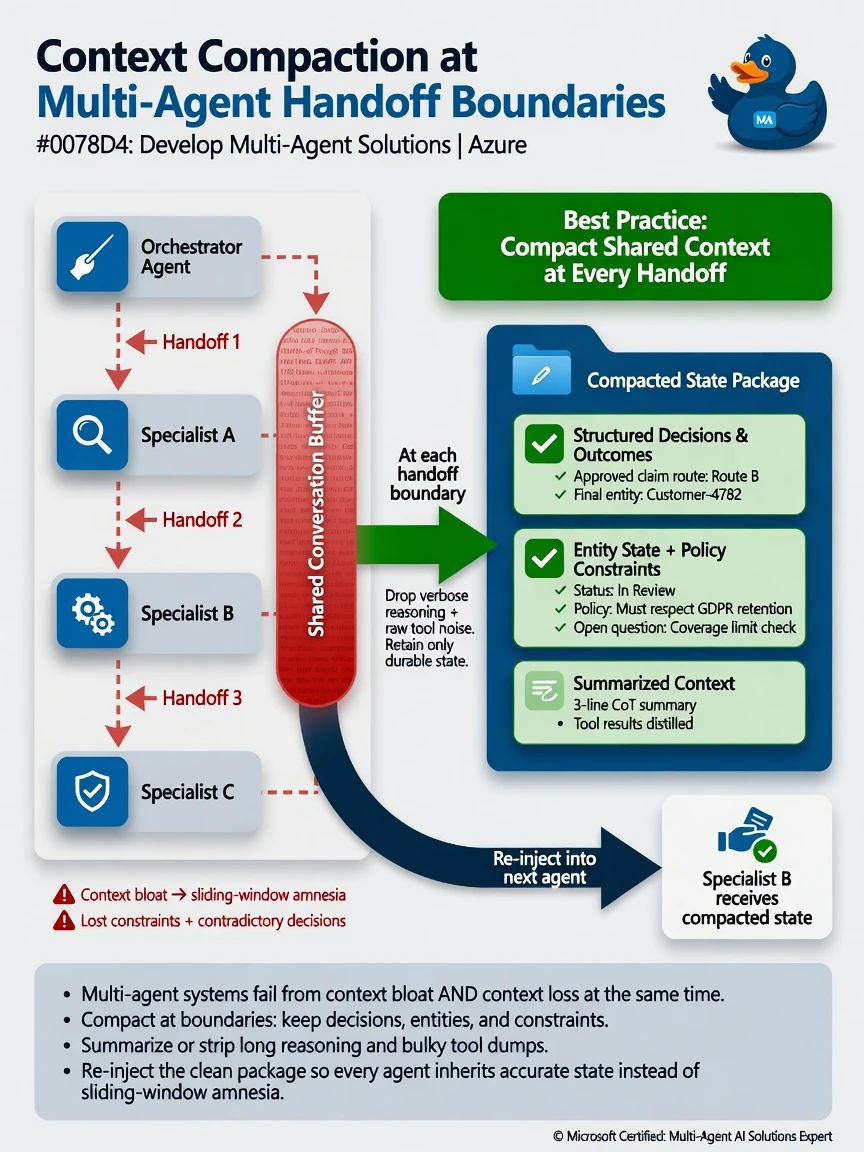
Short Explanation
Pick B. Multi-agent systems die from context bloat and context loss at the same time—too much raw noise, not enough durable state. At each handoff, compact: keep the structured outcomes (decisions, entities, constraints, open questions), summarize or strip long CoT and bulky tool dumps, then inject that compacted package into the next agent. Dumping everything forever causes sliding-window amnesia of the important bits. Wiping history destroys continuity. One megaprompt for three personas is not a real multi-agent architecture and still hits window limits. Compaction plus re-injection is the development pattern the blueprint calls for.
Full Explanation
Correct Answer — B
Context management between agents covers accumulation, retrieval, injection, and compaction. At handoff boundaries you should retain high-value structured state—decisions, entities, policy constraints—while compacting verbose intermediate reasoning and raw tool noise, then inject that compact package into the receiving agent. That preserves continuity without exhausting the context window.
Why A is wrong: Unbounded accumulation of CoT and raw tool dumps crowds out earlier constraints and drives contradictions (classic context degradation).
Why C is wrong: Emptying history after every specialist eliminates shared state and breaks multi-step case continuity.
Why D is wrong: Collapsing specialists into one megaprompt abandons multi-agent orchestration and does not solve window pressure or role boundaries.
Exam tip: Handoff = compact structured state + re-inject; do not ship raw tool dumps forever.