
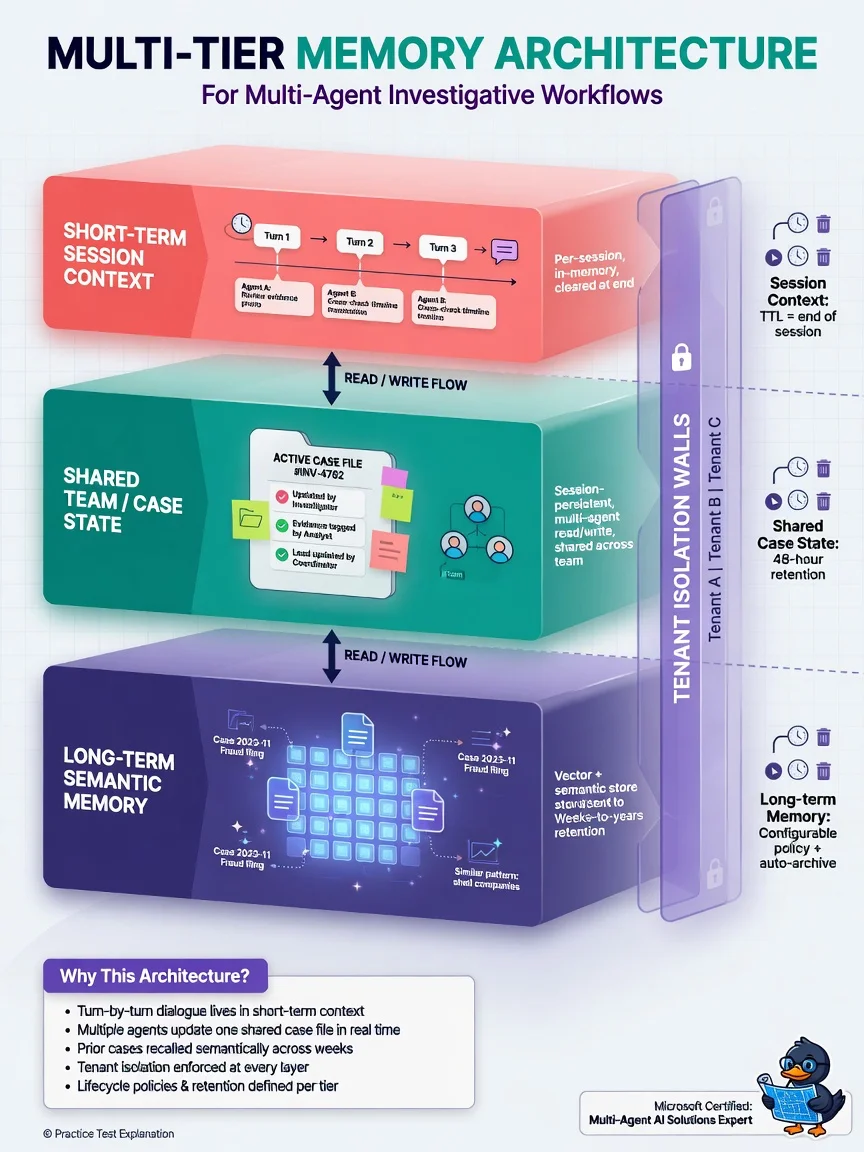
A multi-agent investigative workflow needs turn-by-turn dialogue context, a shared case file that several agents update during a session, and durable knowledge of prior cases for semantic recall across weeks. Tenant isolation and lifecycle policies are mandatory. Which memory architecture should you specify?
Select an answer to reveal the explanation.
Short Explanation
Correct answer: A. Multi-agent architecture requires short-term and long-term memory designs plus multi-tier persistence for session state, shared team state, and long-term semantic memory with lifecycle and tenant isolation. Context-window-only (B) hits limits and loses durability. Public unscoped blobs (C) fail isolation. No memory (D) breaks multi-step collaboration. Design each tier’s store, access control, and retention explicitly.
Full Explanation
The exam calls out designing short-term and long-term memory architectures including context sharing, and specifying multi-tier state persistence for session state, shared team state, and long-term semantic memory with lifecycle and tenant-isolation policies. Map technologies accordingly (for example, in-memory/redis for session, durable DB for case files, vector store for semantic long-term memory) without treating the LLM context as a database. Option B fails length limits and cross-session needs. Option C violates tenancy and retention. Option D sacrifices solution goals. Include compaction strategies, what is shared versus private per agent, and encryption/RBAC on each store.