
You must reduce prompt injection and unsafe tool use in a multi-agent Foundry deployment. Security asks for defense in depth across the agent pipeline. Which guardrail strategy is most appropriate?
Select an answer to reveal the explanation.
Short Explanation
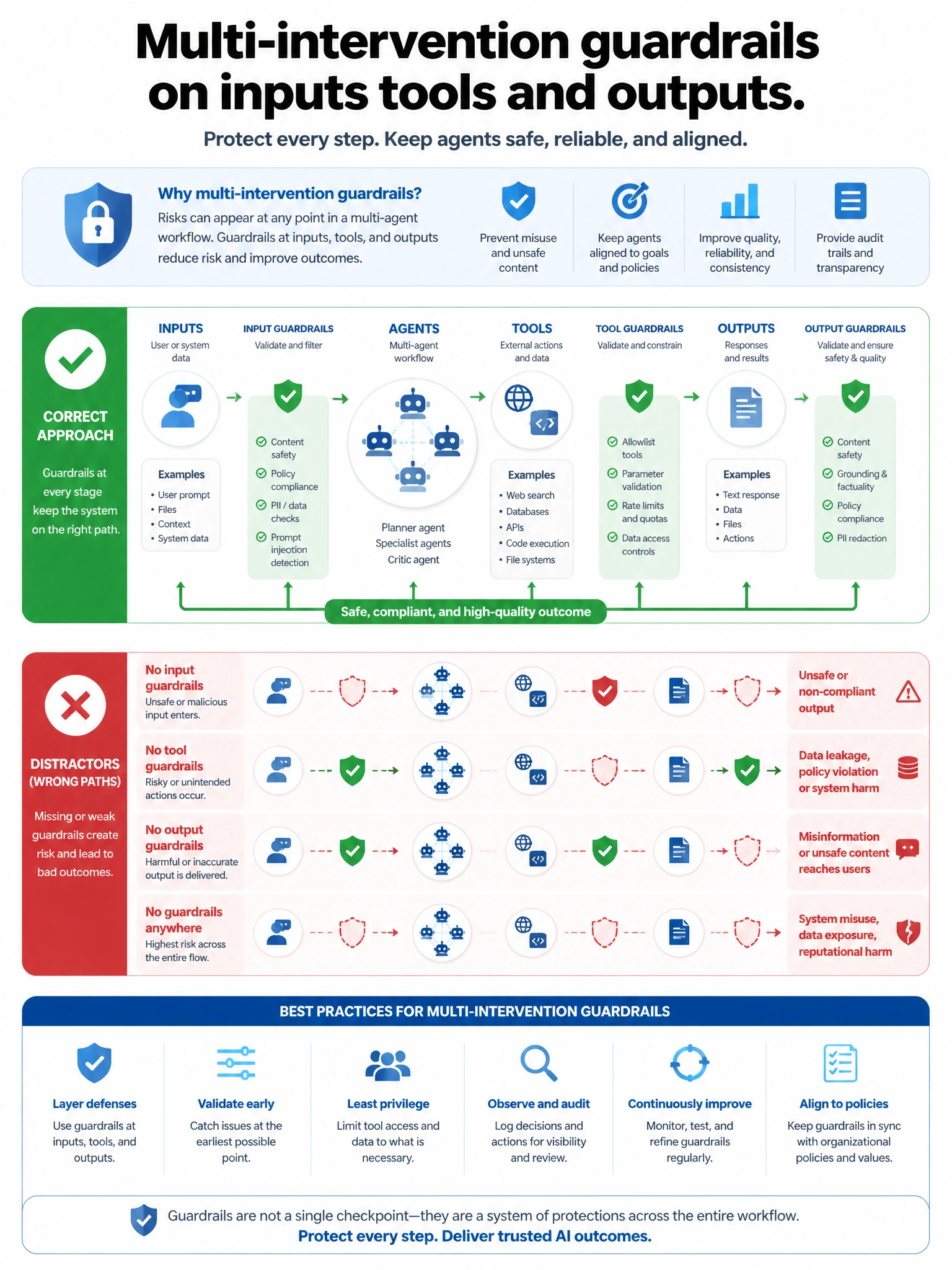
B is the secure/govern skill: multi-intervention guardrails on user inputs, tool calls, tool responses, and outputs—plus custom domain constraints and synthetic testing. A single output filter is porous; injections often hit tools mid-pipeline. C disabling guardrails is malpractice. D reactive user reports are not a design. Layer checks at each hop so compromised input cannot freely call dangerous tools or return toxic content.
Full Explanation
Correct Answer — B
Guardrail design for multi-agent solutions uses multi-intervention coverage: user inputs, tool calls, tool responses, and outputs, with custom domain constraints and validation including synthetic attack data.
Why A is wrong: Output-only filtering leaves input and tool stages unprotected.
Why C is wrong: Disabling guardrails increases injection and unsafe tool risk.
Why D is wrong: After-the-fact user reports are not preventive controls.
Exam tip: Guard every stage—input, tools, tool results, output—not just the final message.