
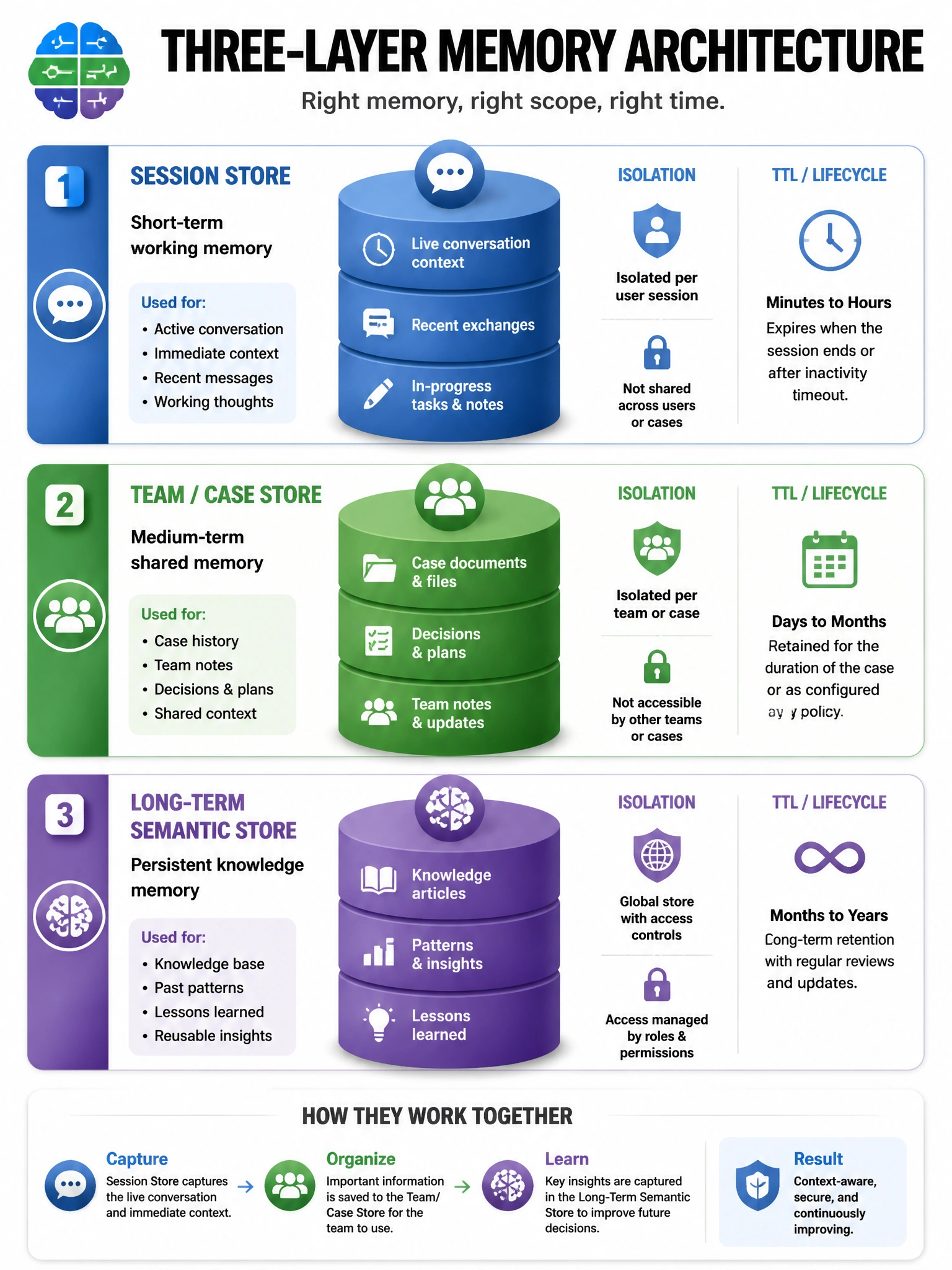
A collaborative multi-agent design needs (1) per-user session state, (2) shared team workspace state for agents cooperating on one case, and (3) long-term semantic memory across cases, each with different lifecycle and isolation rules. Which persistence approach should you specify?
Select an answer to reveal the explanation.
Short Explanation
Correct answer: A. Three tiers—session, shared team/case state, long-term semantic memory—each with lifecycle and tenant isolation. Public unkeyed Redis (B), single-instance RAM only (C), and email-as-database (D) fail isolation, durability, or scale. Define who can read/write each tier and how long data lives.
Full Explanation
Architecture guidance calls for multi-tier state persistence addressing session state, shared team state, and long-term semantic memory with lifecycle and tenant-isolation policies. Option A is complete. Option B lacks isolation and lifecycle. Option C fails multi-instance and durability. Option D is not an operational state store. Align encryption and RBAC with each tier’s sensitivity.