
A multi-agent legal research system needs turn-by-turn conversational context for the active session and durable recall of matter-specific facts across weeks, with tenant isolation between law firm clients. Which memory architecture should you specify?
Select an answer to reveal the explanation.
Short Explanation
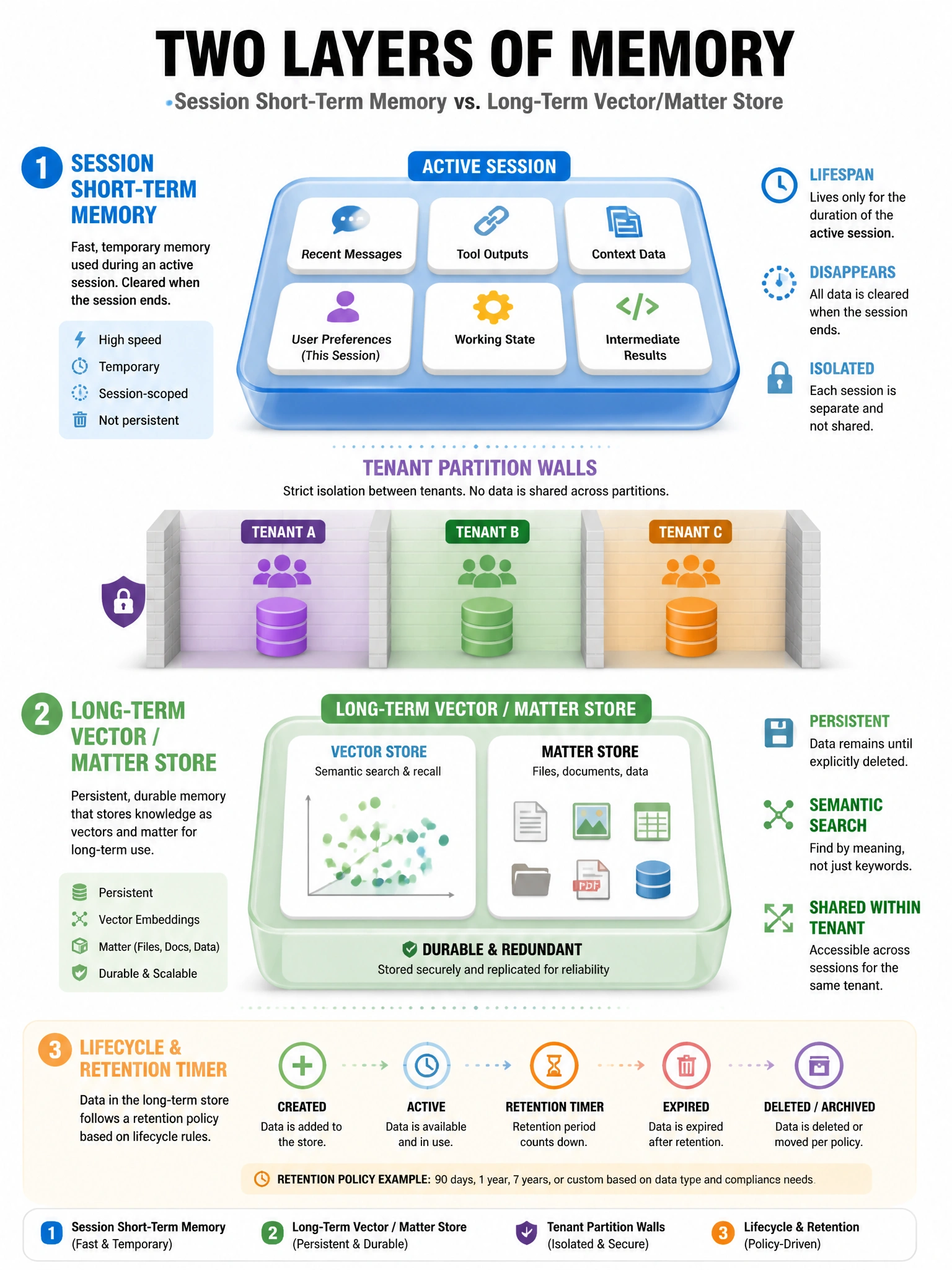
Correct answer: C. You need both short-term session state and long-term semantic memory, partitioned by tenant/matter, with retention lifecycle. Cookies alone (A) are too weak. One global scratchpad (B) breaks isolation. Nightly fine-tunes on chats (D) are the wrong mechanism for per-matter memory and create privacy risk. Design context sharing rules so collaborating agents read only authorized memory scopes.
Full Explanation
Logical architecture includes short-term and long-term memory with context sharing and multi-tier state: session state, shared team state, and long-term semantic memory with tenant isolation and lifecycle. Option C matches. Option A lacks durable controlled memory. Option B violates tenant isolation. Option D confuses parametric model updates with retrieval memory and is inappropriate for confidential client facts. Specify encryption, access control, and purge workflows for closed matters.