
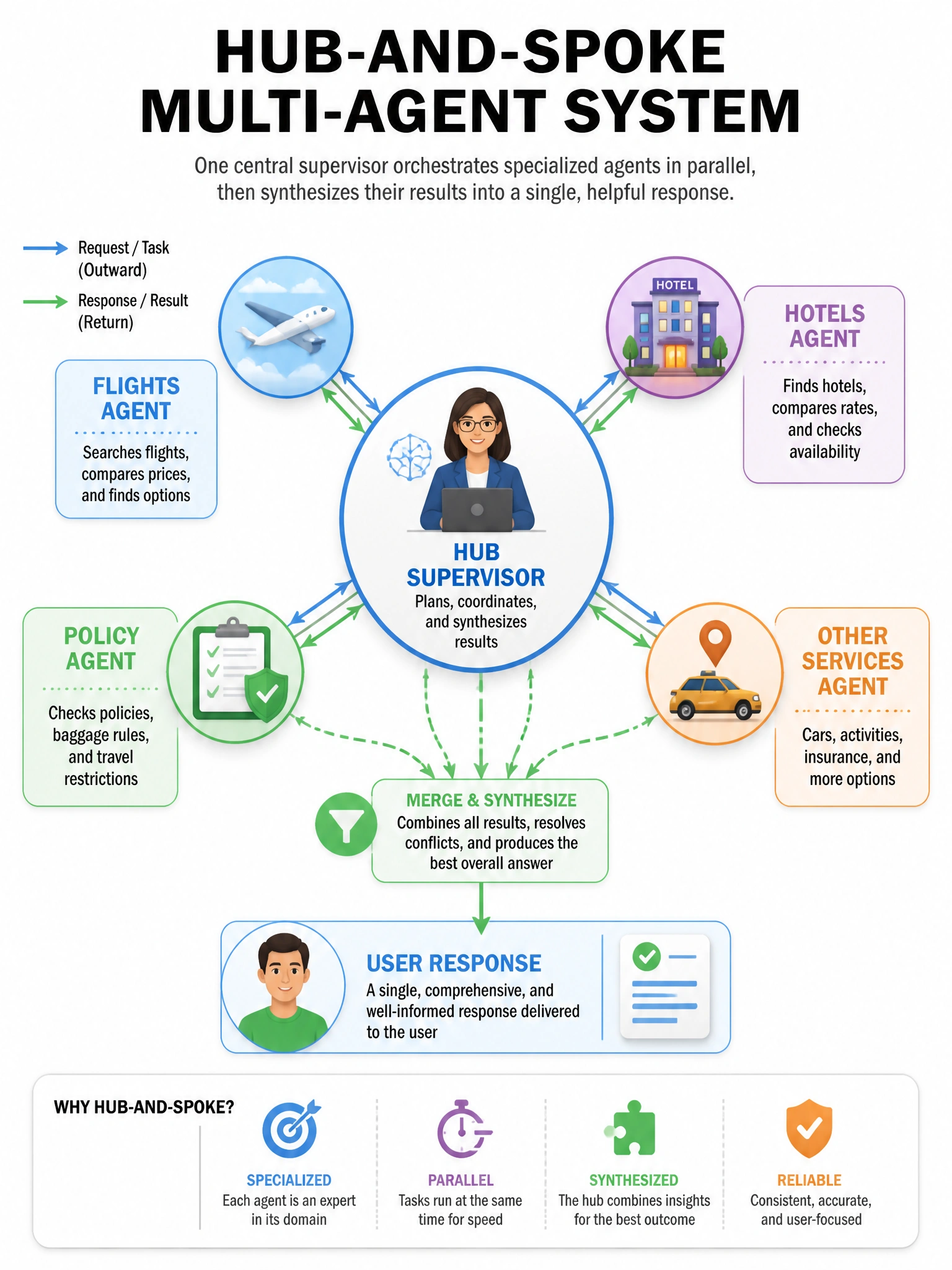
You are designing a multi-agent solution for corporate travel. A supervisor must route requests to specialized agents (flights, hotels, policy compliance) that may run concurrently, then merge results for the user. Which logical orchestration pattern best fits?
Select an answer to reveal the explanation.
Short Explanation
Correct answer: A. Travel booking with specialized domains and a merge step is classic hub-and-spoke: supervisor routes, specialists work (in parallel when independent), results aggregate. One mega-prompt (B) loses clear scopes. Unsupervised P2P with internet scans (C) is chaotic and insecure. Forced full sequencing (D) wastes time when flights and hotels are independent. Define clear personas and tool boundaries on each spoke.
Full Explanation
Architecting multi-agent solutions includes selecting orchestration patterns such as hub-and-spoke, sequential, parallel, peer-to-peer, and orchestrator-subagent. The travel scenario needs routing, specialization, concurrent work, and aggregation—matching hub-and-spoke. Option B abandons multi-agent structure. Option C removes control and introduces unsafe discovery. Option D ignores beneficial parallelism. Specify protocols for supervisor-to-agent messaging, timeouts, and failure handling when a spoke fails.