
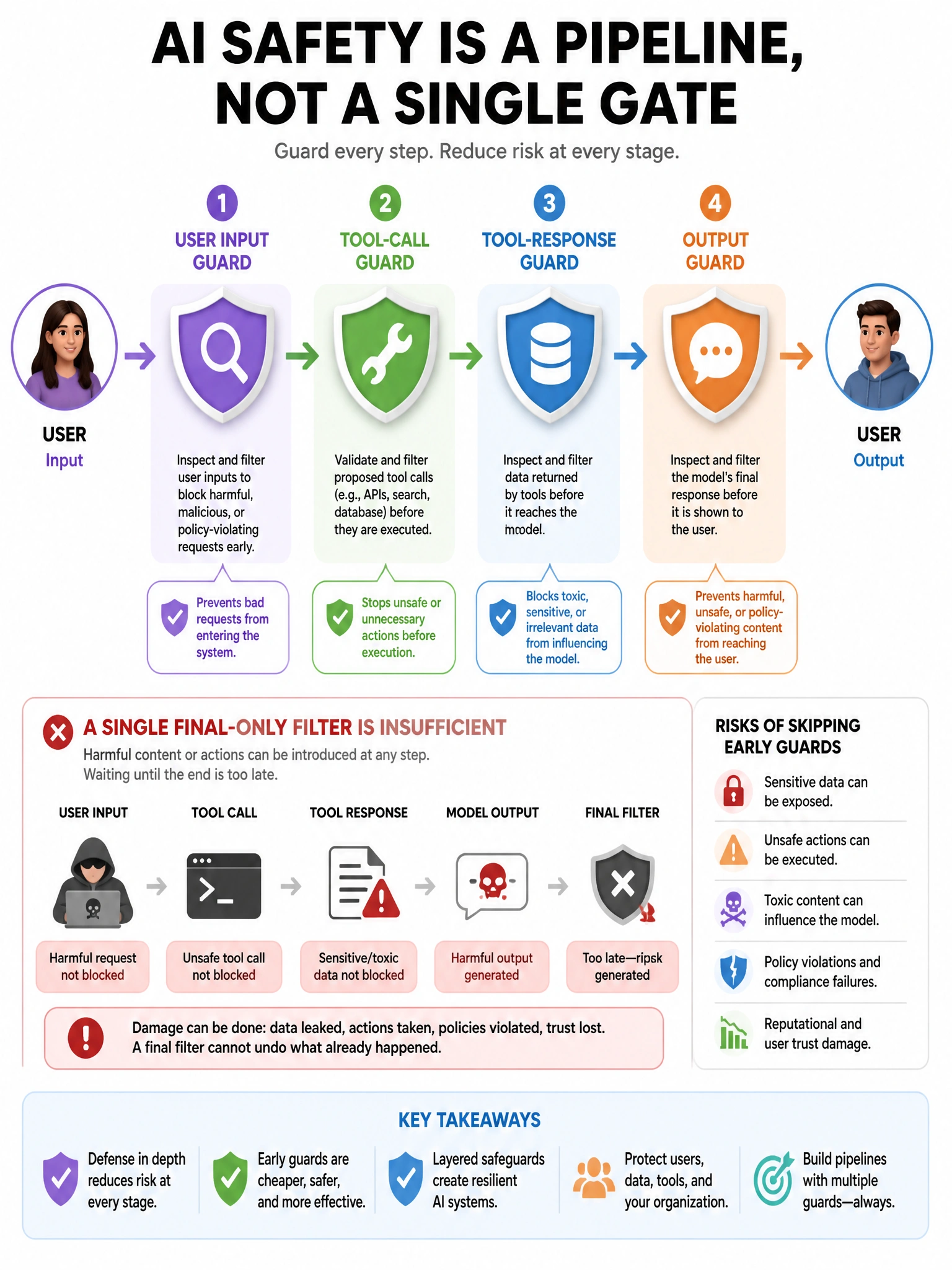
An enterprise multi-agent system must block toxic user inputs, prevent disallowed tool calls, validate tool responses before they re-enter the model, and filter unsafe final answers. Security rejects a single check only on the final response. What guardrail strategy should you design?
Select an answer to reveal the explanation.
Short Explanation
Correct answer: C. One final-output filter is not enough. You need multi-intervention guardrails: inspect user inputs, gate tool calls, validate tool responses before they re-enter context, and filter model outputs—each with logging. Marketing-form-only checks (A), training-only trust (B), and post-harm logging (D) fail enterprise requirements. Layered controls reduce blast radius when any single stage misses an attack.
Full Explanation
Designing multi-intervention guardrails across user inputs, tool calls, tool responses, and outputs is an explicit secure/govern skill. Option C implements independent enforcement at each stage with observability of blocks. Option A leaves the agent path unprotected. Option B ignores runtime threats such as injection and tool misuse. Option D is detective-only and too late for many harms. Add domain-specific custom guardrails where regulations demand, and test layers with synthetic adversarial data.