
During a flash sale, your multi-agent support system tries to spawn a new specialist agent per concurrent user message, exhausting model rate limits and budget. Which implementation control is most appropriate?
Select an answer to reveal the explanation.
Short Explanation
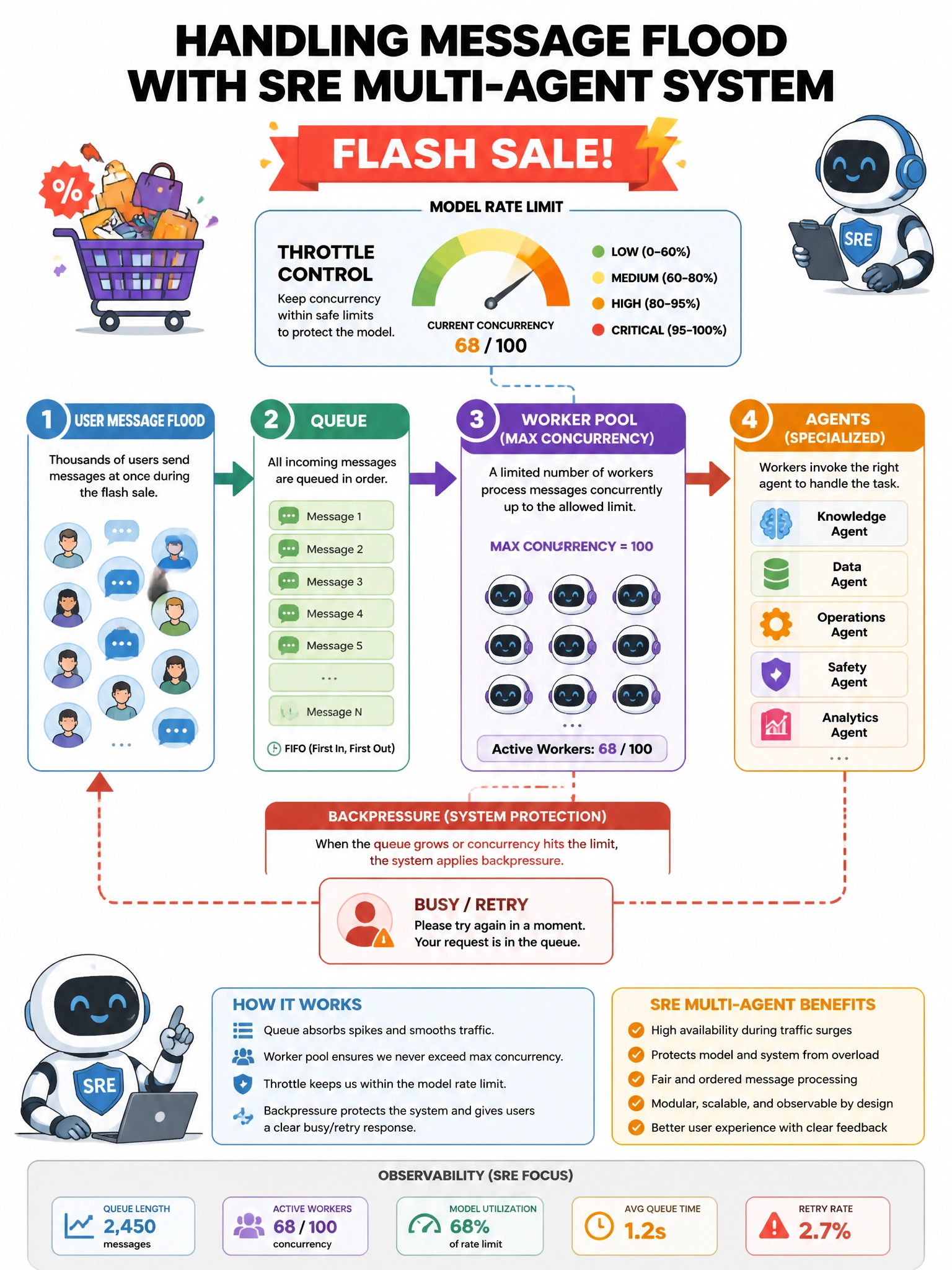
C is controlled concurrency: queues, pools, batching, throttles, and backpressure so spawning doesn’t melt quotas. Unbounded spawn (the status quo problem) is the failure mode. A doubles down. B over-corrects into a bottleneck. D lies to users. Multi-agent systems need explicit concurrency governance tied to rate limits and cost.
Full Explanation
C is correct because developers must implement scaling and control of multi-agent spawning, batching, and concurrent execution. Rate-limit-aware throttling and queues protect platform stability during spikes. A is incorrect: unlimited concurrency without control risks outages and cost overruns. B is incorrect: total serialization may miss latency SLOs under load. D is incorrect: masking failures prevents remediation and harms trust. Expose metrics on queue depth, spawn rate, 429s, and rejected work.